





Download the App & Start Learning
- Expert Faculty Guidance
- Updated Study Material
- Mock Tests & Practice Quiz
- Live Doubt Solving Sessions
- Exam-Oriented Preparation
- Motivation & Success Strategy
Katara Academy

24/11/2026
Average is a basic arithmetic topic for candidates preparing for the SSC GD Constable 2027 examination. Questions based on averages often involve calculating the average of numbers, finding missing values, combining groups and solving simple word problems.
Weighted average is another useful concept in which different values contribute differently to the final average. Understanding the difference between a simple average and a weighted average can help candidates solve questions more accurately.
This guide covers average formulas, weighted-average basics, shortcut methods, solved examples and practice MCQs for SSC GD 2027.
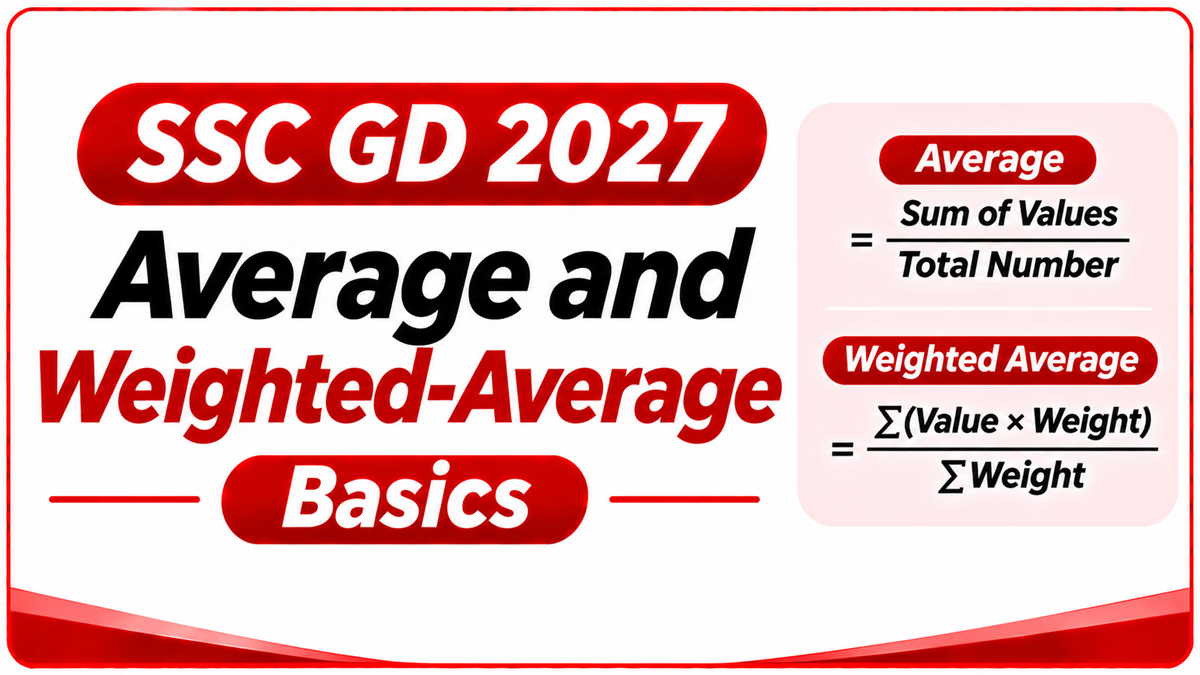
Average is a value that represents a group of numbers. It is calculated by adding all the observations and dividing the sum by the total number of observations.
Average = Sum of all values ÷ Number of values
Example: Find the average of 10, 20, 30, 40 and 50.
Sum = 10 + 20 + 30 + 40 + 50 = 150
Number of values = 5
Average = 150 ÷ 5
Answer: 30
These formulas are useful when a question gives the average and asks for the total, the number of observations or a missing value.
If the average and the other values are given, first calculate the total sum using average × number of values. Then subtract the known values to find the missing number.
Example: The average of five numbers is 18. Four numbers are 12, 15, 20 and 17. Find the fifth number.
Total = 18 × 5 = 90
Sum of known numbers = 12 + 15 + 20 + 17 = 64
Missing number = 90 − 64
Answer: 26
When two groups have different numbers of members and different averages, the combined average is calculated using the total sum of both groups divided by their combined number of members.
Combined Average = (Group 1 Total + Group 2 Total) ÷ (Total Members)
Group total = Group average × Number of members
Example: The average marks of 20 students is 50 and the average marks of 30 students is 60. Find the combined average.
Total marks of first group = 20 × 50 = 1,000
Total marks of second group = 30 × 60 = 1,800
Combined total = 2,800
Total students = 20 + 30 = 50
Combined average = 2,800 ÷ 50
Answer: 56 marks
A weighted average is used when different values have different importance or occur in different quantities. Each value is multiplied by its weight, and the products are added together. The result is divided by the total weight.
Weighted Average = Sum of (Value × Weight) ÷ Sum of weights
Unlike a simple average, a weighted average does not treat every value equally when their weights are different.
Example: A student scores 70 marks in a test carrying weight 2 and 80 marks in a test carrying weight 3. Find the weighted average.
Weighted total = (70 × 2) + (80 × 3)
= 140 + 240 = 380
Total weight = 2 + 3 = 5
Weighted average = 380 ÷ 5
Answer: 76 marks
When all weights are equal, the weighted average is the same as the simple average.
Sum = 15 + 25 + 35 + 45 + 50 = 170
Average = 170 ÷ 5
Answer: 34
Total of eight numbers = 8 × 24 = 192
Missing number = 192 − 168
Answer: 24
First group total = 10 × 40 = 400
Second group total = 20 × 50 = 1,000
Combined total = 1,400
Number of workers = 30
Combined average = 1,400 ÷ 30
Answer: 46.67 approximately
Total cost = (2 × 40) + (3 × 60)
= 80 + 180 = ₹260
Total quantity = 2 + 3 = 5 kg
Average price = 260 ÷ 5
Answer: ₹52 per kg
Total of six numbers = 6 × 15 = 90
Remaining total = 90 − 20 = 70
Remaining numbers = 5
Average = 70 ÷ 5
Answer: 14
Try to solve the following questions before checking the answer key.
Q1 – C) 15
Sum = 60. Average = 60 ÷ 4 = 15.
Q2 – C) 24
Total = 8 × 24 = 192. Missing number = 192 − 168 = 24.
Q3 – B) 63.75
Total = (5 × 60) + (3 × 70) = 510. Combined average = 510 ÷ 8 = 63.75.
Q4 – C) ₹52
Total cost = 80 + 180 = 260. Total quantity = 5 kg. Average = 260 ÷ 5 = ₹52.
Q5 – C) 14
Total = 6 × 15 = 90. Remaining total = 90 − 20 = 70. Average = 70 ÷ 5 = 14.
Q6 – C) 46.67
Combined total = 400 + 1,000 = 1,400. Average = 1,400 ÷ 30 ≈ 46.67.
Q7 – C) ₹26
Weighted total = (4 × 20) + (6 × 30) = 260. Total items = 10. Average = 260 ÷ 10 = ₹26.
Q8 – C) 45
Sum = 180. Average = 180 ÷ 4 = 45.
Average is the sum of all values divided by the total number of values.
Calculate the total using average × number of observations, then subtract the sum of known numbers.
A weighted average considers the importance or quantity of each value by multiplying values by their weights and dividing by the total weights.
A simple average treats all values equally, while a weighted average considers different weights or quantities for different values.
Practice basic average calculations, missing-number problems, combined averages and weighted-average questions. Learn the formulas and solve MCQs regularly.
Average and weighted-average questions can be solved easily when candidates understand totals, group sizes and the role of weights. Start with simple average calculations, practice missing-number questions and gradually move to combined and weighted averages.
Regular practice of these mathematical concepts can help improve speed and accuracy for SSC GD 2027 preparation.