
Download the App & Start Learning
- Expert Faculty Guidance
- Updated Study Material
- Mock Tests & Practice Quiz
- Live Doubt Solving Sessions
- Exam-Oriented Preparation
- Motivation & Success Strategy
Katara Academy

25/11/2026
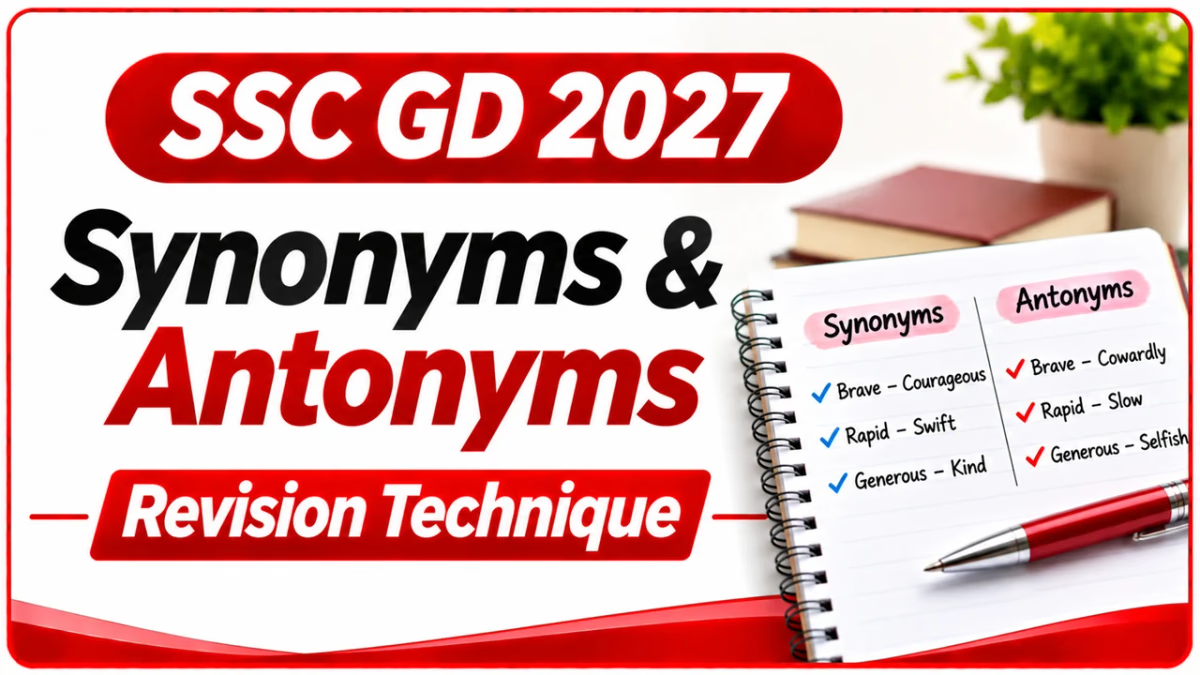
Synonyms and antonyms are important vocabulary topics for candidates preparing for SSC GD Constable 2027. Learning word meanings is not enough; candidates must also revise them regularly to remember the meanings and identify the correct options during the examination. Many students learn dozens of new words but forget them after a few days because they do not follow a proper revision strategy. A smart revision technique can help you remember vocabulary for longer, improve accuracy and solve English questions more confidently. In this guide, you will learn practical techniques for revising synonyms and antonyms, creating word pairs, following a daily revision routine and practising exam-style MCQs.
Synonyms are words with similar meanings, while antonyms are words with opposite meanings. These questions require you to understand the meaning of a word and recognise its relationship with other words. Regular revision helps you: - Remember previously learned vocabulary. - Recognise similar and opposite word meanings quickly. - Avoid confusion between unfamiliar options. - Improve vocabulary-based English question accuracy. - Reduce the time spent solving vocabulary MCQs. - Build confidence for competitive English examinations. Instead of learning hundreds of words randomly, revise a smaller number of words consistently and test your memory.
The easiest way to revise synonyms and antonyms is to learn each word along with its similar and opposite meanings. Do not memorise only one meaning. Create a small vocabulary table and revise the complete word group. | Word | Meaning | Synonyms | Antonyms | |---|---|---|---| | Abundant | Available in large quantities | Plenty, Ample | Scarce, Limited | | Ancient | Very old | Old, Historic | Modern, Recent | | Brave | Showing courage | Courageous, Fearless | Cowardly, Timid | | Expand | Increase in size | Enlarge, Extend | Contract, Reduce | | Hostile | Unfriendly | Aggressive, Antagonistic | Friendly, Kind | | Rapid | Very fast | Quick, Swift | Slow, Sluggish | | Victory | Success in a contest | Triumph, Win | Defeat, Loss | | Generous | Willing to give | Kind, Charitable | Stingy, Selfish | | Diligent | Hard-working | Industrious, Dedicated | Lazy, Careless | | Transparent | Clear or easy to see through | Clear, Visible | Opaque, Cloudy | **Revision Tip:** Cover the synonym and antonym columns and try to recall the words yourself. Active recall is more effective than simply reading the same list repeatedly.
Use this simple three-step technique whenever you learn new vocabulary.
Learn 5–10 words in one session. Understand the meaning of each word and read one simple sentence using it. Example: **Rapid** – Fast or happening quickly. Sentence: The train was moving at a rapid speed.
After learning the words, close your notebook and try to remember their meanings, synonyms and antonyms without looking. Ask yourself: - What does the word mean? - Can I recall one synonym? - Can I recall one antonym?
Solve 5–10 MCQs based on the words you studied. Mark the questions you answered incorrectly and revise those words again. This Learn–Recall–Test method helps you identify which words you actually remember and which need more practice.
Do not revise all vocabulary only on the day you learn it. Review the same words after increasing time intervals. A simple revision cycle can be: | Revision | When to Revise | |---|---| | Revision 1 | Same day | | Revision 2 | After 1 day | | Revision 3 | After 3 days | | Revision 4 | After 7 days | | Revision 5 | After 15 days | | Revision 6 | After 30 days | For example, if you learn 10 words on Monday, revise them on Monday evening, Tuesday, Thursday, the following Monday and continue according to your revision cycle. Words you forget should be revised more frequently than words you already know well.
A mistake notebook is one of the most useful tools for English revision. Whenever you answer a synonym or antonym question incorrectly, write the word in a separate notebook. Use the following format: | Word | Meaning | Synonym | Antonym | My Mistake | |---|---|---|---|---| | Hostile | Unfriendly | Aggressive | Friendly | Confused with helpful | | Scarce | Limited | Rare | Abundant | Forgot opposite | | Diligent | Hard-working | Industrious | Lazy | Forgot synonym | Review this notebook every few days. Do not waste too much time revising words you already know perfectly; give more attention to difficult and forgotten words.
Learning a word with both similar and opposite meanings improves your understanding of vocabulary. For example: **Word: Generous** - Meaning: Willing to give or share. - Synonym: Kind, charitable. - Antonym: Stingy, selfish. **Word: Victory** - Meaning: Success in a competition or battle. - Synonym: Triumph, win. - Antonym: Defeat, loss. **Word: Ancient** - Meaning: Belonging to a very old period. - Synonym: Old, historic. - Antonym: Modern, recent. This approach helps you revise three or four vocabulary connections at the same time instead of learning isolated words.
Do not practise only synonyms or only antonyms in separate sessions. Once you have learned the words, solve mixed questions to improve your ability to identify what the question is asking. **Q1. Choose the synonym of “Abundant.”** A) Scarce B) Ample C) Empty D) Weak **Q2. Choose the antonym of “Hostile.”** A) Aggressive B) Angry C) Friendly D) Unkind **Q3. Choose the synonym of “Diligent.”** A) Lazy B) Industrious C) Careless D) Weak **Q4. Choose the antonym of “Ancient.”** A) Historic B) Old C) Traditional D) Modern **Q5. Choose the synonym of “Rapid.”** A) Slow B) Swift C) Late D) Weak **Q6. Choose the antonym of “Generous.”** A) Helpful B) Kind C) Stingy D) Charitable **Q7. Choose the synonym of “Victory.”** A) Failure B) Defeat C) Triumph D) Problem **Q8. Choose the antonym of “Expand.”** A) Extend B) Enlarge C) Increase D) Contract **Q9. Choose the synonym of “Brave.”** A) Timid B) Fearless C) Weak D) Nervous **Q10. Choose the antonym of “Transparent.”** A) Clear B) Visible C) Opaque D) Bright
**Q1. Answer: B) Ample** — Abundant means available in a large quantity; ample means sufficient or plenty. **Q2. Answer: C) Friendly** — Hostile means unfriendly, so friendly is its opposite. **Q3. Answer: B) Industrious** — Diligent describes someone who works hard and carefully. **Q4. Answer: D) Modern** — Ancient refers to the distant past, while modern refers to the present or recent period. **Q5. Answer: B) Swift** — Rapid means fast or quick. **Q6. Answer: C) Stingy** — Generous means willing to give, while stingy means unwilling to spend or share. **Q7. Answer: C) Triumph** — Victory means success or triumph. **Q8. Answer: D) Contract** — Expand means increase in size, while contract means decrease in size. **Q9. Answer: B) Fearless** — Brave means showing courage or being fearless. **Q10. Answer: C) Opaque** — Transparent means allowing light to pass through or being easy to see through; opaque means not allowing light to pass through.
Follow this simple routine every day to keep vocabulary revision consistent. | Time | Activity | |---|---| | 5 minutes | Learn 5 new words with meanings | | 5 minutes | Revise synonyms and antonyms | | 5 minutes | Recall yesterday's vocabulary without notes | | 5 minutes | Solve 5–10 MCQs | You can increase the number of words as your vocabulary improves. Focus on remembering the words correctly instead of rushing through a large list.
- Learning too many words in one day and forgetting them later. - Reading vocabulary lists without testing memory. - Memorising only synonyms and ignoring antonyms. - Revising only new words without reviewing older words. - Not recording difficult words and incorrect answers. - Practising without checking explanations. - Ignoring words from previous SSC exam questions. Avoid these mistakes by following a fixed revision cycle and testing yourself regularly.
Learn words in pairs, recall their meanings without looking, solve MCQs and revise them at regular intervals.
Start with 5–10 words daily. Focus on meanings, synonyms, antonyms and correct recall.
Both are important, but revision is necessary to retain words you have already learned. Balance new words with older vocabulary.
Use active recall, word pairs, simple sentences, a vocabulary notebook and spaced revision to remember words for longer.
Yes. Previous SSC vocabulary questions are useful for practising exam-style word meanings, synonyms and antonyms. Include them in your regular revision sessions.
Synonyms and antonyms revision for SSC GD 2027 becomes easier when you follow a consistent method. Learning word pairs, using active recall, maintaining a mistake notebook, following spaced revision and solving mixed MCQs can help improve vocabulary retention. Do not try to learn hundreds of words in one sitting. Learn a few words daily, revise them regularly and test your progress to build stronger English vocabulary for SSC GD 2027.