




Download the App & Start Learning
- Expert Faculty Guidance
- Updated Study Material
- Mock Tests & Practice Quiz
- Live Doubt Solving Sessions
- Exam-Oriented Preparation
- Motivation & Success Strategy
Katara Academy

18/11/2026
Age-based reasoning questions are an important type of mathematical reasoning problem for competitive exam preparation. These questions test your ability to understand relationships between the ages of two or more people and calculate their present, past or future ages.
In SSC MTS 2027 preparation, practising age-based problems can help you improve calculation skills and logical thinking. Most basic questions involve age differences, ratios, sums of ages and changes in age over a given number of years.
This guide explains the basic concepts, formulas, solving methods and common age-based question patterns. It also includes 15 original practice MCQs with answers and step-by-step explanations.
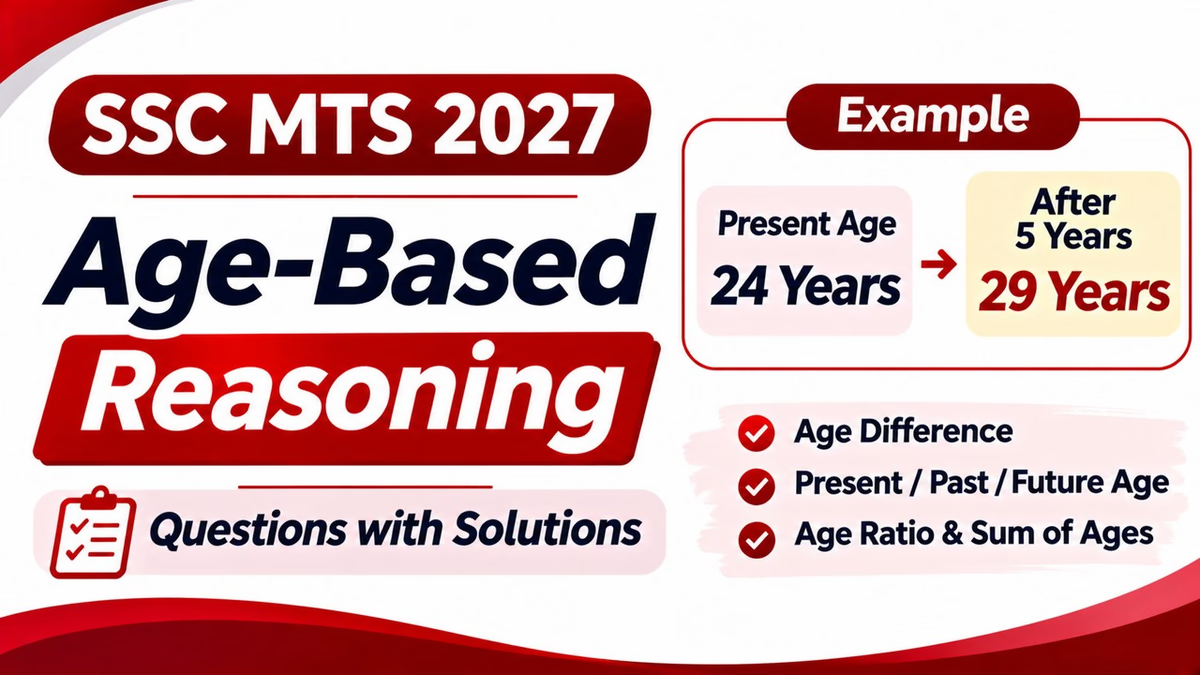
Age-based reasoning questions involve calculating the ages of individuals using given information about their present ages, past ages, future ages, age differences or age ratios.
Example: The present age of Rahul is 20 years. What will be his age after 5 years?
Present age = 20 years
Future age = 20 + 5 = 25 years
Such questions can be solved by understanding the relationship between the given ages and applying simple arithmetic operations.
Remember these basic formulas before attempting age-based questions.
| Concept | Formula |
|---|---|
| Age after n years | Present age + n |
| Age n years ago | Present age - n |
| Age difference | Older age - Younger age |
| Sum of ages | Age of Person 1 + Age of Person 2 |
| Age ratio | Age of Person 1 : Age of Person 2 |
| Total age after n years (two people) | Present total age + 2n |
| Total age n years ago (two people) | Present total age - 2n |
Important rule: The age difference between two people remains constant over time, provided both ages are measured at the same point in time.
These questions ask you to calculate the current age of a person using information about another person's age or their age relationship.
Example: Amit is 5 years older than Rahul. If Rahul is 18 years old, find Amit's age.
Amit's age = 18 + 5 = 23 years.
These questions involve calculating the age of a person a certain number of years ago.
Example: Priya is currently 25 years old. What was her age 7 years ago?
Past age = 25 - 7 = 18 years.
These questions ask you to calculate the age of a person after a specific number of years.
Example: Rohan is 22 years old. What will his age be after 8 years?
Future age = 22 + 8 = 30 years.
These questions involve finding the difference between the ages of two people.
Example: A father is 45 years old and his son is 15 years old. Find their age difference.
Age difference = 45 - 15 = 30 years.
These questions provide the ratio between two people's ages. You need to calculate their actual ages using additional information, such as their total age or age difference.
Example: The ratio of the ages of A and B is 3:2. Their total age is 40 years. Find their ages.
Therefore, their ages are 24 years and 16 years.
These questions provide the combined age of two or more people. You may need to calculate an individual age using the given difference or ratio.
Example: The total age of two brothers is 35 years. One brother is 5 years older than the other. Find their ages.
Therefore, their ages are 15 years and 20 years.
The sum of the ages of a father and son is 60 years. The father is 30 years older than his son. Find their present ages.
Solution:
Son's age = 15 years and father's age = 45 years.
The present ages of two sisters are 18 years and 24 years. What will be the sum of their ages after 5 years?
Solution:
Answer: 52 years.
The present age ratio of two friends is 4:3. If their age difference is 6 years, find their ages.
Solution:
Answer: 24 years and 18 years.
Practise the following original questions to test your understanding of age calculations. Select the correct option for each question.
Rahul is 20 years old. What will be his age after 7 years?
(A) 25 years (B) 26 years (C) 27 years (D) 28 years
Priya is 28 years old. What was her age 6 years ago?
(A) 20 years (B) 21 years (C) 22 years (D) 24 years
A father is 45 years old and his son is 15 years old. What is the difference between their ages?
(A) 25 years (B) 30 years (C) 35 years (D) 40 years
The present ages of A and B are in the ratio 3:2. If their total age is 40 years, what is B's age?
(A) 12 years (B) 14 years (C) 16 years (D) 18 years
The sum of the ages of two brothers is 35 years. The older brother is 5 years older than the younger brother. Find the younger brother's age.
(A) 10 years (B) 12 years (C) 15 years (D) 20 years
The present age of a mother is 40 years and her daughter is 10 years old. What will be the ratio of their ages after 10 years?
(A) 2:1 (B) 3:1 (C) 4:1 (D) 5:2
Five years ago, Amit was 15 years old. What will be his age after 8 years from now?
(A) 25 years (B) 26 years (C) 27 years (D) 28 years
The present ages of two friends are 24 years and 18 years. What will be the sum of their ages after 4 years?
(A) 46 years (B) 48 years (C) 50 years (D) 52 years
The ratio of the ages of two people is 5:3. If their age difference is 10 years, what is the age of the older person?
(A) 20 years (B) 25 years (C) 30 years (D) 35 years
A father is three times as old as his son. If the son's present age is 12 years, what is the father's age?
(A) 30 years (B) 32 years (C) 36 years (D) 40 years
The present age of a person is 32 years. What was the person's age 8 years ago?
(A) 22 years (B) 24 years (C) 26 years (D) 28 years
The sum of the present ages of a father and son is 50 years. If the father is 30 years older than the son, find the son's age.
(A) 8 years (B) 10 years (C) 12 years (D) 15 years
The present age ratio of two sisters is 2:3. If the younger sister is 12 years old, what is the older sister's age?
(A) 15 years (B) 16 years (C) 18 years (D) 20 years
Ten years from now, Ravi will be 35 years old. What is his present age?
(A) 20 years (B) 22 years (C) 25 years (D) 30 years
The present ages of A and B are 30 years and 20 years respectively. After how many years will the sum of their ages be 60 years?
(A) 3 years (B) 4 years (C) 5 years (D) 6 years
| Question | Correct Answer | Calculation |
|---|---|---|
| 1 | C – 27 years | 20 + 7 = 27 |
| 2 | C – 22 years | 28 - 6 = 22 |
| 3 | B – 30 years | 45 - 15 = 30 |
| 4 | C – 16 years | 40 × 2/5 = 16 |
| 5 | C – 15 years | (35 - 5) ÷ 2 = 15 |
| 6 | B – 3:1 | 50:20 = 5:2 |
| 7 | C – 28 years | 15 + 5 + 8 = 28 |
| 8 | D – 50 years | 24 + 18 + 8 = 50 |
| 9 | B – 25 years | 10 × 5/2 = 25 |
| 10 | C – 36 years | 12 × 3 = 36 |
| 11 | B – 24 years | 32 - 8 = 24 |
| 12 | B – 10 years | (50 - 30) ÷ 2 = 10 |
| 13 | C – 18 years | 12 × 3/2 = 18 |
| 14 | C – 25 years | 35 - 10 = 25 |
| 15 | C – 5 years | (60 - 50) ÷ 2 = 5 |
| Day | Practice Topic | Daily Target |
|---|---|---|
| Day 1 | Basic age calculations | 10 questions |
| Day 2 | Present and past age problems | 15 questions |
| Day 3 | Future age problems | 15 questions |
| Day 4 | Age difference questions | 15 questions |
| Day 5 | Age ratio questions | 15 questions |
| Day 6 | Sum of ages and equation-based problems | 20 questions |
| Day 7 | Mixed revision and timed practice | 25 questions |
Consistent practice can help you understand age relationships, solve equations and improve your reasoning accuracy. Revise the basic formulas and practise different types of age-based questions regularly.
Explore learning resources and courses at Katara Academy to support your SSC MTS 2027 preparation.
Age-based reasoning questions become easier when you understand the relationship between present, past and future ages. Learning basic formulas, age differences, ratios and equation-based methods can help you solve these problems systematically.
For SSC MTS 2027 preparation, practise a variety of age-based questions, check your calculations and revise the important concepts regularly to improve your confidence and accuracy.
Age-based reasoning questions involve calculating the ages of individuals using information about their present ages, past ages, future ages, age differences or age ratios.
Add the given number of years to the person's present age. For example, a person aged 20 will be 25 after 5 years.
Subtract the given number of years from the person's present age. For example, a person aged 30 was 25 five years ago.
No. The age difference between two people remains constant because both people grow older by the same number of years.
Represent the ages using the given ratio, calculate the value of one ratio part using the total age or age difference, and then find each person's age.
Variables such as x help represent unknown ages and convert relationships between people into mathematical equations.
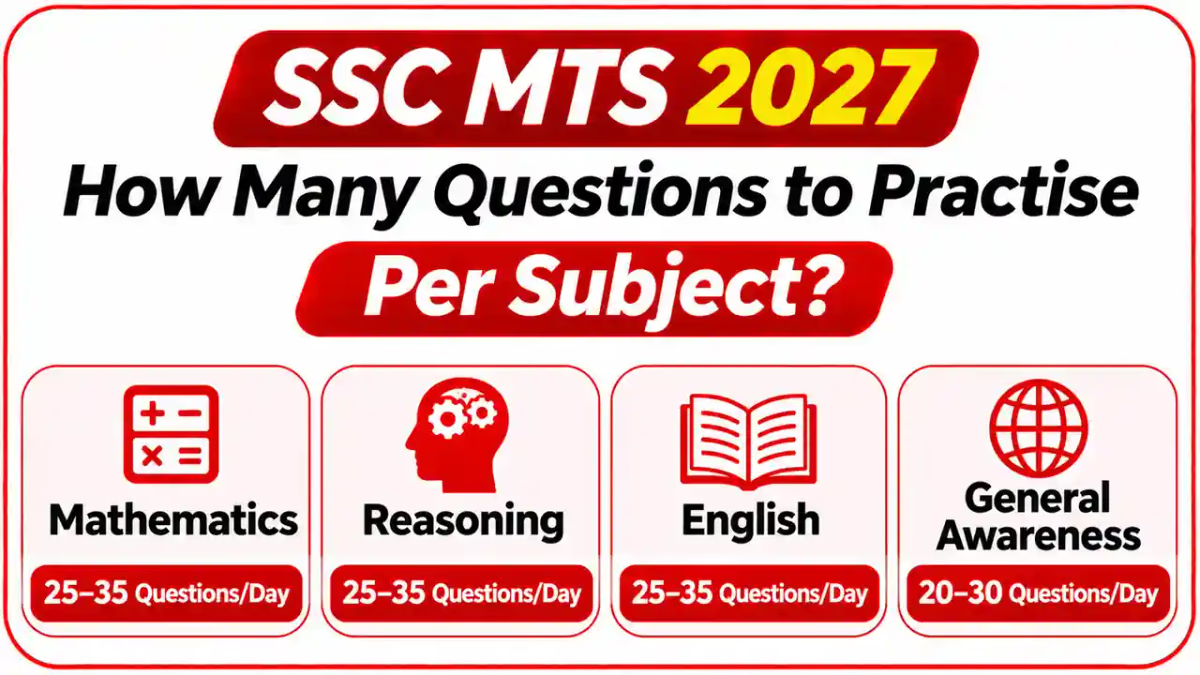
Start with 10–15 questions daily. Gradually increase the number as your understanding and calculation speed improve.
Yes. Practising age-based problems helps strengthen mathematical reasoning, equation formation and basic calculation skills for competitive exam preparation.
