
Download the App & Start Learning
- Expert Faculty Guidance
- Updated Study Material
- Mock Tests & Practice Quiz
- Live Doubt Solving Sessions
- Exam-Oriented Preparation
- Motivation & Success Strategy
Katara Academy

21/11/2026
Getting selected as Multi-Tasking Staff (MTS) through the SSC examination is an important achievement for candidates seeking a Central Government job. However, many aspirants have another important question: What happens after joining as MTS, and what career growth opportunities are available in the future?
An MTS employee does not necessarily remain in the same position throughout their entire government service. Depending on the allotted department, applicable recruitment rules, educational qualifications, service experience and departmental examinations, employees may become eligible for higher responsibilities and promotion opportunities.
Career growth can also include financial progression under government schemes, even when a regular promotion is not immediately available.
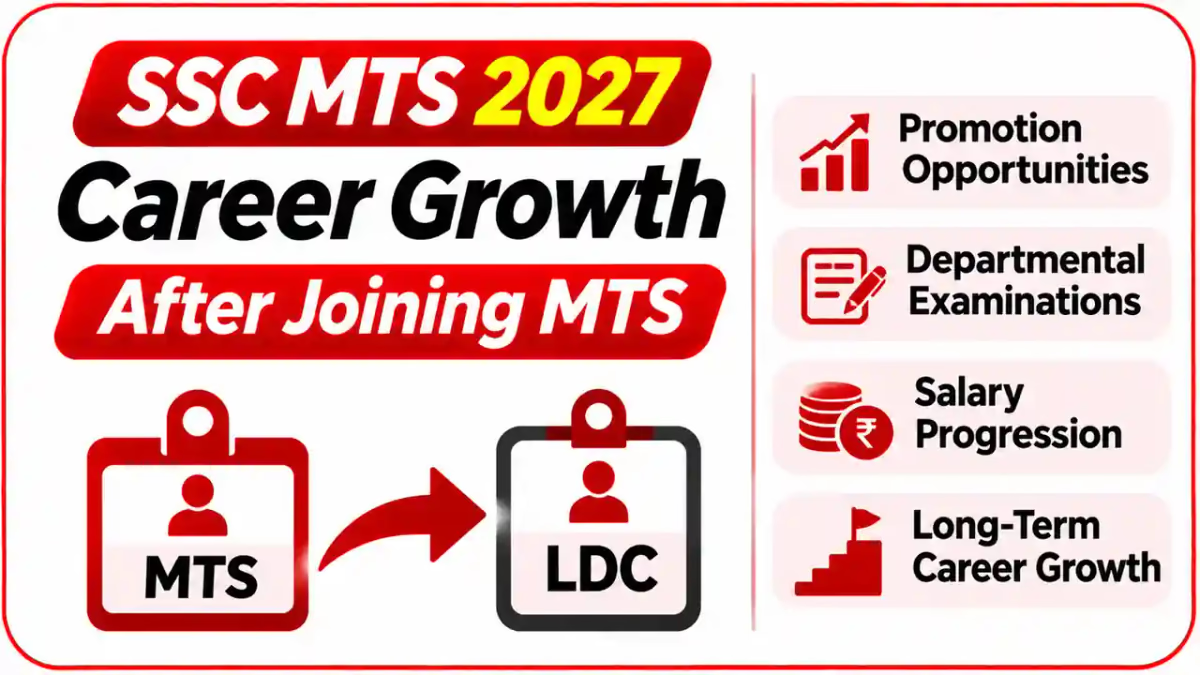
In this guide, we will explain SSC MTS 2027 career growth, promotion opportunities, the MTS to LDC pathway, departmental examinations, salary progression and long-term career planning.
SSC MTS stands for Multi-Tasking (Non-Technical) Staff. It is a General Central Service Group C, Non-Gazetted and Non-Ministerial post available in various Central Government Ministries, Departments and Offices.
After selection and appointment, employees perform different non-technical and administrative support responsibilities according to their department.
| Particular | Details |
|---|---|
| Post Name | Multi-Tasking Staff (MTS) |
| Group | Group C |
| Classification | Non-Gazetted, Non-Ministerial |
| Pay Level | Level 1 |
| Starting Basic Pay | ₹18,000 |
| Pay Matrix Range | ₹18,000–₹56,900 |
| Recruitment Authority | Staff Selection Commission (SSC) |
The salary structure is based on the 7th Central Pay Commission Pay Matrix. Actual monthly earnings depend on applicable allowances, posting location and deductions.
Career progression for MTS employees generally depends on the recruitment rules of the concerned department or cadre. There is no single universal promotion hierarchy that applies identically to every MTS employee across all Central Government departments.
Broadly, career development can take place through the following routes:
Employees should check the applicable recruitment rules to understand which opportunities are available in their allotted department.
One important career opportunity for eligible MTS employees is progression to the Lower Division Clerk (LDC) grade.
The Staff Selection Commission conducts Limited Departmental Competitive Examinations for promotion from MTS to LDC in eligible cadres.
LDC stands for Lower Division Clerk. It is a clerical post involving administrative and record-management responsibilities in government offices.
Moving from MTS to LDC can provide an opportunity to take on more clerical and administrative responsibilities.
Eligibility depends on the applicable departmental recruitment rules and the specific examination quota.
For example, certain departmental procedures provide opportunities to eligible MTS employees who have:
Some departmental rules also provide promotion opportunities based on seniority-cum-fitness.
Important: Service requirements and eligibility conditions differ across cadres. Three years of service or any other qualifying period should not be treated as a universal SSC MTS promotion rule.
Departmental examinations can provide an additional opportunity for eligible employees to move into higher posts.
The Staff Selection Commission conducts certain Limited Departmental Competitive Examinations for serving government employees.
Eligible MTS employees may appear in the prescribed departmental examination for promotion to the LDC grade, subject to the relevant eligibility requirements and examination notification.
The exact syllabus and selection process depend on the examination and applicable recruitment rules. Employees should consult the official examination notice before beginning preparation.
Not every employee receives a regular promotion quickly. To provide financial progression in eligible cases, the Government of India has the Modified Assured Career Progression (MACP) Scheme.
MACP provides financial upgradation to eligible Central Government employees who meet the prescribed conditions and have not received the required regular promotions within the specified service periods.
| Service Milestone | Financial Upgradation |
|---|---|
| 10 Years | First financial upgradation, subject to eligibility |
| 20 Years | Second financial upgradation, subject to eligibility |
| 30 Years | Third financial upgradation, subject to eligibility |
Important: MACP is a financial upgradation scheme, not an automatic change in job designation or regular promotion. The benefits depend on applicable government instructions, service history and eligibility conditions.
Salary growth is another important factor for candidates considering an MTS career.
At the time of joining, MTS employees are placed in Pay Level 1 under the 7th Central Pay Commission Pay Matrix.
Therefore, salary growth is not limited to promotion alone. Annual increments and applicable allowances also contribute to changes in monthly earnings.
Employees who want to improve their career opportunities should focus on developing useful administrative and professional skills.
Learn basic computer operations, MS Word, MS Excel, email communication and document management.
Practise English typing and improve accuracy. Typing proficiency may be relevant for certain departmental examinations and clerical posts.
Improve written and verbal communication to handle official correspondence and interact effectively with colleagues.
Develop knowledge of government administration, office procedures and relevant departmental rules.
Learn to organise tasks, complete assigned responsibilities on time and maintain accurate records.
Newly appointed employees can follow a gradual career development plan while performing their regular responsibilities.
| Career Stage | Suggested Focus |
|---|---|
| After Joining | Understand departmental responsibilities and service rules. |
| Early Service | Develop computer, typing and communication skills. |
| During Service | Check eligibility for departmental examinations. |
| Career Development | Prepare for eligible LDC or other departmental opportunities. |
| Long-Term Service | Understand regular promotion and MACP eligibility. |
This is a suggested career-planning approach, not a fixed government promotion timetable.
SSC MTS can be a suitable long-term career option for candidates looking for Central Government employment.
Candidates should understand the career structure of their allotted department instead of assuming that every MTS employee follows the same promotion path.
MTS employees may become eligible for departmental promotions, limited departmental competitive examinations and financial upgradation under MACP, depending on their department and service rules.
Yes. Eligible MTS employees can have opportunities to move to the LDC grade through applicable departmental recruitment rules and examinations.
Certain LDC recruitment rules require a 12th-standard qualification for eligible departmental promotion or examination quotas. Candidates must check the specific rules applicable to their cadre.
Yes. SSC conducts Limited Departmental Competitive Examinations for eligible serving employees, including examinations for progression from MTS to LDC grade.
MACP stands for Modified Assured Career Progression. It provides financial upgradation to eligible employees under prescribed government conditions when regular promotions have not been received.
No. MACP provides financial upgradation but does not automatically change the employee's designation or grant a regular promotion.
There is no single service period applicable to every MTS employee. Qualifying service depends on the relevant departmental recruitment rules and promotion channel.
No. Promotion depends on vacancies, eligibility, departmental rules, examination performance and other prescribed conditions.
Yes. Annual increments, applicable allowances and eligible financial upgradation under MACP can contribute to salary growth without a regular promotion.
Yes. It offers a Central Government employment opportunity with a defined pay structure, service benefits and potential career progression under applicable departmental rules.
SSC MTS 2027 is not just an opportunity to enter Central Government service; it can also provide a foundation for long-term career development.
After joining as MTS, employees can explore eligible departmental examinations, promotion opportunities, clerical positions and financial progression under government schemes.
However, career growth depends on the allotted department, recruitment rules, educational qualifications, service requirements and available vacancies.
Candidates should focus on building computer skills, improving communication, understanding departmental procedures and preparing for eligible examinations. With consistent professional development and knowledge of service rules, MTS employees can make informed decisions about their future career.
