



Download the App & Start Learning
- Expert Faculty Guidance
- Updated Study Material
- Mock Tests & Practice Quiz
- Live Doubt Solving Sessions
- Exam-Oriented Preparation
- Motivation & Success Strategy
Katara Academy

18/11/2026
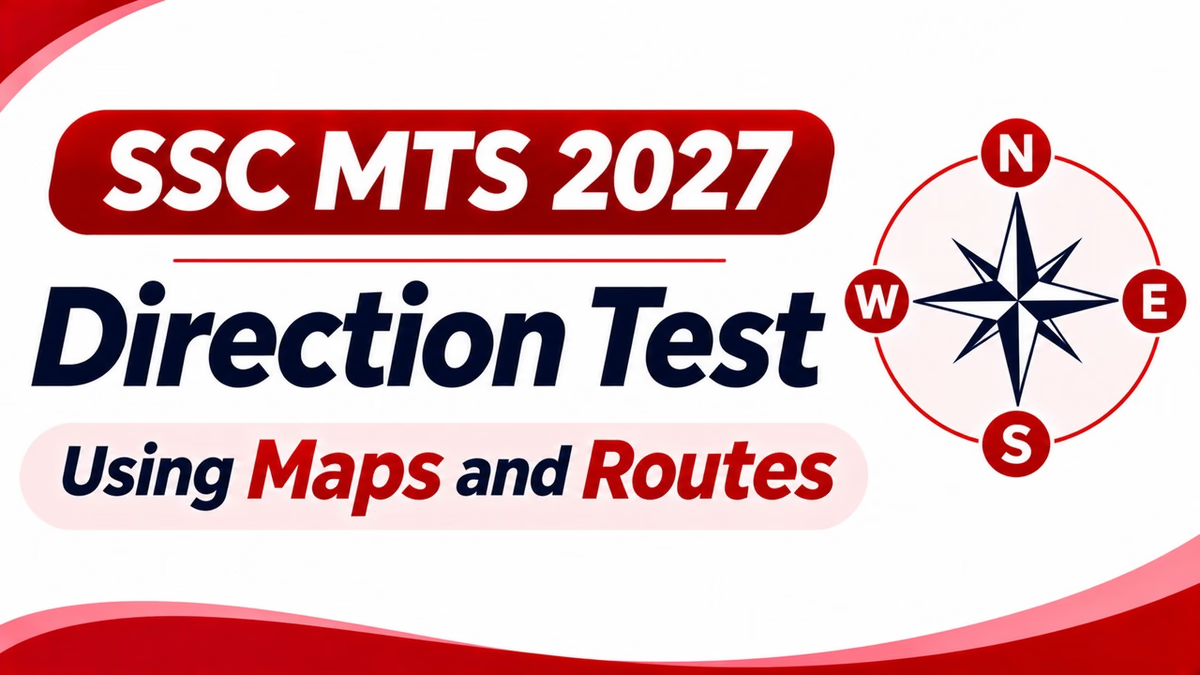
Direction and distance questions are an important part of the reasoning section in competitive examinations. In the SSC MTS 2027 exam, candidates may encounter questions involving directions, turning points, distances, routes and map-based movement.
These questions test your ability to understand a person's movement from one location to another and identify their final direction or position. Regular practice with simple maps and route diagrams can help improve accuracy and save time.
A direction test is a reasoning exercise in which a person moves in different directions according to given instructions. You must determine the final direction, distance or position after following the complete route.
The four main directions are North, South, East and West. Four additional directions are formed between them: North-East, North-West, South-East and South-West.
| Direction | Position |
|---|---|
| North (N) | Up |
| South (S) | Down |
| East (E) | Right |
| West (W) | Left |
| North-East (NE) | Between North and East |
| North-West (NW) | Between North and West |
| South-East (SE) | Between South and East |
| South-West (SW) | Between South and West |
Eight-Direction Map
| NW | N | NE |
| W | CENTRE | E |
| SW | S | SE |
Remember: North is at the top, South at the bottom, East on the right and West on the left.
A left or right turn depends on the direction in which a person is currently facing. It does not always mean moving west or east.
| Facing | Turn Left | Turn Right |
|---|---|---|
| North | West | East |
| South | East | West |
| East | North | South |
| West | South | North |
Important: A 180-degree turn means facing the opposite direction. A 90-degree turn means turning left or right once.
When a person travels in different directions, the total distance travelled and the shortest distance from the starting point may be different.
Total Distance: Add all the distances covered during the journey.
Shortest Distance: If the horizontal and vertical movements form a right-angled triangle, use the Pythagorean theorem.
Shortest Distance = √(Horizontal Distance² + Vertical Distance²)
Example: A person walks 3 km east and then 4 km north. The shortest distance from the starting point is:
√(3² + 4²) = √(9 + 16) = √25 = 5 km.
Example 1: Finding the Final Direction
Question: Ravi is facing North. He turns right, then turns right again. Which direction is he facing now?
Solution: North → Right turn → East → Right turn → South.
Answer: South.
Example 2: Finding the Shortest Distance
Question: A person walks 6 km towards the East and then 8 km towards the North. Find the shortest distance from the starting point.
Solution: √(6² + 8²) = √(36 + 64) = √100 = 10 km.
Answer: 10 km.
Example 3: Understanding a Route Map
Question: A person starts from point A, walks 5 km North, then 3 km East and finally 5 km South. Where is the person in relation to point A?
Solution: The 5 km North and 5 km South movements cancel each other. The remaining movement is 3 km East.
Answer: 3 km East of point A.
Attempt these 15 practice questions to test your understanding of directions, turns, distances and routes.
Q1. Ramesh is facing North. He turns right. Which direction is he facing now?
A) West
B) East
C) South
D) North
Q2. A person walks 5 km towards the East and then 5 km towards the West. How far is the person from the starting point?
A) 5 km
B) 10 km
C) 0 km
D) 15 km
Q3. Priya is facing South. She turns left. Which direction is she facing?
A) West
B) East
C) North
D) South
Q4. A man walks 3 km North and then 4 km East. What is the shortest distance from his starting point?
A) 5 km
B) 6 km
C) 7 km
D) 4 km
Q5. A person is facing East. He turns right and then turns left. Which direction is he facing?
A) South
B) West
C) North
D) East
Q6. A person walks 8 km towards the North and then 3 km towards the South. What is the final position from the starting point?
A) 11 km North
B) 5 km North
C) 5 km South
D) 3 km North
Q7. Mohan starts from point A and walks 4 km East, 3 km North and 4 km West. In which direction is he from point A?
A) East
B) West
C) North
D) South
Q8. A person is facing West. He turns 180 degrees. Which direction is he facing now?
A) North
B) South
C) East
D) West
Q9. A person walks 6 km South and then 8 km East. What is the shortest distance from the starting point?
A) 10 km
B) 12 km
C) 14 km
D) 8 km
Q10. Neha is facing North. She turns left, then turns left again. Which direction is she facing?
A) East
B) West
C) North
D) South
Q11. A person walks 7 km East, 2 km North and 7 km West. How far and in which direction is the person from the starting point?
A) 2 km North
B) 2 km South
C) 7 km East
D) 7 km West
Q12. If a person is facing South-East, what is the opposite direction?
A) North-East
B) South-West
C) North-West
D) East
Q13. A person starts from point P, walks 10 km North, 6 km East and then 10 km South. Where is the person in relation to P?
A) 6 km West
B) 6 km East
C) 10 km North
D) 10 km South
Q14. A person is facing South. He turns right, then right again. Which direction is he facing now?
A) North
B) South
C) East
D) West
Q15. A person walks 9 km North and 12 km East. What is the shortest distance from the starting point?
A) 15 km
B) 18 km
C) 21 km
D) 12 km
| Question | Correct Answer | Result |
|---|---|---|
| 1 | B | East |
| 2 | C | 0 km |
| 3 | B | East |
| 4 | A | 5 km |
| 5 | D | East |
| 6 | B | 5 km North |
| 7 | C | North |
| 8 | C | East |
| 9 | A | 10 km |
| 10 | D | South |
| 11 | A | 2 km North |
| 12 | C | North-West |
| 13 | B | 6 km East |
| 14 | A | North |
| 15 | A | 15 km |
Q1 Explanation: A right turn from North leads to East. Therefore, option B is correct.
Q2 Explanation: The person walks 5 km East and returns 5 km West. The movements cancel each other, so the final distance is 0 km.
Q3 Explanation: When facing South, a left turn leads towards East. Option B is correct.
Q4 Explanation: The movements form a right-angled triangle. Shortest distance = √(3² + 4²) = 5 km.
Q5 Explanation: Facing East, a right turn leads South. A left turn from South leads East. Option D is correct.
Q6 Explanation: The person moves 8 km North and 3 km South. Net movement = 8 − 3 = 5 km North.
Q7 Explanation: The 4 km East and 4 km West movements cancel. The remaining movement is 3 km North.
Q8 Explanation: A 180-degree turn changes the direction to its opposite. The opposite of West is East.
Q9 Explanation: Shortest distance = √(6² + 8²) = √100 = 10 km.
Q10 Explanation: North → Left → West → Left → South. Therefore, option D is correct.
Q11 Explanation: The 7 km East and 7 km West movements cancel. The remaining position is 2 km North.
Q12 Explanation: The direction opposite to South-East is North-West.
Q13 Explanation: The 10 km North and 10 km South movements cancel. The person remains 6 km East of point P.
Q14 Explanation: South → Right → West → Right → North. Therefore, option A is correct.
Q15 Explanation: Shortest distance = √(9² + 12²) = √(81 + 144) = √225 = 15 km.
| Day | Practice Topic |
|---|---|
| Day 1 | Learn the four main and four diagonal directions. |
| Day 2 | Practise left turns, right turns and opposite directions. |
| Day 3 | Solve basic distance and movement questions. |
| Day 4 | Practise shortest-distance calculations. |
| Day 5 | Solve map-based and route-based questions. |
| Day 6 | Attempt mixed direction and distance MCQs. |
| Day 7 | Take a timed practice test and review mistakes. |
Consistent reasoning practice can help you become more confident in solving direction, distance and map-based questions. Revise the basic concepts, practise different question patterns and analyse your mistakes regularly.
Explore structured preparation resources and courses at Katara Academy to support your competitive exam preparation.
Explore Courses at Katara Academy
Direction and distance reasoning questions become easier when you understand the eight directions, turning rules and basic distance calculations. Use rough maps to trace each movement and carefully identify the final position. Regular practice with different route patterns can improve your speed and accuracy for the SSC MTS 2027 reasoning section.
A direction test is a reasoning topic in which you identify a person's direction, route or final position after a series of movements and turns.
There are four main directions: North, South, East and West.
The four diagonal directions are North-East, North-West, South-East and South-West.
First identify the direction in which the person is facing. Then apply each left or right turn according to that facing direction.
For perpendicular horizontal and vertical movements, use: Shortest Distance = √(Horizontal Distance² + Vertical Distance²).
Total distance is the sum of all movements. Shortest distance is the direct distance between the starting and final positions.
Yes. Drawing simple maps and marking routes helps you understand movement, turning points and final positions more clearly.
Learn the direction chart, practise turn sequences, use rough diagrams and solve timed MCQ sets regularly.
