





Download the App & Start Learning
- Expert Faculty Guidance
- Updated Study Material
- Mock Tests & Practice Quiz
- Live Doubt Solving Sessions
- Exam-Oriented Preparation
- Motivation & Success Strategy
Katara Academy

14/11/2026
Ratio is an important concept in Numerical Ability for competitive examinations. In SSC MTS preparation, ratio-based questions may involve sharing money, comparing ages, shopping expenses, recipes, distances, savings and other everyday situations. Understanding how to convert a word problem into a mathematical ratio makes these questions easier to solve.
This guide explains the basic concepts of ratio, important formulas, step-by-step solved examples, common mistakes and practice MCQs to help you strengthen your preparation for SSC MTS 2027.
Important Preparation Tip:
Always identify what the ratio represents, whether the quantities are in the same unit, and whether the question gives a total, a difference or a fraction of the whole.
| Topic | Key Information |
|---|---|
| Meaning | Comparison of two or more quantities by division |
| Notation | a : b |
| Simplification | Divide all terms by their common factor |
| Equivalent ratio | Multiply or divide every term by the same non-zero number |
| Sharing a total | Divide the total according to the sum of ratio parts |
| Common applications | Money, age, shopping, recipes, distance and savings |
A ratio is a mathematical way of comparing two or more quantities of the same kind. It tells us how much one quantity is compared with another.
For example, if a class has 10 boys and 15 girls, the ratio of boys to girls is:
10 : 15 = 2 : 3
This means that for every 2 boys, there are 3 girls.
| Given Ratio | Simplification | Simplest Ratio |
|---|---|---|
| 12 : 18 | Divide by 6 | 2 : 3 |
| 20 : 30 | Divide by 10 | 2 : 3 |
| 25 : 40 | Divide by 5 | 5 : 8 |
| 36 : 48 | Divide by 12 | 3 : 4 |
1. Division of a total in a given ratio
If a total amount is divided in the ratio a : b:
First share = Total × a / (a + b)
Second share = Total × b / (a + b)
2. Finding one part
One ratio part = Total amount / Sum of ratio terms
3. Finding quantities from a difference
One ratio part = Difference between quantities / Difference between ratio terms
4. Equivalent ratios
a : b = ka : kb, where k is a non-zero number.
5. Comparing two ratios
To compare a : b and c : d, compare a × d with b × c.
Ravi and Amit share ₹1,200 in the ratio 2 : 3. Find the amount received by each person.
Solution:
Ratio = 2 : 3
Total parts = 2 + 3 = 5
Value of one part = 1,200 ÷ 5 = ₹240
Ravi's share = 2 × 240 = ₹480
Amit's share = 3 × 240 = ₹720
Answer: Ravi receives ₹480 and Amit receives ₹720.
The present ages of a mother and her daughter are in the ratio 5 : 2. If the sum of their ages is 49 years, find their present ages.
Solution:
Ratio = 5 : 2
Total parts = 5 + 2 = 7
One part = 49 ÷ 7 = 7 years
Mother's age = 5 × 7 = 35 years
Daughter's age = 2 × 7 = 14 years
Answer: Mother is 35 years old and daughter is 14 years old.
Neha spends money on groceries and transport in the ratio 4 : 1. If her total expenditure on these two items is ₹2,500, find the amount spent on each.
Solution:
Ratio = 4 : 1
Total parts = 4 + 1 = 5
One part = 2,500 ÷ 5 = ₹500
Groceries = 4 × 500 = ₹2,000
Transport = 1 × 500 = ₹500
Answer: ₹2,000 on groceries and ₹500 on transport.
The ratio of flour to sugar in a recipe is 5 : 2. If 750 grams of flour is used, how much sugar is required?
Solution:
Flour : Sugar = 5 : 2
5 parts = 750 grams
1 part = 750 ÷ 5 = 150 grams
Sugar = 2 × 150 = 300 grams
Answer: 300 grams of sugar.
The distances covered by two cyclists are in the ratio 3 : 4. If the first cyclist covers 24 km, how far does the second cyclist travel?
Solution:
First cyclist : Second cyclist = 3 : 4
3 parts = 24 km
1 part = 24 ÷ 3 = 8 km
Second cyclist = 4 × 8 = 32 km
Answer: 32 km.
The salaries of two employees are in the ratio 7 : 5. If the difference between their salaries is ₹6,000, find their salaries.
Solution:
Ratio = 7 : 5
Difference in parts = 7 − 5 = 2
Value of one part = 6,000 ÷ 2 = ₹3,000
First salary = 7 × 3,000 = ₹21,000
Second salary = 5 × 3,000 = ₹15,000
Answer: ₹21,000 and ₹15,000.
The ratio of boys to girls in a classroom is 4 : 5. If there are 36 students in total, find the number of boys and girls.
Solution:
Total parts = 4 + 5 = 9
One part = 36 ÷ 9 = 4
Boys = 4 × 4 = 16
Girls = 5 × 4 = 20
Answer: 16 boys and 20 girls.
The ratio of a person's savings to expenditure is 2 : 3. If the total of savings and expenditure is ₹10,000, find the savings.
Solution:
Ratio = 2 : 3
Total parts = 2 + 3 = 5
One part = 10,000 ÷ 5 = ₹2,000
Savings = 2 × 2,000 = ₹4,000
Answer: ₹4,000.
Quick Shortcut:
When a total is given, divide it by the sum of the ratio terms. When a difference is given, divide it by the difference between the ratio terms. This helps you find the value of one part quickly.
| Common Mistake | Correct Approach |
|---|---|
| Reversing the ratio order | Follow the exact order asked in the question. |
| Adding ratio terms incorrectly | Use the sum of all parts when the total is given. |
| Using the total formula for a difference | Use the difference between ratio terms instead. |
| Ignoring different units | Convert quantities into the same unit before comparing. |
| Stopping after finding one part | Multiply by the required ratio term to get the final answer. |
Test your understanding with these 15 ratio-based questions. Try to solve them independently before checking the answer key.
₹900 is divided between A and B in the ratio 2 : 3. How much does B receive?
A) ₹300 B) ₹450 C) ₹540 D) ₹600
The ratio of boys to girls in a class is 3 : 5. If there are 40 students, how many boys are there?
A) 10 B) 15 C) 20 D) 25
The ages of two brothers are in the ratio 4 : 3. If their total age is 35 years, find the age of the younger brother.
A) 12 years B) 15 years C) 18 years D) 20 years
The ratio of tea to sugar in a mixture is 7 : 2. If the quantity of tea is 350 grams, how much sugar is required?
A) 75 grams B) 100 grams C) 125 grams D) 150 grams
Two numbers are in the ratio 5 : 8. If their sum is 78, find the smaller number.
A) 25 B) 30 C) 35 D) 40
The ratio of the monthly income of two people is 6 : 5. If the difference between their incomes is ₹4,000, find the higher income.
A) ₹16,000 B) ₹18,000 C) ₹20,000 D) ₹24,000
The ratio of money spent on food and travel is 3 : 2. If the total expenditure is ₹2,500, how much is spent on travel?
A) ₹500 B) ₹750 C) ₹1,000 D) ₹1,500
The ratio of two distances is 5 : 7. If the smaller distance is 25 km, find the larger distance.
A) 30 km B) 35 km C) 40 km D) 45 km
A sum of ₹1,500 is divided between P and Q in the ratio 4 : 1. Find the difference between their shares.
A) ₹600 B) ₹750 C) ₹900 D) ₹1,000
The ratio of red balls to blue balls in a box is 2 : 7. If there are 63 balls in total, how many are blue?
A) 14 B) 28 C) 42 D) 49
The ratio of the savings of A and B is 3 : 4. If B saves ₹2,400, how much does A save?
A) ₹1,200 B) ₹1,600 C) ₹1,800 D) ₹2,000
The ratio of two numbers is 9 : 4. If their difference is 35, find the larger number.
A) 36 B) 45 C) 54 D) 63
The ratio of flour to sugar in a recipe is 4 : 1. If 600 grams of flour is used, how much sugar is needed?
A) 100 grams B) 125 grams C) 150 grams D) 200 grams
The ratio of the prices of two bags is 5 : 6. If the cheaper bag costs ₹750, find the price of the costlier bag.
A) ₹800 B) ₹850 C) ₹900 D) ₹950
The ratio of men to women in an office is 7 : 5. If there are 84 employees, how many women work in the office?
A) 30 B) 35 C) 40 D) 49
| Question | Correct Answer | Question | Correct Answer | Question | Correct Answer |
|---|---|---|---|---|---|
| 1 | C | 6 | C | 11 | C |
| 2 | B | 7 | C | 12 | D |
| 3 | B | 8 | B | 13 | C |
| 4 | B | 9 | C | 14 | C |
| 5 | B | 10 | D | 15 | B |
| Day | Study Topic | Practice Task |
|---|---|---|
| Day 1 | Meaning and simplification of ratios | Solve 15 basic questions |
| Day 2 | Equivalent ratios and comparison | Solve 15 questions |
| Day 3 | Sharing money and total-based problems | Solve 20 questions |
| Day 4 | Age and salary problems | Solve 20 questions |
| Day 5 | Shopping, savings and daily-life problems | Solve 20 questions |
| Day 6 | Mixed ratio word problems | Solve 25 questions |
| Day 7 | Revision and timed practice | Attempt a 20-question practice test |
Consistent practice is essential for improving calculation speed and accuracy in Numerical Ability. Revise important formulas, understand the logic behind word problems and solve questions regularly to strengthen your preparation.
Build your quantitative aptitude with structured learning, practice questions and exam-focused preparation.
Ratio-based everyday word problems become easier when you understand the relationship between quantities and know how to find the value of one ratio part. Practise questions based on money, ages, shopping, savings, recipes and distances to improve your problem-solving ability. Regular revision and timed practice can help you build confidence for the SSC MTS 2027 Numerical Ability section.
A ratio is a comparison of two or more quantities by division. It is generally written using a colon, such as 2 : 3.
Add the ratio terms to find the total parts. Divide the total amount by the total parts to find one part, then multiply by each ratio term.
Subtract the smaller ratio term from the larger ratio term. Divide the given difference by this result to find the value of one part.
Before comparing quantities, convert them into the same unit. For example, convert metres into centimetres if both quantities need to be compared in centimetres.
Equivalent ratios have the same value. For example, 2 : 3, 4 : 6 and 6 : 9 are equivalent ratios.
Ratios are used in sharing money, comparing ages, preparing recipes, calculating expenses, comparing distances and dividing quantities.
Learn the total-based and difference-based methods, practise mental calculations and solve mixed word problems regularly.
A ratio compares two or more quantities, while a fraction represents a part of a whole or a division. A ratio such as 2 : 3 can also be written as 2/3 when expressing the first quantity relative to the second.
Yes. Practising ratio-based word problems helps strengthen basic arithmetic, calculation skills and the ability to interpret quantitative information.
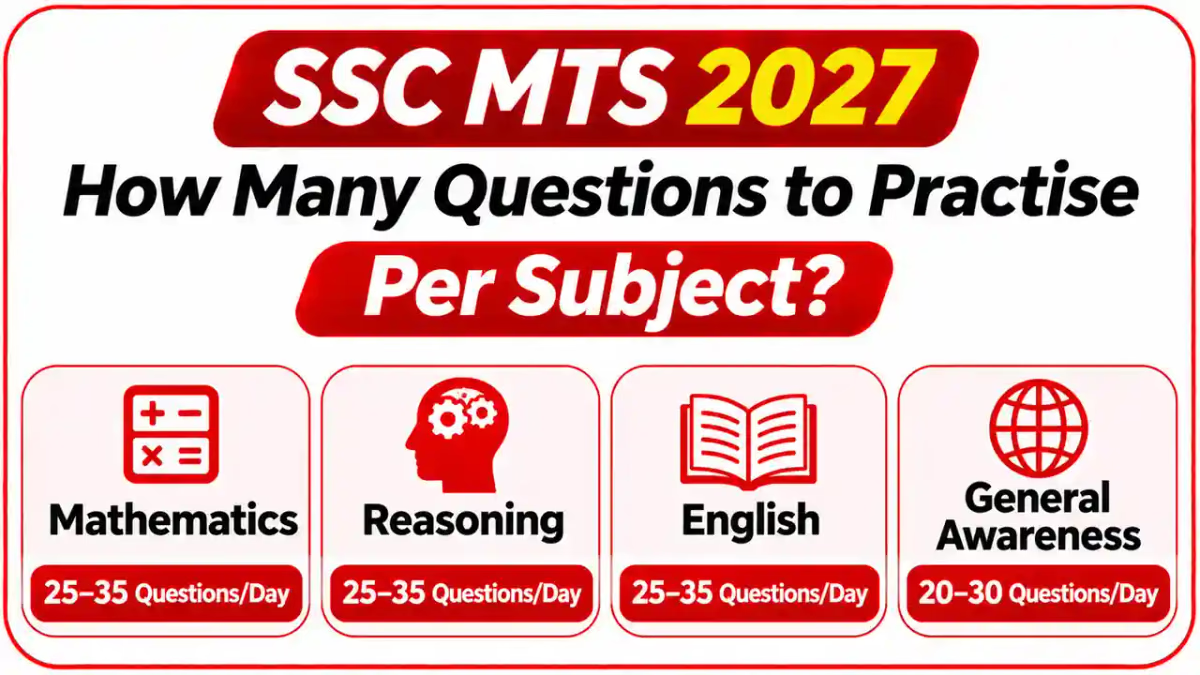
You can begin with 10–15 questions daily and gradually increase the number as your speed and accuracy improve.