




Download the App & Start Learning
- Expert Faculty Guidance
- Updated Study Material
- Mock Tests & Practice Quiz
- Live Doubt Solving Sessions
- Exam-Oriented Preparation
- Motivation & Success Strategy
Katara Academy

14/11/2026
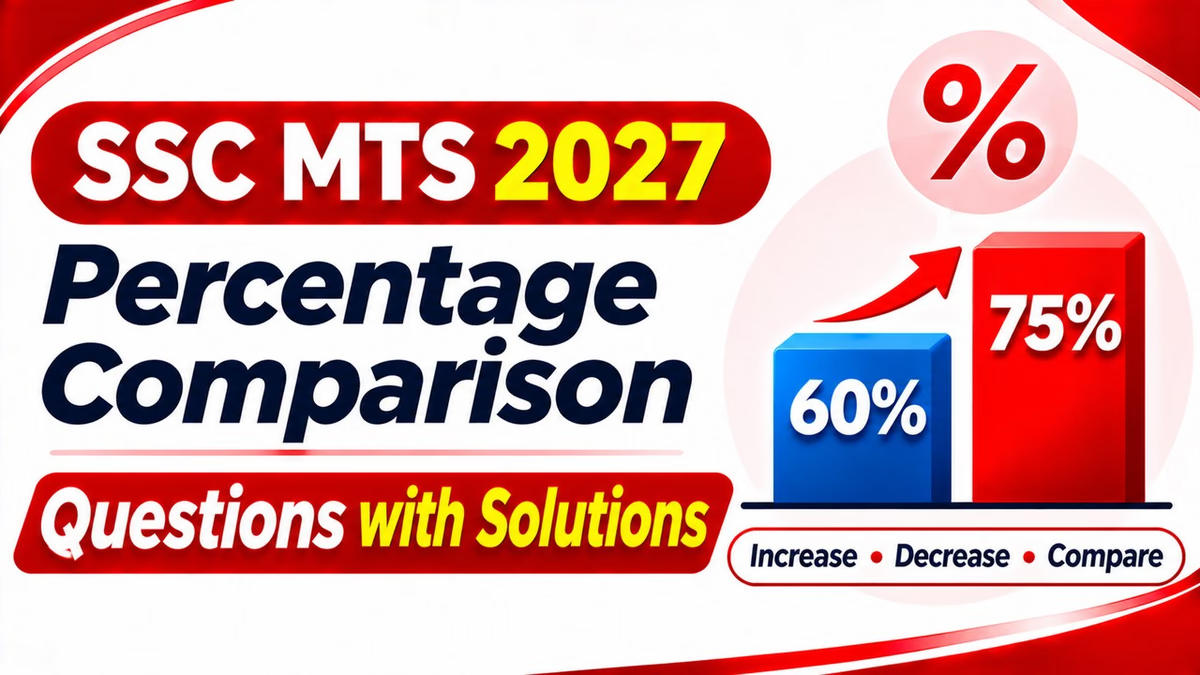
Percentage is an important topic in Numerical Ability for competitive examinations. Percentage comparison questions test your ability to compare two quantities, calculate percentage differences, identify increases and decreases, and understand how one value relates to another.
In SSC MTS preparation, these questions may involve marks, salaries, prices, expenses, population, discounts and daily-life calculations. Learning the correct percentage formulas and identifying the comparison base can help you solve these questions more accurately.
Important Tip:
Always identify the original value before calculating a percentage increase or decrease. In comparison questions, the base value determines the correct answer.
| Topic | What You Need to Know |
|---|---|
| Percentage | A value expressed out of 100 |
| Percentage of a number | Number × Percentage / 100 |
| Percentage increase | Increase / Original Value × 100 |
| Percentage decrease | Decrease / Original Value × 100 |
| Comparing two values | Find their difference and compare it with the specified base |
| Common applications | Marks, salary, prices, discounts and expenses |
Percentage means a number or quantity expressed as a fraction of 100. The symbol used for percentage is %.
For example, 25% means 25 out of 100.
25% = 25/100 = 1/4
If a student scores 80 marks out of 100, the percentage is 80%.
| Percentage | Fraction | Decimal |
|---|---|---|
| 10% | 1/10 | 0.10 |
| 12.5% | 1/8 | 0.125 |
| 20% | 1/5 | 0.20 |
| 25% | 1/4 | 0.25 |
| 30% | 3/10 | 0.30 |
| 40% | 2/5 | 0.40 |
| 50% | 1/2 | 0.50 |
| 60% | 3/5 | 0.60 |
| 75% | 3/4 | 0.75 |
| 80% | 4/5 | 0.80 |
1. Percentage of a number
Percentage value = Number × Percentage / 100
2. Percentage increase
Percentage increase = (Increase / Original Value) × 100
3. Percentage decrease
Percentage decrease = (Decrease / Original Value) × 100
4. Percentage comparison
Percentage difference relative to A = [(B − A) / A] × 100
Use this formula when comparing B with A and A is the specified base.
5. Finding the original value after an increase
Original Value = New Value × 100 / (100 + Increase%)
6. Finding the original value after a decrease
Original Value = New Value × 100 / (100 − Decrease%)
7. Successive percentage change
Net change % = a + b + (ab / 100)
Use positive signs for increases and negative signs for decreases.
Ravi scores 360 marks out of 500, while Amit scores 400 marks out of 500. By what percentage are Amit's marks higher than Ravi's?
Solution:
Ravi's marks = 360
Amit's marks = 400
Difference = 400 − 360 = 40
Percentage increase over Ravi's marks = (40 / 360) × 100
= 11.11% approximately
Answer: Amit's marks are approximately 11.11% higher than Ravi's.
The price of a bag increases from ₹800 to ₹920. Find the percentage increase.
Solution:
Original price = ₹800
New price = ₹920
Increase = 920 − 800 = ₹120
Percentage increase = (120 / 800) × 100
= 15%
Answer: The price increases by 15%.
Find 20% of 250 and 25% of 200. Which value is greater?
Solution:
20% of 250 = (20 / 100) × 250 = 50
25% of 200 = (25 / 100) × 200 = 50
Both values are equal.
Answer: Both values are equal to 50.
The salary of A is 20% less than the salary of B. If B earns ₹750 per day, find A's daily salary.
Solution:
B's salary = ₹750
A's salary = 80% of B's salary
= (80 / 100) × 750
= ₹600
Answer: A earns ₹600 per day.
The price of a mobile phone decreases from ₹1,000 to ₹750. Find the percentage decrease.
Solution:
Original price = ₹1,000
New price = ₹750
Decrease = 1,000 − 750 = ₹250
Percentage decrease = (250 / 1,000) × 100
= 25%
Answer: The price decreases by 25%.
Find 60% of 450 and 45% of 600. Compare the results.
Solution:
60% of 450 = (60 / 100) × 450 = 270
45% of 600 = (45 / 100) × 600 = 270
Both values are equal.
Answer: Both results are 270.
After a 20% increase, the price of an item becomes ₹600. Find its original price.
Solution:
New price = ₹600
Original price = 600 × 100 / 120
= ₹500
Answer: The original price was ₹500.
A person's salary is increased by 10% and then decreased by 10%. If the original salary is ₹10,000, find the final salary.
Solution:
After a 10% increase:
10,000 × 110 / 100 = ₹11,000
After a 10% decrease:
11,000 × 90 / 100 = ₹9,900
Answer: The final salary is ₹9,900, which is 1% less than the original salary.
| Calculation | Quick Method |
|---|---|
| 10% of a number | Divide the number by 10 |
| 20% of a number | Divide the number by 5 |
| 25% of a number | Divide the number by 4 |
| 50% of a number | Divide the number by 2 |
| 75% of a number | Multiply by 3/4 |
| 12.5% of a number | Divide the number by 8 |
Remember:
If A is 20% more than B, then A = 120% of B. If A is 20% less than B, then A = 80% of B. The comparison base matters when reversing the relationship.
| Common Mistake | Correct Approach |
|---|---|
| Using the new value as the base for percentage increase | Use the original value as the base. |
| Confusing percentage points with percentage change | Calculate the relative change using the original percentage or value as the base. |
| Assuming equal increases and decreases cancel out | Apply each change to the updated value. |
| Reversing the comparison | Check which value is being compared with which base. |
| Ignoring the units | Compare values in the same units. |
Attempt these 15 percentage comparison questions to test your understanding. Try solving them without checking the answer key first.
What is 25% of 480?
A) 100 B) 110 C) 120 D) 125
The price of an item increases from ₹600 to ₹750. Find the percentage increase.
A) 20% B) 25% C) 30% D) 35%
A student scores 360 marks out of 450. What is the percentage scored?
A) 75% B) 80% C) 85% D) 90%
A is 25% more than B. If B = 400, find A.
A) 450 B) 475 C) 500 D) 525
A price of ₹800 is reduced by 15%. Find the new price.
A) ₹660 B) ₹680 C) ₹700 D) ₹720
Find 40% of 650.
A) 240 B) 250 C) 260 D) 280
A is 20% less than B. If B = 750, find A.
A) 550 B) 575 C) 600 D) 625
The population of a town increases from 20,000 to 23,000. Find the percentage increase.
A) 10% B) 12% C) 15% D) 20%
What is 35% of 240?
A) 72 B) 80 C) 84 D) 96
Which is greater: 60% of 300 or 45% of 400?
A) 60% of 300 B) 45% of 400 C) Both are equal D) Cannot be determined
A salary of ₹12,000 is increased by 10%. Find the new salary.
A) ₹12,600 B) ₹13,000 C) ₹13,200 D) ₹13,500
A number is decreased by 20% and becomes 640. Find the original number.
A) 720 B) 760 C) 800 D) 840
A value is increased by 10% and then decreased by 10%. What is the net result?
A) No change B) 1% increase C) 1% decrease D) 2% decrease
In an examination, a student obtains 72 marks out of 90. Find the percentage.
A) 75% B) 80% C) 85% D) 90%
The price of a product is ₹1,200. It is sold at a discount of 15%. Find its selling price.
A) ₹1,000 B) ₹1,020 C) ₹1,050 D) ₹1,080
| Question | Answer | Question | Answer | Question | Answer |
|---|---|---|---|---|---|
| 1 | C | 6 | C | 11 | C |
| 2 | B | 7 | C | 12 | C |
| 3 | B | 8 | C | 13 | C |
| 4 | C | 9 | C | 14 | B |
| 5 | B | 10 | C | 15 | B |
| Day | Study Topic | Practice Task |
|---|---|---|
| Day 1 | Percentage basics and conversions | Solve 15 basic questions |
| Day 2 | Percentage of a number | Solve 20 questions |
| Day 3 | Percentage increase and decrease | Solve 20 questions |
| Day 4 | Comparing marks, salaries and prices | Solve 20 questions |
| Day 5 | Successive percentage changes | Solve 15 questions |
| Day 6 | Mixed percentage comparison problems | Solve 25 questions |
| Day 7 | Formula revision and timed practice | Attempt a 20-question test |
Regular practice is essential for improving speed and accuracy in percentage-based questions. Revise important formulas, understand the comparison base and practise different types of numerical problems.
Improve your quantitative aptitude with structured learning, practice questions and exam-focused preparation.
Percentage comparison questions become easier when you understand the relationship between values and use the correct base for calculations. Practise questions involving marks, prices, salaries, discounts and successive percentage changes to improve your numerical ability. Regular revision and timed practice can help you build confidence for SSC MTS 2027 preparation.
Percentage comparison means comparing two values by expressing their difference or relationship as a percentage of a specified base value.
Subtract the original value from the new value, divide the increase by the original value and multiply by 100.
Subtract the new value from the original value, divide the decrease by the original value and multiply by 100.
Percentage points describe the direct difference between two percentages. Percentage change expresses that difference relative to the original percentage.
Calculate each percentage value using its given base, then compare the results. You can also use fraction or decimal conversions for simpler calculations.
No. A 10% increase followed by a 10% decrease results in a net decrease of 1%, because the second change is calculated on the increased value.
Divide the new value by (100 + increase percentage) and multiply by 100.
Divide the new value by (100 − decrease percentage) and multiply by 100.
Percentage comparison is used in comparing examination marks, salary changes, product prices, discounts, household expenses and population changes.
Memorise common fraction-percentage conversions, practise mental calculations, revise formulas and solve timed practice questions regularly.
