.avif)

Download the App & Start Learning
- Expert Faculty Guidance
- Updated Study Material
- Mock Tests & Practice Quiz
- Live Doubt Solving Sessions
- Exam-Oriented Preparation
- Motivation & Success Strategy
Katara Academy

24/11/2026
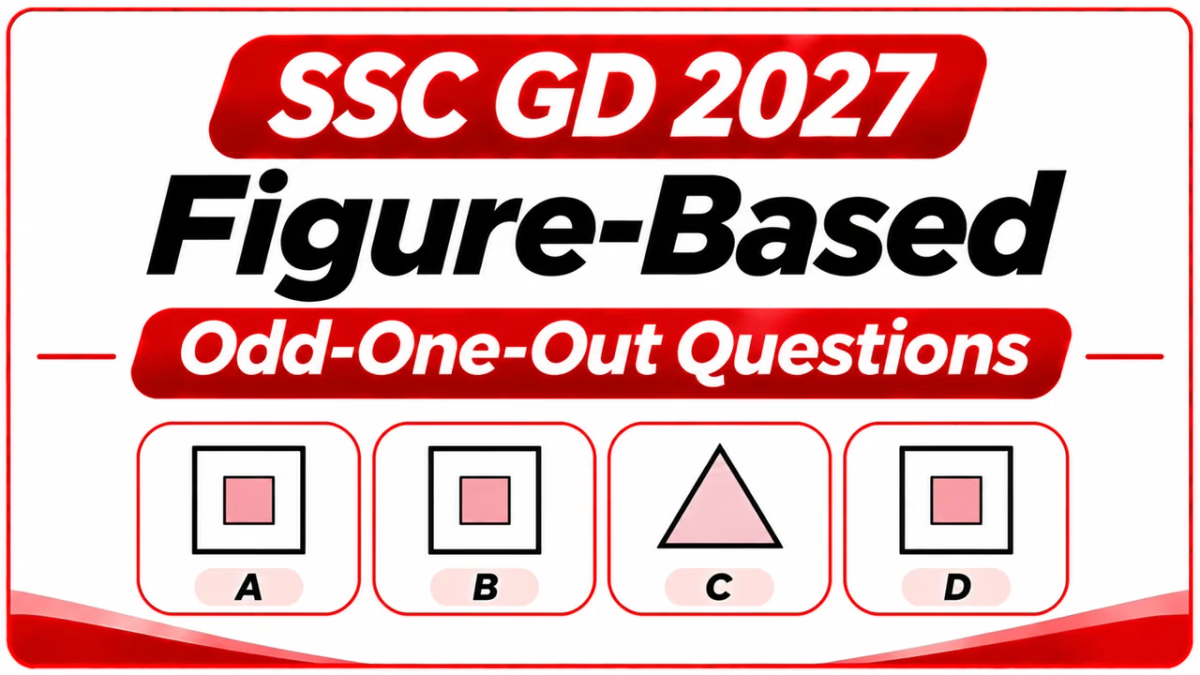
Figure-based odd-one-out questions are a common type of non-verbal reasoning practice. In these questions, candidates are shown multiple figures and must identify the one that does not follow the same pattern or rule as the remaining figures.
These questions test visual observation, pattern recognition, shape properties, and logical thinking. Practicing figure-based odd-one-out questions can help SSC GD 2027 aspirants improve their ability to identify similarities and differences quickly and accurately.
In an odd-one-out question, four or more figures are presented. Most of the figures follow a common visual property, while one figure differs from that property.
The difference may be based on:
Your task is to identify the figure that does not belong to the same group.
These questions are based on the basic properties of figures such as triangles, squares, rectangles, circles, and other polygons. Compare the number of sides, corners, or shape characteristics.
Some questions contain dots, lines, arrows, or small shapes. Count the elements in each figure and check whether one figure has a different number.
Figures may have the same shape but face different directions. Check the orientation of arrows, objects, or symbols to identify the one that does not match.
Figures may differ in the number of shaded sections, shaded areas, or the position of filled parts. Observe the shading carefully instead of focusing only on the outer shape.
Some figures follow a symmetrical arrangement, while one figure may be irregular or lack the same line of symmetry.
Look at the relative position of shapes inside or outside another figure. A small shape may be placed in a different location in the odd figure.
Avoid spending too much time on complicated possibilities when a simple visual rule explains the figures.
Try the following practice questions. Since these examples are described in text, imagine or sketch each figure using the given properties to identify the odd one out.
Which figure is different from the remaining three?
A) Square
B) Rectangle
C) Triangle
D) Rhombus
Three figures contain the same number of dots, while one contains a different number. Identify the odd figure.
A) Figure with 3 dots
B) Figure with 4 dots
C) Figure with 3 dots
D) Figure with 3 dots
Identify the arrow that does not match the others.
A) →
B) →
C) ←
D) →
Three figures have exactly half of their area shaded, while one figure is completely shaded. Which one is the odd figure?
A) Figure with half shaded area
B) Figure with completely shaded area
C) Figure with half shaded area
D) Figure with half shaded area
Which shape does not have the same symmetry property as the others?
A) Square
B) Circle
C) Equilateral triangle
D) Scalene triangle
Each option contains a square and a small circle. Identify the odd figure based on the position of the circle.
A) Small circle inside the square
B) Small circle inside the square
C) Small circle outside the square
D) Small circle inside the square
Question 1 – Answer: C) Triangle
Square, rectangle, and rhombus are quadrilaterals with four sides. A triangle has three sides, making it the odd figure.
Question 2 – Answer: B) Figure with 4 dots
Options A, C, and D each contain three dots. Option B contains four dots, so it differs from the group.
Question 3 – Answer: C) ←
Three arrows point to the right, while option C points to the left.
Question 4 – Answer: B) Figure with completely shaded area
Three figures have only half their area shaded. Option B is completely shaded, so it does not follow the same pattern.
Question 5 – Answer: D) Scalene triangle
A square, circle, and equilateral triangle have multiple lines of symmetry. A scalene triangle has no line of symmetry, making it the odd figure.
Question 6 – Answer: C) Small circle outside the square
In options A, B, and D, the small circle is inside the square. In option C, it is outside the square.
These questions ask you to identify a figure that does not share the common property or pattern followed by the other figures.
Common patterns include shapes, sides, dots, directions, rotation, shading, symmetry, and arrangement of elements.
Compare basic features first, such as number of elements, shape, direction, and shading. Choose the simplest rule that clearly separates one figure.
They are useful for developing observation, visual classification, and non-verbal reasoning skills as part of your reasoning preparation.
Yes. Rough sketches can help you compare shapes, positions, directions, and patterns when the visual relationship is not immediately clear.
Figure-based odd-one-out questions can be solved effectively by observing patterns and comparing the properties of each figure. Regular practice with different visual rules can improve your non-verbal reasoning ability and help you approach SSC GD 2027 reasoning questions with greater confidence.