

Download the App & Start Learning
- Expert Faculty Guidance
- Updated Study Material
- Mock Tests & Practice Quiz
- Live Doubt Solving Sessions
- Exam-Oriented Preparation
- Motivation & Success Strategy
Katara Academy

24/11/2026
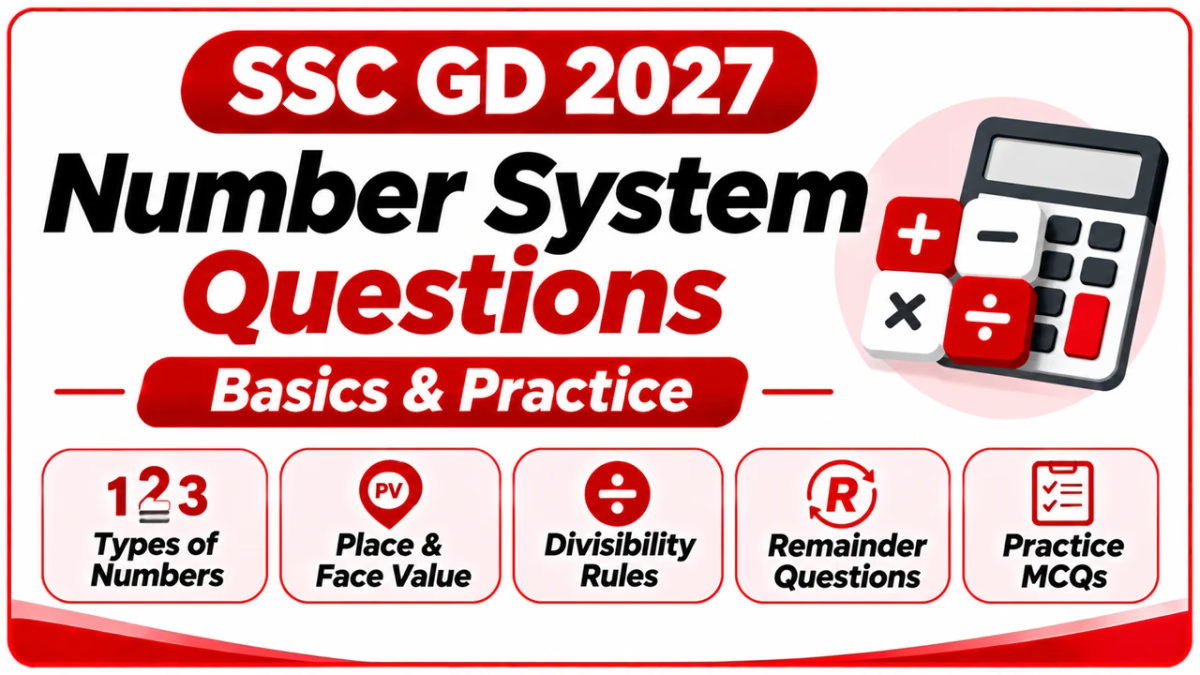
The number system is one of the fundamental topics in mathematics and an important area to practice for competitive examinations. Understanding numbers, their properties, place values, divisibility, and remainders helps candidates solve calculation-based questions more confidently.
For SSC GD 2027 Mathematics preparation, candidates should build a strong foundation in number system concepts before moving to more advanced arithmetic topics. Regular practice of basic number system questions can improve calculation speed, accuracy, and problem-solving ability.
A number system is a way of representing and classifying numbers according to their properties. In mathematics, different types of numbers are used for counting, calculations, measurements, and solving problems.
Understanding the basic number categories is helpful when solving SSC GD maths questions involving number properties and calculations.
Natural numbers are counting numbers starting from 1.
Examples: 1, 2, 3, 4, 5, 6, 7, ...
Whole numbers include zero and all natural numbers.
Examples: 0, 1, 2, 3, 4, 5, 6, ...
Integers include negative numbers, zero, and positive numbers without fractions or decimal parts.
Examples: -5, -4, -3, -2, -1, 0, 1, 2, 3, 4, 5
Even numbers are integers divisible by 2 without leaving a remainder.
Examples: 2, 4, 6, 8, 10, 12, 14
Odd numbers are integers that are not divisible by 2 evenly.
Examples: 1, 3, 5, 7, 9, 11, 13
A prime number is a natural number greater than 1 that has exactly two positive factors: 1 and itself.
Examples: 2, 3, 5, 7, 11, 13, 17, 19
Composite numbers are natural numbers greater than 1 that have more than two positive factors.
Examples: 4, 6, 8, 9, 10, 12, 14, 15
Place value and face value are basic concepts that help in understanding numbers and performing calculations.
Face Value: The face value of a digit is the digit itself, regardless of its position.
Place Value: The place value of a digit depends on its position in the number.
Example: In the number 5,482:
The face value of 8 is 8, while its place value is 80.
Divisibility rules help determine whether a number can be divided by another number without performing lengthy calculations.
Example: Is 729 divisible by 9?
Sum of digits = 7 + 2 + 9 = 18
Since 18 is divisible by 9, 729 is also divisible by 9.
A remainder is the amount left after dividing one number by another when the division is not exact.
Example: Divide 23 by 5.
5 × 4 = 20
23 − 20 = 3
Therefore, the quotient is 4 and the remainder is 3.
Understanding remainders is useful in number system questions involving divisibility, division, and number properties.
Question: Which of the following is an integer?
A) 2.5
B) 3/4
C) -7
D) 1.2
Answer: C) -7
Explanation: Integers include negative whole numbers, zero, and positive whole numbers. -7 is an integer, while the other options are fractions or decimals.
Question: What is the place value of 6 in 46,281?
A) 6
B) 60
C) 600
D) 6,000
Answer: D) 6,000
Explanation: In 46,281, the digit 6 is in the thousands place. Therefore, its place value is 6 × 1,000 = 6,000.
Question: Which of the following numbers is divisible by 9?
A) 452
B) 621
C) 734
D) 815
Answer: B) 621
Explanation: The sum of digits of 621 is 6 + 2 + 1 = 9. Since 9 is divisible by 9, the number 621 is divisible by 9.
Question: What is the remainder when 47 is divided by 6?
A) 3
B) 4
C) 5
D) 6
Answer: B) 5
Explanation: 6 × 7 = 42. Therefore, 47 − 42 = 5, so the remainder is 5. Correct option: C) 5.
Test your understanding by solving the following questions without looking at the answers first.
Which of the following is a prime number?
A) 21
B) 27
C) 29
D) 33
Which of the following is an even number?
A) 135
B) 247
C) 368
D) 519
What is the face value of 7 in the number 57,324?
A) 7
B) 70
C) 700
D) 7,000
Which number is divisible by 5?
A) 342
B) 416
C) 525
D) 638
What is the remainder when 35 is divided by 8?
A) 1
B) 2
C) 3
D) 4
Which of the following is a composite number?
A) 11
B) 13
C) 17
D) 21
What is the place value of 4 in 84,562?
A) 4
B) 40
C) 400
D) 4,000
Which number is divisible by 3?
A) 124
B) 235
C) 411
D) 502
Question 1 – Answer: C) 29
29 is a prime number because it has only two positive factors, 1 and 29.
Question 2 – Answer: C) 368
368 ends in 8, so it is divisible by 2 and is an even number.
Question 3 – Answer: A) 7
Face value is the digit itself, so the face value of 7 is 7.
Question 4 – Answer: C) 525
A number is divisible by 5 if it ends in 0 or 5. 525 ends in 5.
Question 5 – Answer: C) 3
8 × 4 = 32 and 35 − 32 = 3. The remainder is 3.
Question 6 – Answer: D) 21
21 has factors 1, 3, 7, and 21. It has more than two factors, so it is composite.
Question 7 – Answer: D) 4,000
The digit 4 is in the thousands place. Its place value is 4 × 1,000 = 4,000.
Question 8 – Answer: C) 411
4 + 1 + 1 = 6. Since 6 is divisible by 3, 411 is divisible by 3.
Number system is a mathematics topic that covers different types of numbers and their properties, including integers, whole numbers, natural numbers, prime numbers, and composite numbers.
Yes. Divisibility rules help candidates check whether numbers can be divided exactly and can save time during calculations.
Face value is the digit itself, while place value depends on the position of that digit within a number.
Practice basic arithmetic, divisibility rules, number classification, and remainder questions regularly. Reviewing mistakes also helps improve accuracy.
Start with types of numbers, even and odd numbers, prime and composite numbers, place value, and simple divisibility rules before attempting more complex questions.
Number system concepts form the foundation of mathematics preparation. By learning the properties of numbers, understanding divisibility rules, and practicing basic questions, SSC GD 2027 aspirants can strengthen their mathematical fundamentals and develop better calculation accuracy.