



Download the App & Start Learning
- Expert Faculty Guidance
- Updated Study Material
- Mock Tests & Practice Quiz
- Live Doubt Solving Sessions
- Exam-Oriented Preparation
- Motivation & Success Strategy
Katara Academy

15/11/2026
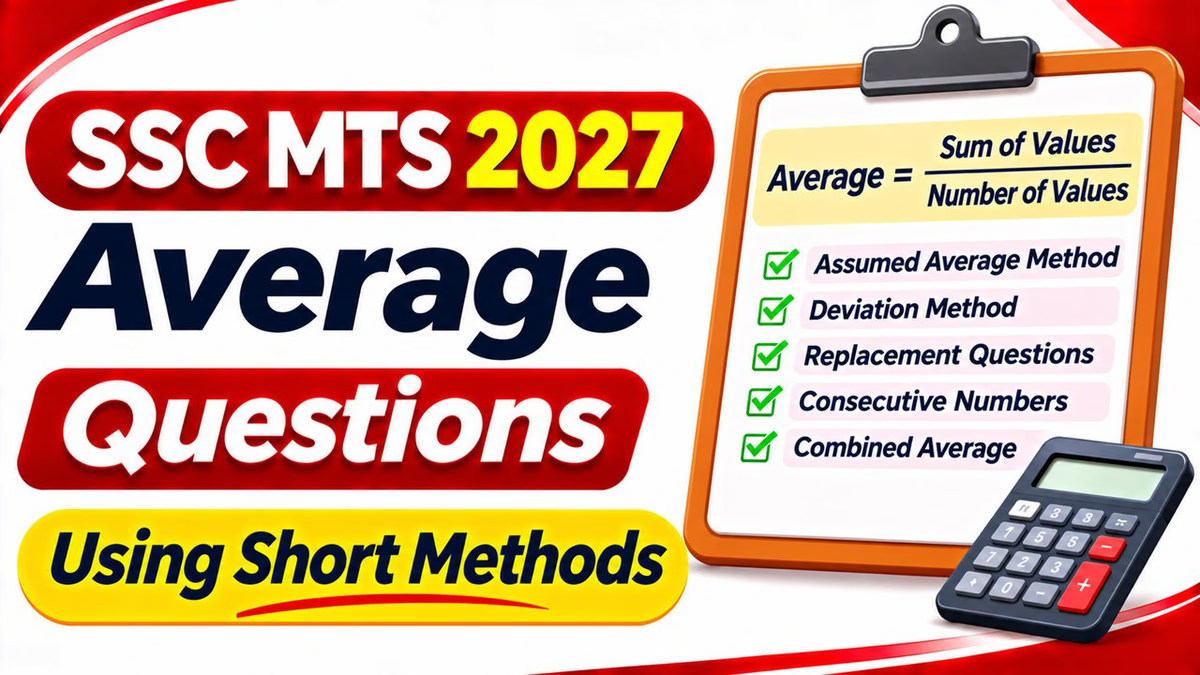
Average is an important arithmetic topic for competitive examination preparation. In SSC MTS 2027 Numerical Ability preparation, average-based questions can involve finding the average of numbers, missing values, replacement of numbers, consecutive numbers and combined averages.
Learning short calculation methods can help you solve these questions more efficiently. In this guide, you will learn important average formulas, quick tricks, step-by-step solved examples and 15 practice MCQs with answers and explanations.
What You Will Learn
Average is the equal share of the total value among the given number of observations. It represents the central value of a group of numbers.
Example: The marks of three students are 40, 50 and 60.
Total marks = 40 + 50 + 60 = 150
Number of students = 3
Average marks = 150 ÷ 3 = 50
Therefore, the average marks are 50.
1. Basic Average Formula
Average = Sum of Observations ÷ Number of Observations
2. Total Sum
Sum = Average × Number of Observations
3. Missing Number
Missing Number = Required Total − Sum of Known Numbers
4. New Average After Adding a Number
New Average = (Old Sum + New Number) ÷ New Count
5. Combined Average
Combined Average = Combined Total ÷ Combined Count
This method is useful when the given numbers are close to one another. Assume a convenient number as the average and calculate the differences.
Example: Find the average of 48, 50, 52, 54 and 56.
Assumed average = 52
Differences = −4, −2, 0, +2, +4
Sum of differences = 0
Actual average = 52 + (0 ÷ 5)
Answer: 52
When numbers are near a common value, calculate their deviations from that value instead of adding all the numbers directly.
Example: Find the average of 102, 104, 106 and 108.
Assumed average = 100
Deviations = 2, 4, 6 and 8
Average deviation = (2 + 4 + 6 + 8) ÷ 4 = 5
Actual average = 100 + 5
Answer: 105
First calculate the required total using Average × Number of Observations. Then subtract the sum of the known numbers.
Example: The average of 5 numbers is 20. Four numbers are 15, 18, 22 and 25. Find the fifth number.
Required total = 20 × 5 = 100
Sum of known numbers = 15 + 18 + 22 + 25 = 80
Missing number = 100 − 80
Answer: 20
When one number is replaced by another, the change in average depends on the difference between the two numbers.
Formula:
Change in Average = (New Number − Old Number) ÷ Total Number of Observations
Example: The average of 8 numbers is 25. If 18 is replaced by 34, find the new average.
Difference = 34 − 18 = 16
Increase in average = 16 ÷ 8 = 2
New average = 25 + 2
Answer: 27
For a group of consecutive numbers, the average is the middle number when the count is odd. When the count is even, the average is the mean of the two middle numbers.
Example: Find the average of 11, 12, 13, 14 and 15.
The middle number is 13.
Answer: 13
To find the combined average of two groups, calculate the total of each group separately and divide their combined total by the combined number of observations.
Example: The average marks of 10 students is 60, and the average marks of another 20 students is 70. Find the combined average.
First group total = 10 × 60 = 600
Second group total = 20 × 70 = 1,400
Combined total = 600 + 1,400 = 2,000
Combined students = 10 + 20 = 30
Combined average = 2,000 ÷ 30
Answer: 66.67 (approximately)
Question: Find the average of 20, 30, 40, 50 and 60.
Solution:
Sum = 20 + 30 + 40 + 50 + 60 = 200
Number of observations = 5
Average = 200 ÷ 5
Answer: 40
Question: The average of 6 numbers is 15. Five numbers are 10, 12, 14, 16 and 18. Find the sixth number.
Solution:
Total = 6 × 15 = 90
Known sum = 10 + 12 + 14 + 16 + 18 = 70
Missing number = 90 − 70
Answer: 20
Question: The average of 5 numbers is 24. If another number, 36, is added, find the new average.
Solution:
Old total = 5 × 24 = 120
New total = 120 + 36 = 156
New count = 6
New average = 156 ÷ 6
Answer: 26
Question: Find the average of the first 7 natural numbers.
Short Method:
Average of the first n natural numbers = (n + 1) ÷ 2
= (7 + 1) ÷ 2 = 4
Answer: 4
Question: The average marks of 20 students is 65. Find the total marks obtained by all students.
Solution:
Total = Average × Number of Students
Total = 65 × 20
Answer: 1,300 marks
| Question Type | Shortcut |
|---|---|
| First n natural numbers | (n + 1) ÷ 2 |
| First n even numbers | n + 1 |
| First n odd numbers | n |
| Consecutive numbers (odd count) | Middle number |
| Replacement of a number | Change in total ÷ Count |
| Adding a new observation | New total ÷ New count |
Note: The shortcuts for the first n natural, even and odd numbers apply when the sequence starts from 1, 2 and 1 respectively.
Try these 15 practice questions to test your understanding of Average. Solve them using the short methods explained above.
Find the average of 10, 20, 30 and 40.
A) 20 B) 25 C) 30 D) 35
Find the average of the first 5 natural numbers.
A) 2 B) 3 C) 4 D) 5
The average of 8 numbers is 15. If 24 is added as the ninth number, find the new average.
A) 15 B) 16 C) 17 D) 18
The average of 6 numbers is 18. If 12 is replaced by 24, find the new average.
A) 18 B) 19 C) 20 D) 21
The average of 5 numbers is 32. If four of the numbers have a total of 120, find the fifth number.
A) 35 B) 40 C) 45 D) 50
The average of three numbers is 24. Two numbers are 18 and 26. Find the third number.
A) 26 B) 28 C) 30 D) 32
The average age of 10 workers is 25 years. If a new worker aged 36 joins them, find the new average age.
A) 25 B) 26 C) 27 D) 28
The average of four consecutive even numbers is 15. Find the largest number.
A) 16 B) 18 C) 20 D) 22
The average of 7 numbers is 14. If one number, 20, is removed, find the average of the remaining numbers.
A) 12 B) 13 C) 14 D) 15
The average of 5 numbers is 12. If each number is increased by 3, what will be the new average?
A) 12 B) 14 C) 15 D) 18
The average marks of 20 students is 60. If 5 more students with an average of 70 marks join them, find the new average.
A) 60 B) 61 C) 62 D) 65
The average of 6 numbers is 25. The average of the first 5 numbers is 24. Find the sixth number.
A) 25 B) 30 C) 35 D) 40
The average of 4 numbers is 16. What number should be added to make the average of all 5 numbers equal to 18?
A) 22 B) 24 C) 26 D) 28
The average of 9 numbers is 40. If 58 is replaced by 31, find the new average.
A) 35 B) 36 C) 37 D) 38
The average of 5 consecutive odd numbers is 21. Find the largest number.
A) 23 B) 25 C) 27 D) 29
| Q. | Answer | Short Explanation |
|---|---|---|
| 1 | B) 25 | (10 + 20 + 30 + 40) ÷ 4 = 25. |
| 2 | B) 3 | Average of first n natural numbers = (n + 1) ÷ 2 = 3. |
| 3 | B) 16 | Old total = 8 × 15 = 120. New average = (120 + 24) ÷ 9 = 16. |
| 4 | C) 20 | Increase = (24 − 12) ÷ 6 = 2. New average = 18 + 2 = 20. |
| 5 | B) 40 | Total = 5 × 32 = 160. Fifth number = 160 − 120 = 40. |
| 6 | B) 28 | Total = 3 × 24 = 72. Third number = 72 − 18 − 26 = 28. |
| 7 | B) 26 | New average = (250 + 36) ÷ 11 = 26. |
| 8 | B) 18 | Numbers are 12, 14, 16 and 18. Their average is 15. |
| 9 | B) 13 | Old total = 7 × 14 = 98. New average = (98 − 20) ÷ 6 = 13. |
| 10 | C) 15 | When each value increases by 3, the average also increases by 3. New average = 12 + 3 = 15. |
| 11 | C) 62 | Combined average = (20 × 60 + 5 × 70) ÷ 25 = 62. |
| 12 | B) 30 | Total = 6 × 25 = 150. First five total = 5 × 24 = 120. Sixth = 30. |
| 13 | C) 26 | Required total = 5 × 18 = 90. Existing total = 4 × 16 = 64. Number = 26. |
| 14 | C) 37 | Decrease = 58 − 31 = 27. Average decreases by 27 ÷ 9 = 3. New average = 37. |
| 15 | B) 25 | The middle number is 21. The five numbers are 17, 19, 21, 23 and 25. |
| Day | Practice Topic |
|---|---|
| Day 1 | Understand the basic average formula and solve simple questions. |
| Day 2 | Practise assumed average and deviation methods. |
| Day 3 | Solve missing number and total-based questions. |
| Day 4 | Practise replacement and addition-based questions. |
| Day 5 | Revise consecutive number and combined average questions. |
| Day 6 | Solve mixed MCQs using short methods. |
| Day 7 | Take a timed practice test and review mistakes. |
Regular practice can help you improve calculation speed and accuracy in Numerical Ability. Learn the basic concepts, revise important shortcuts and practise different types of average questions.
Strengthen your Mathematics fundamentals and practise important questions with structured exam preparation.
Average = Sum of all observations ÷ Number of observations.
Add the given values and divide their sum by the total number of values. For numbers close to each other, use the assumed average or deviation method.
It is a shortcut in which you select a convenient value as the assumed average and calculate the average of the differences from that value.
Multiply the given average by the total number of observations, then subtract the sum of the known numbers.
The average changes by the difference between the new and old numbers divided by the total number of observations.
The formula is (n + 1) ÷ 2.
The formula is n + 1, when the sequence starts from 2.
The average is n, when the sequence starts from 1.
Calculate the total of each group by multiplying its average by its count. Add both totals and divide by the combined count.
Start with basic average questions, learn shortcut methods, practise missing number and replacement problems, and solve mixed MCQs regularly.
Average questions become easier when you understand the relationship between total values and the number of observations. Methods such as assumed average, deviation, replacement and combined average can help simplify calculations. Practise the solved examples and MCQs in this guide to strengthen your Numerical Ability preparation for SSC MTS 2027.
