



Download the App & Start Learning
- Expert Faculty Guidance
- Updated Study Material
- Mock Tests & Practice Quiz
- Live Doubt Solving Sessions
- Exam-Oriented Preparation
- Motivation & Success Strategy
Katara Academy

20/11/2026
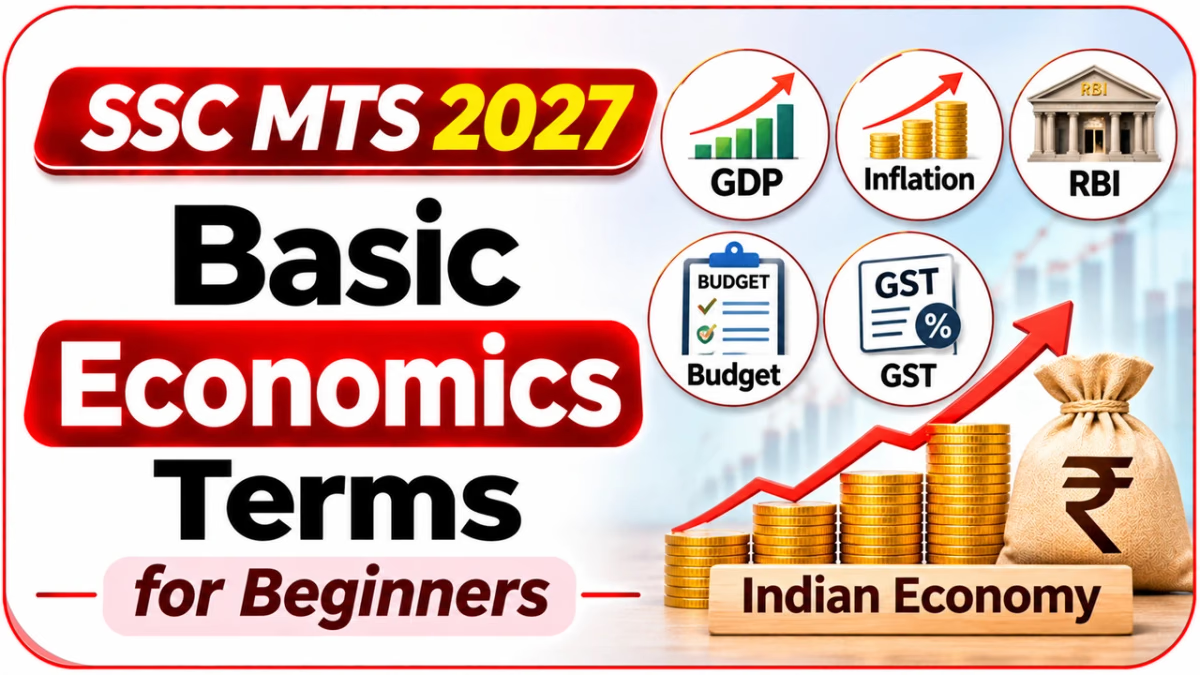
Economics is the study of how individuals, businesses and governments use limited resources to satisfy their needs and wants. It explains how goods and services are produced, distributed and consumed in an economy.
Basic economics is an important topic for the General Awareness section of the SSC MTS 2027 examination. Candidates should understand common economic terms such as GDP, inflation, banking, budget, demand, supply, poverty and unemployment.
Learning these concepts with simple definitions and examples makes economics easier for beginners. This article covers important economic terminology, Indian economy concepts and practice questions to help students prepare for SSC MTS 2027.
| Economic Term | Simple Definition |
|---|---|
| Economics | The study of production, distribution and consumption of goods and services. |
| Economy | A system through which a country produces, distributes and consumes goods and services. |
| Goods | Physical products that satisfy human needs, such as food, clothes and furniture. |
| Services | Activities provided to satisfy people's needs, such as education, healthcare and banking. |
| Scarcity | A situation in which resources are limited compared with human wants. |
| Utility | The satisfaction a person receives from consuming a good or service. |
| Consumption | The use of goods and services to satisfy human wants. |
| Production | The process of creating goods and providing services. |
| Distribution | The process through which goods, services and income are allocated. |
| Capital | Man-made resources used in production, such as machinery, tools and buildings. |
Demand and supply are two fundamental concepts of economics. They help explain how prices of goods and services are determined in a market.
Demand refers to the quantity of a good or service that consumers are willing and able to purchase at a particular price during a given period.
Example: If the price of apples decreases, consumers may be willing to purchase more apples, assuming other factors remain unchanged.
Supply refers to the quantity of a good or service that producers are willing and able to sell at a particular price during a given period.
Example: If the market price of a product increases, producers may be willing to supply more of that product, assuming other factors remain unchanged.
National income and production indicators help measure the economic performance of a country. These terms are important for competitive examinations.
| Term | Meaning |
|---|---|
| GDP | Gross Domestic Product is the total value of final goods and services produced within a country's geographical boundaries during a specified period. |
| GNP | Gross National Product measures the value of final goods and services produced by a country's residents, including net factor income from abroad. |
| NNP | Net National Product is GNP minus depreciation. |
| National Income | In the traditional factor-cost concept, it refers to NNP at factor cost. |
| Per Capita Income | Average income per person, calculated by dividing total income by population. |
| Nominal GDP | GDP measured using current market prices. |
| Real GDP | GDP measured using constant prices to remove the effect of price changes. |
| Economic Growth | An increase in the production of goods and services in an economy over time. |
| Economic Development | A broader improvement in living standards, income, health, education and economic opportunities. |
Important Formula:
Per Capita Income = National Income ÷ Population
Example: If a country's national income is ₹10 lakh crore and its population is 10 crore, its per capita income is ₹1 lakh.
Changes in the general price level affect the purchasing power of money. Inflation and deflation are important economic concepts related to price movements.
Inflation refers to a sustained increase in the general price level of goods and services over time. During inflation, the purchasing power of money generally decreases.
Example: If the prices of vegetables, fuel and essential products increase over time, consumers may need to spend more money to purchase the same items.
Deflation refers to a sustained decrease in the general price level of goods and services over time.
Banking plays an important role in the Indian economy. Banks accept deposits, provide loans and support financial transactions.
| Term | Simple Definition |
|---|---|
| Bank | A financial institution that accepts deposits and provides loans and other financial services. |
| RBI | Reserve Bank of India, the central bank of India. |
| Repo Rate | The rate at which the RBI lends short-term funds to eligible banks against securities under the repo framework. |
| Reverse Repo Rate | The rate at which the RBI borrows funds from banks under the reverse repo framework. |
| CRR | Cash Reserve Ratio is the percentage of a bank's net demand and time liabilities that it must maintain as cash balance with the RBI. |
| SLR | Statutory Liquidity Ratio is the percentage of a bank's net demand and time liabilities that it must maintain in specified liquid assets. |
| Interest | The cost of borrowing money or the return earned on deposited or invested money. |
| Loan | Money borrowed from a bank or financial institution that must be repaid. |
| Deposit | Money placed in a bank account for safekeeping or earning interest. |
| EMI | Equated Monthly Instalment paid regularly to repay a loan. |
| NEFT | National Electronic Funds Transfer, an electronic system for transferring money between bank accounts. |
| UPI | Unified Payments Interface, a system that enables instant bank-to-bank digital payments. |
Exam Fact: The Reserve Bank of India was established on 1 April 1935 and was nationalised on 1 January 1949.
A government budget is an annual financial statement showing the estimated receipts and expenditure of the government for a financial year.
Poverty and unemployment are important socio-economic issues. They affect income levels, living standards and the overall development of a country.
The Indian economy is commonly divided into three major sectors based on the type of economic activity.
The primary sector involves activities that directly use natural resources.
The secondary sector involves the processing of raw materials and manufacturing of finished goods.
The tertiary sector provides services that support individuals, businesses and other economic activities.
Exam Tip: Agriculture belongs to the primary sector, manufacturing belongs to the secondary sector and banking belongs to the tertiary sector.
| Term | Meaning |
|---|---|
| FDI | Foreign Direct Investment – investment by a foreign investor in a business or enterprise in another country with a lasting interest. |
| FII | Foreign Institutional Investor – a term historically used for foreign institutional investors investing in financial markets. |
| Balance of Trade | The difference between the value of a country's exports and imports of goods. |
| Balance of Payments | A record of economic transactions between residents of a country and the rest of the world. |
| Export | Goods and services sold to other countries. |
| Import | Goods and services purchased from other countries. |
| Subsidy | Financial assistance provided by the government to support a particular activity or group. |
| Privatisation | Transfer of ownership or control of a business from the public sector to the private sector. |
| Liberalisation | Reduction of government restrictions and controls on economic activities. |
| Globalisation | Increasing economic integration and interaction among countries. |
| Fiscal Policy | Government policy relating to taxation, public expenditure and borrowing. |
| Monetary Policy | Central bank policy relating to money, credit and interest rates. |
Test your understanding with these multiple-choice questions prepared for SSC MTS General Awareness.
A) General Domestic Production
B) Gross Domestic Product
C) Gross Development Plan
D) General Development Product
Correct Answer: B) Gross Domestic Product
A) SBI
B) NABARD
C) RBI
D) SEBI
Correct Answer: C) RBI
A) General decrease in prices
B) Sustained increase in the general price level
C) Increase in exports only
D) Decrease in population
Correct Answer: B) Sustained increase in the general price level
A) Primary Sector
B) Secondary Sector
C) Tertiary Sector
D) Service Sector
Correct Answer: A) Primary Sector
A) General Sales Tax
B) Goods and Services Tax
C) Government Service Tariff
D) Gross Supply Tax
Correct Answer: B) Goods and Services Tax
A) Total government expenditure
B) Average income per person
C) Total exports
D) Total bank deposits
Correct Answer: B) Average income per person
A) Income Tax
B) Corporate Tax
C) GST
D) Personal Income Tax
Correct Answer: C) GST
A) RBI
B) NITI Aayog
C) SEBI
D) NABARD
Correct Answer: B) NITI Aayog
A) Workers changing their jobs
B) More workers engaged than actually required
C) Workers receiving high salaries
D) Seasonal increase in employment
Correct Answer: B) More workers engaged than actually required
A) Primary Sector
B) Secondary Sector
C) Tertiary Sector
D) Agricultural Sector
Correct Answer: C) Tertiary Sector
Basic economics terms are important for understanding the Indian economy and preparing for the SSC MTS 2027 General Awareness section. Candidates should focus on GDP, inflation, banking, taxation, government budgets, poverty, unemployment and the three sectors of the economy.
Start with simple definitions, understand the examples and revise important economic facts regularly. Practising topic-wise MCQs can help improve your understanding and build confidence for the SSC MTS examination.
