



Download the App & Start Learning
- Expert Faculty Guidance
- Updated Study Material
- Mock Tests & Practice Quiz
- Live Doubt Solving Sessions
- Exam-Oriented Preparation
- Motivation & Success Strategy
Katara Academy

19/11/2026
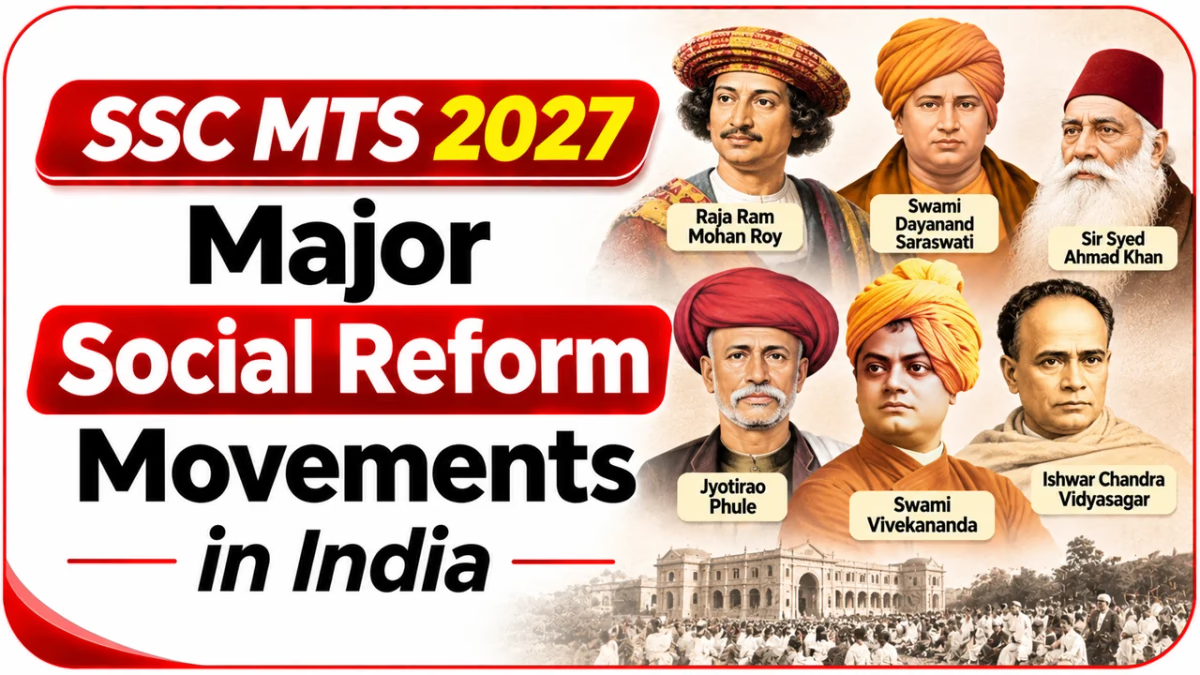
Social reform movements played an important role in transforming Indian society during the 19th and early 20th centuries. These movements aimed to remove harmful social practices, promote education, improve the status of women and challenge caste discrimination and social inequality.
Several Indian reformers established organisations to spread awareness about social and religious reforms. Raja Ram Mohan Roy, Swami Dayanand Saraswati, Jyotirao Phule, Swami Vivekananda, Sir Syed Ahmad Khan and Narayana Guru were among the important personalities associated with these movements.
For the SSC MTS 2027 examination, questions about the founders, establishment years, objectives and contributions of social reform organisations are important under Modern Indian History and General Awareness.
Brahmo Samaj was founded by Raja Ram Mohan Roy in Calcutta (now Kolkata) in 1828. It became an important organisation for religious and social reform in Bengal.
Important Facts:
Major Contributions:
Exam Fact: Raja Ram Mohan Roy is popularly known as the Father of the Indian Renaissance.
The Young Bengal Movement was associated with Henry Louis Vivian Derozio, a teacher at Hindu College in Calcutta. He encouraged students to question traditional beliefs and develop independent thinking.
Ishwar Chandra Vidyasagar played an important role in promoting widow remarriage in India. He campaigned against the social restrictions imposed on Hindu widows and supported their right to remarry.
Exam Fact: Ishwar Chandra Vidyasagar was a leading supporter of the Hindu Widows' Remarriage Act of 1856.
Prarthana Samaj was founded by Atmaram Pandurang in Bombay in 1867. It worked towards religious and social reform, especially in western India.
Major Objectives:
Satyashodhak Samaj was founded by Mahatma Jyotirao Phule in Pune in 1873. The organisation worked for social equality and the rights of oppressed communities.
Major Contributions:
Exam Fact: Jyotirao Phule and Savitribai Phule made important contributions to women's education in India.
The Singh Sabha Movement began in 1873 at Amritsar. It aimed to strengthen Sikh religious identity, promote education and encourage social and religious reform within the Sikh community.
Arya Samaj was founded by Swami Dayanand Saraswati in Bombay in 1875. It aimed to reform Hindu society through the teachings of the Vedas.
Major Contributions:
Exam Fact: Swami Dayanand Saraswati wrote the book Satyarth Prakash.
The Aligarh Movement was led by Sir Syed Ahmad Khan. It aimed to promote modern scientific and English education among Muslims in India.
Major Contributions:
Exam Fact: Sir Syed Ahmad Khan is closely associated with the Aligarh Movement and modern Muslim education in India.
The Theosophical Society was founded in New York in 1875 by Helena Petrovna Blavatsky and Henry Steel Olcott. It later established its international headquarters at Adyar, Madras (now Chennai), in 1882.
Main Objectives:
Ramakrishna Mission was established by Swami Vivekananda in 1897. It was inspired by the teachings of his spiritual teacher, Ramakrishna Paramahamsa.
Major Contributions:
Exam Fact: Swami Vivekananda represented India at the World Parliament of Religions in Chicago in 1893.
The Deoband Movement began with the establishment of Darul Uloom Deoband in 1866 in present-day Uttar Pradesh. It focused on Islamic religious education and the preservation of Islamic scholarship.
The Sri Narayana Dharma Paripalana (SNDP) movement was associated with Sri Narayana Guru and social reform activities in Kerala. SNDP Yogam was established in 1903 to promote social equality and educational advancement.
Famous Teaching: One caste, one religion, one God for humankind.
The Self-Respect Movement was launched by E. V. Ramasamy, popularly known as Periyar, in Tamil Nadu in 1925.
Major Contributions:
Several laws were introduced during British rule to address harmful social practices and support social reform. The following dates are important for competitive examinations.
| Year | Important Law | Associated Reformer / Context |
|---|---|---|
| 1829 | Bengal Sati Regulation | Raja Ram Mohan Roy's campaign; Lord William Bentinck's regulation |
| 1856 | Hindu Widows' Remarriage Act | Ishwar Chandra Vidyasagar |
| 1872 | Special Marriage Act (original Act) | Legal framework for certain civil marriages |
| 1891 | Age of Consent Act | Raised the age of consent for girls to 12 years |
| 1929 | Child Marriage Restraint Act | Also known as the Sarda Act |
| Movement / Organisation | Year | Founder / Leader |
|---|---|---|
| Brahmo Samaj | 1828 | Raja Ram Mohan Roy |
| Young Bengal Movement | 1820s–1830s | Henry Derozio |
| Prarthana Samaj | 1867 | Atmaram Pandurang |
| Deoband Movement | 1866 | Muhammad Qasim Nanautavi and Rashid Ahmad Gangohi |
| Satyashodhak Samaj | 1873 | Jyotirao Phule |
| Singh Sabha Movement | 1873 | Thakur Singh Sandhawalia and others |
| Arya Samaj | 1875 | Swami Dayanand Saraswati |
| Aligarh Movement | 1875 | Sir Syed Ahmad Khan |
| Theosophical Society | 1875 | H. P. Blavatsky and H. S. Olcott |
| Ramakrishna Mission | 1897 | Swami Vivekananda |
| SNDP Yogam | 1903 | Associated with Sri Narayana Guru |
| Self-Respect Movement | 1925 | E. V. Ramasamy (Periyar) |
Test your knowledge with these multiple-choice questions prepared for SSC MTS 2027 General Awareness.
A) Swami Vivekananda
B) Raja Ram Mohan Roy
C) Jyotirao Phule
D) Swami Dayanand Saraswati
Correct Answer: B) Raja Ram Mohan Roy
A) 1828
B) 1867
C) 1875
D) 1897
Correct Answer: C) 1875
A) Jyotirao Phule
B) Mahatma Gandhi
C) Sir Syed Ahmad Khan
D) Swami Vivekananda
Correct Answer: A) Jyotirao Phule
A) Ramakrishna Paramahamsa
B) Swami Vivekananda
C) Raja Ram Mohan Roy
D) Annie Besant
Correct Answer: B) Swami Vivekananda
A) Jyotirao Phule
B) Sir Syed Ahmad Khan
C) Ishwar Chandra Vidyasagar
D) Dayanand Saraswati
Correct Answer: B) Sir Syed Ahmad Khan
A) Mahadev Govind Ranade
B) Periyar E. V. Ramasamy
C) Swami Vivekananda
D) Annie Besant
Correct Answer: B) Periyar E. V. Ramasamy
A) Bombay
B) Calcutta
C) New York
D) Madras
Correct Answer: C) New York
A) Ishwar Chandra Vidyasagar
B) Swami Dayanand Saraswati
C) Sir Syed Ahmad Khan
D) Henry Derozio
Correct Answer: A) Ishwar Chandra Vidyasagar
A) 1828
B) 1867
C) 1873
D) 1897
Correct Answer: B) 1867
A) Muhammad Qasim Nanautavi
B) Raja Ram Mohan Roy
C) Jyotirao Phule
D) Atmaram Pandurang
Correct Answer: A) Muhammad Qasim Nanautavi
Major social reform movements in India played an important role in addressing social inequality, promoting education and encouraging changes in traditional practices. Organisations such as Brahmo Samaj, Arya Samaj, Prarthana Samaj, Satyashodhak Samaj and Ramakrishna Mission contributed to different aspects of social and religious reform.
For SSC MTS 2027 preparation, candidates should focus on the names of reformers, founding years, organisations, important laws and their objectives. Regular revision of the quick revision table and practice MCQs can help strengthen Modern Indian History and General Awareness preparation.
