





Download the App & Start Learning
- Expert Faculty Guidance
- Updated Study Material
- Mock Tests & Practice Quiz
- Live Doubt Solving Sessions
- Exam-Oriented Preparation
- Motivation & Success Strategy
Katara Academy

19/11/2026
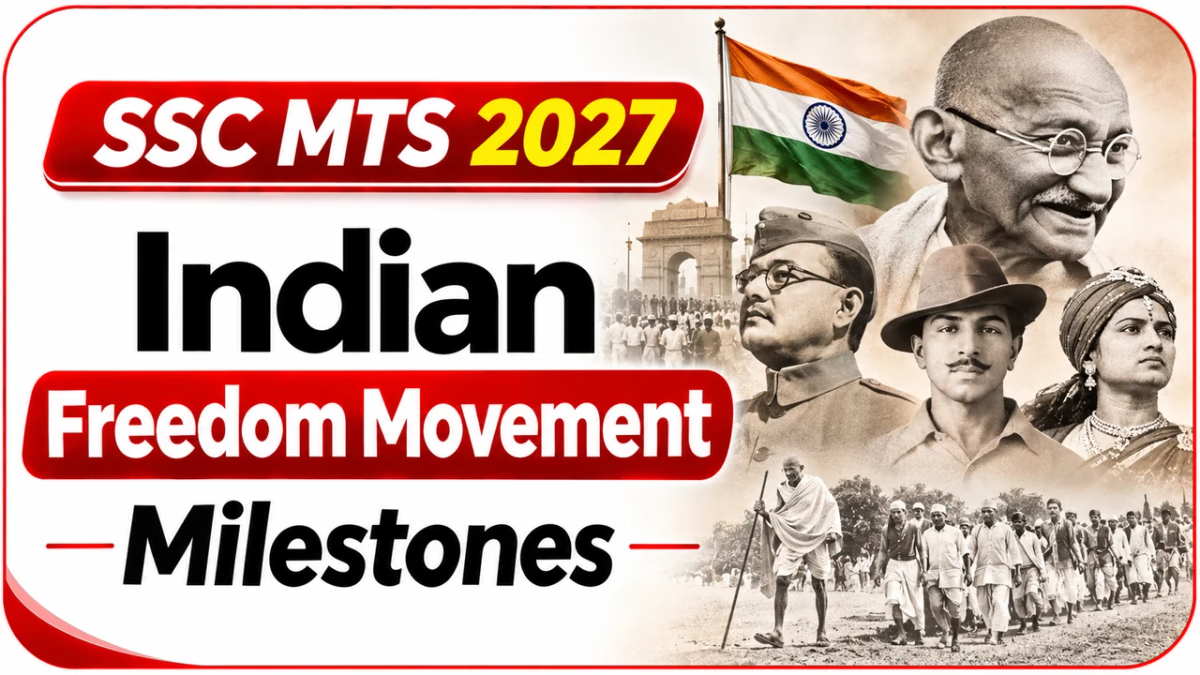
The Indian Freedom Movement was a long struggle against British colonial rule that ultimately led to India's independence on 15 August 1947. It involved freedom fighters, political leaders, revolutionaries, farmers, workers, students and ordinary citizens from different parts of the country.
The movement included several important events such as the Revolt of 1857, formation of the Indian National Congress, Swadeshi Movement, Non-Cooperation Movement, Civil Disobedience Movement and Quit India Movement.
For the SSC MTS 2027 examination, understanding important historical milestones, their years, leaders and associated events is essential for the General Awareness section. This article covers the major events of the Indian freedom struggle in chronological order to make revision easier.
The Revolt of 1857 was a major uprising against the rule of the British East India Company. It began among Indian soldiers (sepoys) at Meerut on 10 May 1857 and spread to several regions of northern and central India.
Important Leaders of the Revolt:
Important Facts:
The Indian National Congress (INC) was established in December 1885. It became one of the most important political organisations in India's freedom struggle.
In 1905, Lord Curzon announced the Partition of Bengal. The partition came into effect on 16 October 1905 and led to widespread protests across India.
The Swadeshi Movement encouraged Indians to use locally manufactured goods and boycott British products.
The All-India Muslim League was established in 1906 at Dhaka. It became an important political organisation during the later stages of the Indian freedom struggle.
The Indian National Congress experienced a major division at its Surat Session in 1907. The organisation split into two broad groups known as Moderates and Extremists.
The Home Rule Movement was launched in 1916 to demand self-government for India within the British Empire.
Mahatma Gandhi returned to India from South Africa in January 1915. He introduced and developed the method of Satyagraha in several Indian movements.
| Movement | Year | Location | Main Issue |
|---|---|---|---|
| Champaran Satyagraha | 1917 | Bihar | Problems faced by indigo cultivators |
| Ahmedabad Mill Strike | 1918 | Gujarat | Wage dispute involving textile workers |
| Kheda Satyagraha | 1918 | Gujarat | Demand for revenue relief after crop failure |
Exam Tip: Remember the sequence: Champaran – 1917, Ahmedabad – 1918, Kheda – 1918.
The British Government passed the Rowlatt Act in 1919. It gave the authorities extensive powers to detain individuals without trial in certain cases. Gandhi and other Indian leaders strongly opposed the legislation.
The Jallianwala Bagh Massacre took place on 13 April 1919 in Amritsar, Punjab. British troops under Brigadier-General Reginald Dyer fired on an unarmed gathering of people at Jallianwala Bagh.
Mahatma Gandhi launched the Non-Cooperation Movement in 1920. It encouraged Indians to withdraw their cooperation from British institutions and authorities.
Major Activities:
Important Facts:
On 5 February 1922, a violent incident occurred at Chauri Chaura in the Gorakhpur district of present-day Uttar Pradesh. A police station was set on fire during a confrontation, resulting in the deaths of policemen.
Following this incident, Mahatma Gandhi decided to withdraw the Non-Cooperation Movement because he believed the movement should remain non-violent.
The British Government appointed the Simon Commission in 1927 to review the working of constitutional reforms in India. The commission arrived in India in 1928.
The Nehru Report was prepared under the chairmanship of Motilal Nehru. It proposed a constitutional framework for India and became an important development in the constitutional history of the freedom movement.
The Lahore Session of the Indian National Congress was held in December 1929 under the presidency of Jawaharlal Nehru.
The Civil Disobedience Movement was launched in 1930 under the leadership of Mahatma Gandhi. The movement challenged British laws through peaceful non-violent actions.
On 12 March 1930, Mahatma Gandhi began the historic Dandi March from Sabarmati Ashram in Gujarat with his followers. They reached Dandi on 6 April 1930, where Gandhi broke the British salt law by making salt.
The Gandhi-Irwin Pact was signed on 5 March 1931 between Mahatma Gandhi and Lord Irwin, the then Viceroy of India.
The Poona Pact was signed on 24 September 1932 between Mahatma Gandhi and Dr. B. R. Ambedkar, along with other representatives.
The Government of India Act 1935 was an important constitutional development during British rule. It proposed a federal structure and introduced provincial autonomy.
The Quit India Movement was one of the most important mass movements against British rule. The Indian National Congress launched the movement in August 1942, demanding an immediate end to British rule in India.
Despite the arrests, protests, demonstrations and underground activities continued in several parts of India.
The Indian National Army (INA), also known as Azad Hind Fauj, played an important role in the struggle against British rule.
The Cabinet Mission arrived in India in 1946 to discuss the transfer of power and constitutional arrangements for an independent India.
The Indian Independence Act was passed by the British Parliament in July 1947. It provided for the creation of two independent dominions, India and Pakistan.
India finally became independent on 15 August 1947, ending nearly two centuries of British political dominance in the subcontinent.
| Year / Date | Important Event |
|---|---|
| 1857 | Revolt of 1857 |
| 1858 | British Crown takes over administration from East India Company |
| 1885 | Formation of Indian National Congress |
| 1905 | Partition of Bengal and Swadeshi Movement |
| 1906 | Formation of All-India Muslim League |
| 1907 | Surat Split of Congress |
| 1911 | Annulment of Bengal Partition |
| 1916 | Home Rule Movement and Lucknow Pact |
| 1917 | Champaran Satyagraha |
| 1918 | Ahmedabad Mill Strike and Kheda Satyagraha |
| 1919 | Rowlatt Act and Jallianwala Bagh Massacre |
| 1920 | Non-Cooperation Movement |
| 1922 | Chauri Chaura Incident |
| 1927 | Simon Commission appointed |
| 1928 | Simon Commission arrives in India; Nehru Report |
| 1929 | Lahore Session and Purna Swaraj Declaration |
| 1930 | Dandi March and Civil Disobedience Movement |
| 1931 | Gandhi-Irwin Pact |
| 1932 | Poona Pact |
| 1935 | Government of India Act |
| 1942 | Quit India Movement |
| 1943 | Subhas Chandra Bose leads INA; Azad Hind Government established |
| 1946 | Cabinet Mission and Interim Government |
| 1947 | Indian Independence Act and Independence of India |
| Freedom Fighter | Important Contribution |
|---|---|
| Mahatma Gandhi | Non-Cooperation, Civil Disobedience and Quit India Movements |
| Subhas Chandra Bose | Leadership of the Indian National Army |
| Bal Gangadhar Tilak | Home Rule Movement and nationalist activities |
| Jawaharlal Nehru | Lahore Session of 1929 and Purna Swaraj declaration |
| Bhagat Singh | Revolutionary activities against British rule |
| Sardar Vallabhbhai Patel | Bardoli Satyagraha and national movement |
| Rani Lakshmibai | Leadership during the Revolt of 1857 |
| Lala Lajpat Rai | Swadeshi Movement and protest against Simon Commission |
| Annie Besant | Home Rule Movement |
| Dr. B. R. Ambedkar | Advocacy for social justice and political representation |
Test your knowledge with these important multiple-choice questions prepared for SSC MTS 2027 General Awareness.
A) 1757
B) 1857
C) 1885
D) 1905
Correct Answer: B) 1857
A) A.O. Hume
B) Mahatma Gandhi
C) W.C. Bonnerjee
D) Jawaharlal Nehru
Correct Answer: C) W.C. Bonnerjee
A) Lord Mountbatten
B) Lord Curzon
C) Lord Irwin
D) Lord Ripon
Correct Answer: B) Lord Curzon
A) Delhi
B) Lucknow
C) Amritsar
D) Mumbai
Correct Answer: C) Amritsar
A) 1917
B) 1919
C) 1920
D) 1930
Correct Answer: C) 1920
A) Jallianwala Bagh Massacre
B) Chauri Chaura Incident
C) Dandi March
D) Surat Split
Correct Answer: B) Chauri Chaura Incident
A) Mahatma Gandhi
B) Bal Gangadhar Tilak
C) Jawaharlal Nehru
D) Subhas Chandra Bose
Correct Answer: C) Jawaharlal Nehru
A) 12 March 1930
B) 15 August 1930
C) 26 January 1930
D) 6 April 1931
Correct Answer: A) 12 March 1930
A) Jai Jawan Jai Kisan
B) Do or Die
C) Inquilab Zindabad
D) Delhi Chalo
Correct Answer: B) Do or Die
A) 26 January 1950
B) 15 August 1947
C) 2 October 1947
D) 9 August 1942
Correct Answer: B) 15 August 1947
Indian Freedom Movement milestones are an important part of Modern Indian History and the SSC MTS 2027 General Awareness syllabus. Candidates should focus on important years, historical events, freedom fighters, major movements and their associated leaders.
Revision of the chronological timeline from 1857 to 1947 can make it easier to remember the sequence of events. Practising MCQs regularly and connecting important leaders with their contributions will help strengthen your history preparation.
