



Download the App & Start Learning
- Expert Faculty Guidance
- Updated Study Material
- Mock Tests & Practice Quiz
- Live Doubt Solving Sessions
- Exam-Oriented Preparation
- Motivation & Success Strategy
Katara Academy

14/11/2026
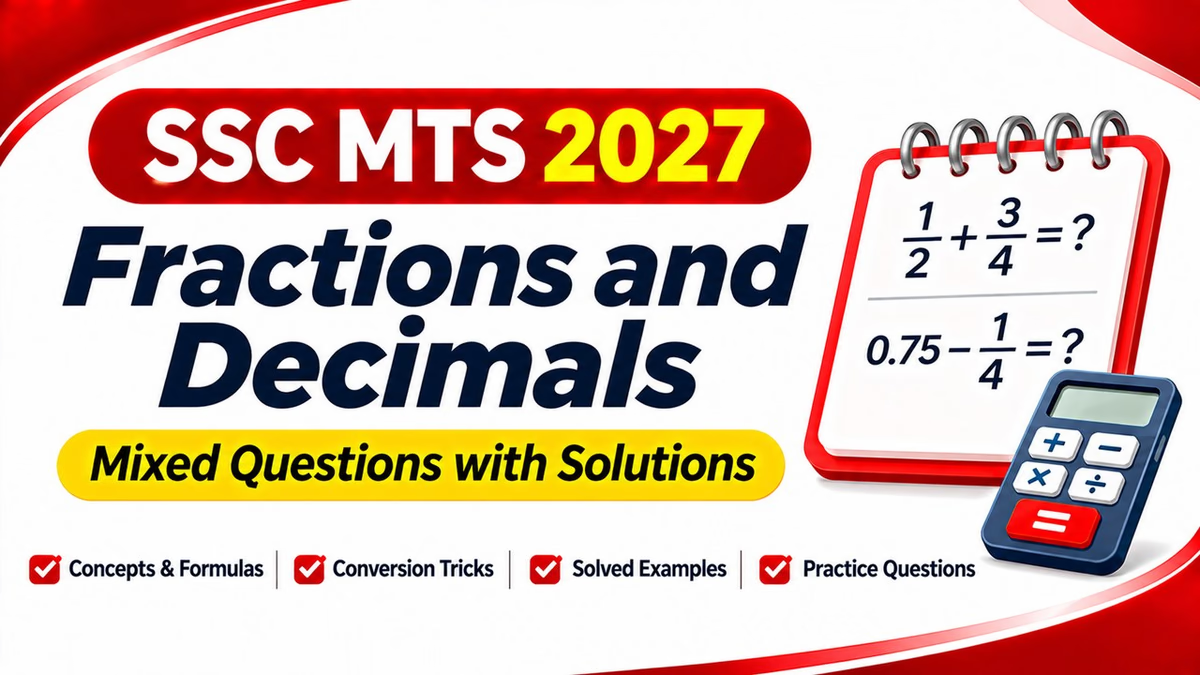
Fractions and decimals are important basic mathematics topics for candidates preparing for SSC MTS 2027. Questions may involve converting fractions into decimals, comparing values, performing arithmetic operations and solving mixed numerical problems. A clear understanding of these concepts can help candidates improve calculation speed and accuracy.
In this article, you will learn the basic concepts of fractions and decimals, useful conversion methods, solved examples and practice questions with answers for SSC MTS Numerical Ability preparation.
A fraction represents a part of a whole. It is written in the form a/b, where:
For example, in 3/5, 3 is the numerator and 5 is the denominator.
Types of fractions:
Decimals represent numbers using a decimal point. The digits after the decimal point show parts of a whole.
Examples:
Understanding decimal places is useful when comparing and calculating decimal values.
Memorise commonly used fraction and decimal equivalents to make calculations faster.
| Fraction | Decimal | Percentage |
|---|---|---|
| 1/2 | 0.5 | 50% |
| 1/4 | 0.25 | 25% |
| 3/4 | 0.75 | 75% |
| 1/5 | 0.2 | 20% |
| 2/5 | 0.4 | 40% |
| 1/8 | 0.125 | 12.5% |
| 3/8 | 0.375 | 37.5% |
| 1/10 | 0.1 | 10% |
| 1/20 | 0.05 | 5% |
| 1/25 | 0.04 | 4% |
To convert a fraction into a decimal, divide the numerator by the denominator.
Example 1: Convert 3/4 into a decimal.
3 ÷ 4 = 0.75
Answer: 0.75
Example 2: Convert 7/8 into a decimal.
7 ÷ 8 = 0.875
Answer: 0.875
Write the decimal number without its decimal point as the numerator. Use 10, 100 or 1000 as the denominator depending on the number of decimal places. Then simplify the fraction.
Example 1: Convert 0.6 into a fraction.
0.6 = 6/10 = 3/5
Example 2: Convert 0.125 into a fraction.
0.125 = 125/1000 = 1/8
For fractions with different denominators, first find the LCM and convert them into like fractions.
Example: 1/2 + 1/4 = 2/4 + 1/4 = 3/4.
For decimals, align the decimal points before adding or subtracting.
Example: 2.5 + 1.25 = 3.75.
Multiply the numerators and denominators separately, then simplify the result.
Example: 2/3 × 3/4 = 6/12 = 1/2.
Decimal example: 0.4 × 0.5 = 0.20 = 0.2.
To divide fractions, multiply the first fraction by the reciprocal of the second fraction.
Example: 3/4 ÷ 1/2 = 3/4 × 2/1 = 3/2.
Decimal example: 1.2 ÷ 0.3 = 12 ÷ 3 = 4.
Example 1: Find the value of 1/2 + 0.25.
Solution: 1/2 = 0.5
0.5 + 0.25 = 0.75
Answer: 0.75
Example 2: Find 3/5 of 40.
Solution: (3/5) × 40 = 3 × 8 = 24.
Answer: 24
Example 3: Simplify 2.5 + 3/4.
Solution: 3/4 = 0.75
2.5 + 0.75 = 3.25
Answer: 3.25
Example 4: Which is greater: 0.65 or 2/3?
Solution: 2/3 = 0.6666... Therefore, 2/3 is greater than 0.65.
Answer: 2/3
Example 5: Find the value of 1.5 ÷ 0.5 + 1/2.
Solution: 1.5 ÷ 0.5 = 3
3 + 0.5 = 3.5
Answer: 3.5
Try these multiple-choice questions to test your understanding. Solve them independently before checking the answer key.
| Question | Correct Answer | Explanation |
|---|---|---|
| 1 | B) 0.35 | 7 ÷ 20 = 0.35 |
| 2 | C) 1 | 0.75 + 0.25 = 1 |
| 3 | C) 30 | (3/5) × 50 = 30 |
| 4 | B) 0.4 | 0.8 × 0.5 = 0.40 |
| 5 | C) 0.5 | 0.5 is greater than 0.45, 0.4 and 0.375. |
| 6 | C) 1/8 | 125/1000 = 1/8 |
| 7 | C) 5/6 | 4/6 + 1/6 = 5/6 |
| 8 | B) 3 | 1.2 ÷ 0.4 = 3 |
| 9 | B) 0.2 | 25% × 0.8 = 0.25 × 0.8 = 0.2 |
| 10 | B) 0.3 | 0.5 × 0.6 = 0.3 |
| 11 | C) 1.75 | 2.5 - 0.75 = 1.75 |
| 12 | B) 2/5 | 0.4 = 4/10 = 2/5 |
| 13 | D) 1.5 | 0.75 ÷ 0.5 = 1.5 |
| 14 | B) 1 | 0.25 + 0.5 + 0.25 = 1 |
| 15 | B) 2/5 | 1 - 0.6 = 0.4 = 2/5 |
Fractions and decimals are useful foundational topics for Numerical Ability. Candidates should practise conversions, comparisons and arithmetic operations.
Divide the numerator by the denominator. For example, 3/4 = 3 ÷ 4 = 0.75.
Convert both values into decimals or convert them into fractions with a common denominator. Then compare their values.
Practise common equivalents such as 1/2 = 0.5, 1/4 = 0.25, 3/4 = 0.75, 1/5 = 0.2 and 1/8 = 0.125.
Start with basic conversions and operations, solve mixed questions regularly and review every incorrect answer to improve accuracy.
Fractions and decimals are fundamental topics for building strong calculation skills in SSC MTS 2027 Numerical Ability. Focus on fraction-to-decimal conversions, arithmetic operations, comparisons and mixed practice questions. Regular revision and timed practice can help you solve numerical problems more confidently and accurately.
For structured exam preparation, practice resources and courses, visit Katara Academy Courses.
