


Download the App & Start Learning
- Expert Faculty Guidance
- Updated Study Material
- Mock Tests & Practice Quiz
- Live Doubt Solving Sessions
- Exam-Oriented Preparation
- Motivation & Success Strategy
Katara Academy

15/11/2026
English grammar is an important foundation for competitive examination preparation. For candidates preparing for SSC MTS 2027, understanding Parts of Speech is one of the first steps towards improving grammar, sentence formation and error identification skills.
Every word in a sentence performs a particular grammatical function. Some words name people or places, some express actions, while others describe, modify or connect words. These functions are classified into different categories called Parts of Speech.
In this guide, you will learn all eight Parts of Speech with definitions, types, examples, identification tricks, common mistakes and practice MCQs to strengthen your SSC MTS English preparation.
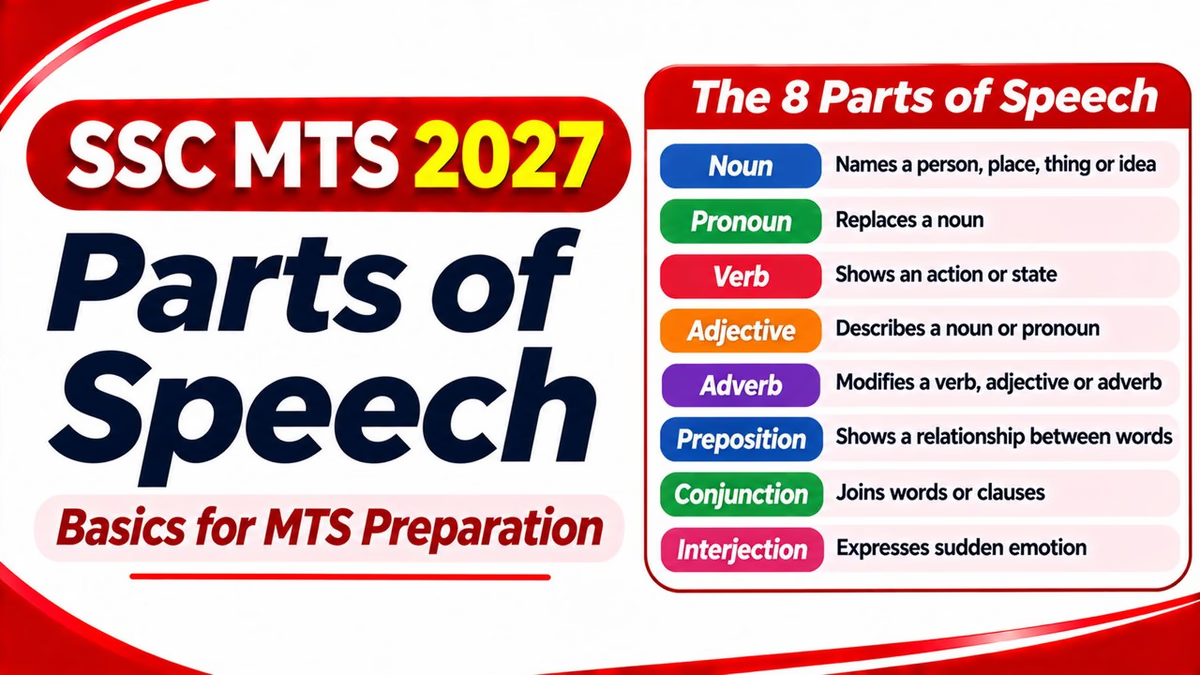
Parts of Speech are categories of words based on their grammatical functions in a sentence. English grammar traditionally recognises eight main Parts of Speech.
| Part of Speech | Function | Example |
|---|---|---|
| Noun | Names a person, place, thing or idea | Teacher |
| Pronoun | Replaces a noun | She |
| Verb | Shows an action or state | Write |
| Adjective | Describes a noun or pronoun | Beautiful |
| Adverb | Modifies a verb, adjective or another adverb | Quickly |
| Preposition | Shows a relationship between words | Under |
| Conjunction | Joins words, phrases or clauses | And |
| Interjection | Expresses sudden emotion | Wow! |
A Noun is a word used to name a person, place, animal, thing or idea.
Examples: Rahul, Mumbai, dog, book, honesty and happiness.
Example: Riya bought a book from the market.
Here, Riya, book and market are nouns because they name a person, thing and place respectively.
A Pronoun is a word used in place of a noun to avoid repetition.
Examples: I, we, you, he, she, it, they, me, him and them.
Example: Amit is a student. He studies every day.
Here, He is a pronoun because it replaces the noun Amit.
A Verb is a word that expresses an action, occurrence or state of being.
Examples: Run, eat, write, sleep, is, am, are, was and were.
Example: The students are preparing for the examination.
Here, are is a helping verb and preparing is the main verb.
An Adjective is a word that describes or gives more information about a noun or pronoun.
Examples: Beautiful, tall, intelligent, five, red and honest.
Example: She purchased a beautiful dress.
Here, beautiful describes the noun dress.
An Adverb modifies a verb, an adjective or another adverb. It often tells us how, when, where or how often an action happens.
Examples: Slowly, quickly, yesterday, here, always and very.
Example: The boy speaks politely.
Here, politely describes how the boy speaks. Therefore, it is an adverb.
A Preposition is a word that shows the relationship of a noun or pronoun with another word in a sentence.
Examples: In, on, at, under, over, between, among, beside, behind and near.
Example: The keys are on the table.
Here, on shows the relationship between the keys and the table.
A Conjunction is a word used to join words, phrases or clauses.
Examples: And, but, or, because, although, since and unless.
Example: I wanted to play, but it was raining.
Here, but connects two contrasting ideas.
An Interjection is a word or short expression used to express sudden feelings or emotions.
Examples: Wow!, Hurrah!, Alas!, Oh!, Ouch! and Bravo!
Example: Wow! That is a beautiful painting.
Here, Wow expresses admiration.
To identify Parts of Speech correctly, understand the function of each word in its sentence. Do not identify a word only by its spelling or appearance because the same word can perform different grammatical functions in different sentences.
Example 1: The intelligent boy speaks politely.
Example 2: She is reading a book in the library.
| Common Mistake | Correct Understanding |
|---|---|
| Confusing adjectives and adverbs | Adjectives describe nouns; adverbs modify verbs, adjectives or adverbs. |
| Identifying every word ending in -ly as an adverb | Some -ly words are adjectives, such as friendly and lovely. |
| Confusing pronouns and possessive determiners | In "my book", my is a possessive determiner; in "the book is mine", mine is a possessive pronoun. |
| Confusing prepositions and conjunctions | Prepositions show relationships; conjunctions connect grammatical elements. |
| Identifying words without reading the sentence | Always check the word's function in context. |
Test your understanding with these 15 practice MCQs. Read each sentence carefully and identify the correct part of speech.
Q1. Identify the noun in the sentence: "The teacher explained the lesson."
A. Explained
B. Teacher
C. Quickly
D. Beautiful
Q2. Which of the following is a pronoun?
A. Quickly
B. Beautiful
C. They
D. School
Q3. Identify the verb in the sentence: "Birds fly in the sky."
A. Birds
B. Fly
C. Sky
D. The
Q4. Identify the adjective: "She has a beautiful dress."
A. She
B. Has
C. Beautiful
D. Quickly
Q5. Identify the adverb: "He runs quickly."
A. He
B. Runs
C. Quickly
D. None
Q6. Which word is a preposition in the sentence: "The cat is under the table"?
A. Cat
B. Is
C. Under
D. Table
Q7. Identify the conjunction: "I was tired but continued working."
A. Tired
B. But
C. Working
D. Continued
Q8. Which of the following is an interjection?
A. Slowly
B. Under
C. Wow!
D. Because
Q9. Identify the abstract noun.
A. Table
B. Honesty
C. Teacher
D. Garden
Q10. Identify the adverb of time: "She arrived yesterday."
A. She
B. Arrived
C. Yesterday
D. None
Q11. In the sentence "This book is mine", the word "mine" is a:
A. Noun
B. Possessive pronoun
C. Adjective
D. Verb
Q12. Identify the adjective in the sentence: "Five students attended the class."
A. Students
B. Attended
C. Five
D. Class
Q13. Which word is a helping verb in the sentence: "She is singing a song"?
A. She
B. Is
C. Singing
D. Song
Q14. Identify the preposition: "The ball is between the chairs."
A. Ball
B. Is
C. Between
D. Chairs
Q15. In the sentence "He speaks very softly", the word "very" is:
A. Noun
B. Adjective
C. Adverb
D. Pronoun
| Question | Correct Answer | Explanation |
|---|---|---|
| 1 | B. Teacher | Teacher names a person. |
| 2 | C. They | They is a personal pronoun. |
| 3 | B. Fly | Fly expresses an action. |
| 4 | C. Beautiful | Beautiful describes the dress. |
| 5 | C. Quickly | Quickly tells how he runs. |
| 6 | C. Under | Under shows the position of the cat. |
| 7 | B. But | But joins contrasting ideas. |
| 8 | C. Wow! | Wow expresses surprise or admiration. |
| 9 | B. Honesty | Honesty names a quality. |
| 10 | C. Yesterday | Yesterday tells when she arrived. |
| 11 | B. Possessive pronoun | Mine indicates ownership and replaces a noun phrase. |
| 12 | C. Five | Five indicates the number of students. |
| 13 | B. Is | Is helps the main verb singing. |
| 14 | C. Between | Between shows the relationship between the ball and chairs. |
| 15 | C. Adverb | Very modifies the adverb softly. |
| Day | Study Topic | Practice Task |
|---|---|---|
| Day 1 | Noun and Pronoun | Identify 20 nouns and pronouns. |
| Day 2 | Verb | Identify main and helping verbs. |
| Day 3 | Adjective | Practise describing words. |
| Day 4 | Adverb | Identify how, when and where. |
| Day 5 | Preposition and Conjunction | Complete sentence-based exercises. |
| Day 6 | Interjection and Revision | Revise all eight categories. |
| Day 7 | Full Practice | Attempt 30 mixed grammar questions. |
Building a strong foundation in English grammar can make sentence understanding and grammar practice easier. Regular revision, vocabulary improvement and solving practice questions can help you develop confidence.
Explore courses and learning resources to strengthen your competitive examination preparation. Take the next step towards your learning goals.
Understanding the eight Parts of Speech is an essential foundation for learning English grammar. Nouns, pronouns, verbs, adjectives, adverbs, prepositions, conjunctions and interjections each perform a different function in a sentence.
For SSC MTS 2027 preparation, revise these concepts regularly, read example sentences and practise identifying words according to their functions. A clear understanding of grammar basics can help you approach more advanced English topics with confidence.
Parts of Speech are categories of words based on their functions in a sentence. The eight traditional categories are noun, pronoun, verb, adjective, adverb, preposition, conjunction and interjection.
English grammar traditionally recognises eight main Parts of Speech.
A noun names a person, place, animal, thing or idea. Examples include teacher, Mumbai, dog, book and honesty.
A noun names someone or something, while a pronoun is used in place of a noun. For example, Rahul is a noun and he is a pronoun.
An adjective describes a noun or pronoun, whereas an adverb modifies a verb, adjective or another adverb.
Look for a word that expresses an action, occurrence or state. Examples include run, write, eat, is and are.
Prepositions show relationships between words. Common examples include in, on, at, under, between and among.
A conjunction joins words, phrases or clauses. Examples include and, but, or, because and although.
Parts of Speech provide a foundation for understanding sentence structure and practising grammar topics such as error identification and sentence correction.
Learn each category, study example sentences, identify word functions and solve mixed grammar MCQs regularly.
