


Download the App & Start Learning
- Expert Faculty Guidance
- Updated Study Material
- Mock Tests & Practice Quiz
- Live Doubt Solving Sessions
- Exam-Oriented Preparation
- Motivation & Success Strategy
Katara Academy

15/11/2026
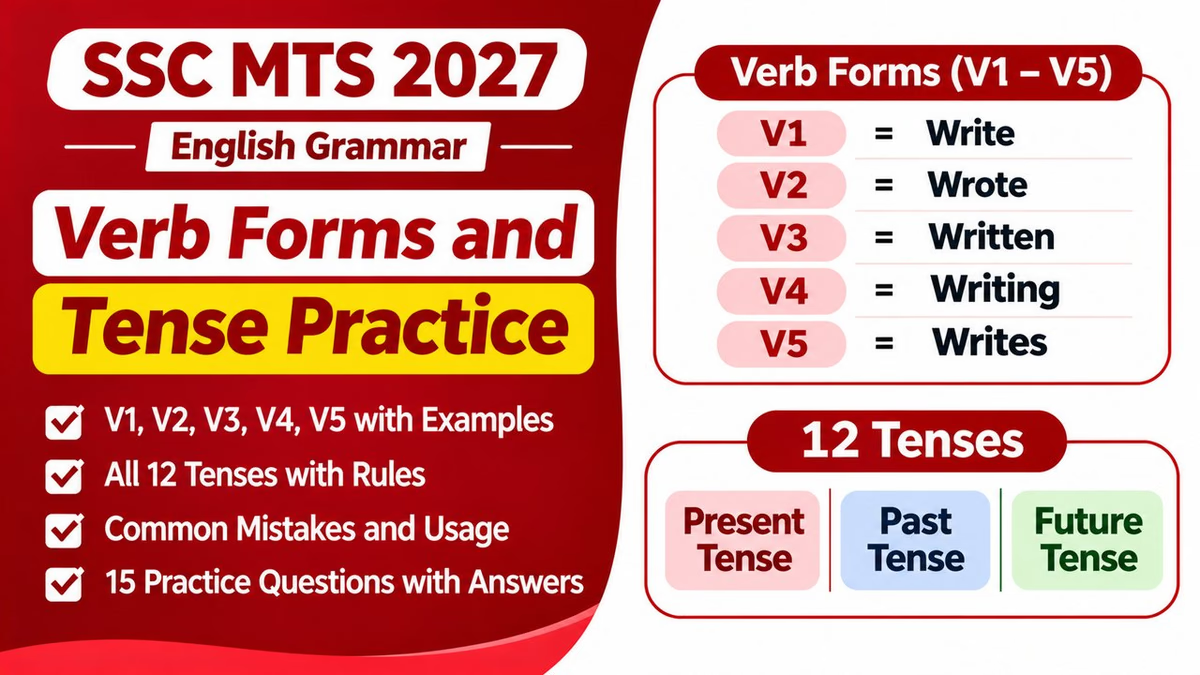
English grammar is an important part of developing strong language skills for competitive examinations. Understanding verb forms and tenses helps candidates identify correct sentence structures, choose appropriate verbs and improve grammar accuracy. For students preparing for SSC MTS 2027, learning these concepts provides a strong foundation for English practice.
In this guide, you will learn V1, V2, V3, V4 and V5 verb forms, the 12 traditional tense structures, important grammar rules, common mistakes and practice questions with answers.
A verb is a word that expresses an action, occurrence or state. Examples include write, read, play, think and understand.
Verb forms are different forms of the same verb used according to grammatical requirements. For example: write, wrote, written, writing and writes.
Tense indicates the time of an action or situation. Traditional English grammar groups tense structures into three main categories:
Each category is traditionally divided into Simple, Continuous, Perfect and Perfect Continuous forms, giving 12 commonly taught tense structures.
Different sentence structures require different forms of a verb. The following table explains the five forms commonly taught in school-level English grammar.
| Form | Meaning | Example |
|---|---|---|
| V1 | Base form | Write |
| V2 | Simple past form | Wrote |
| V3 | Past participle | Written |
| V4 | -ing form | Writing |
| V5 | Third-person singular present form | Writes |
| V1 | V2 | V3 | V4 | V5 |
|---|---|---|---|---|
| Go | Went | Gone | Going | Goes |
| Eat | Ate | Eaten | Eating | Eats |
| Write | Wrote | Written | Writing | Writes |
| Speak | Spoke | Spoken | Speaking | Speaks |
| Take | Took | Taken | Taking | Takes |
| Give | Gave | Given | Giving | Gives |
| See | Saw | Seen | Seeing | Sees |
| Do | Did | Done | Doing | Does |
| Break | Broke | Broken | Breaking | Breaks |
| Study | Studied | Studied | Studying | Studies |
Remember: These five forms are learning labels, not five separate tenses. The correct form depends on the sentence structure and helping verb.
English verbs can be broadly grouped into regular and irregular verbs according to how they form their simple past and past participle forms.
Regular verbs generally form V2 and V3 by adding -ed or -d to the base form.
Irregular verbs do not follow one fixed pattern for forming V2 and V3. Their forms need to be learned individually.
Study tip: Make a separate list of commonly used irregular verbs and revise a few forms every day. Practise using each verb in a sentence instead of memorising only the word list.
Present tense structures describe habits, general truths, ongoing actions and actions connected to the present.
Structure: Subject + V1/V5 + Object.
Use: Daily routines, habits, facts and general truths.
Negative: Subject + do/does + not + V1.
Example: He does not play football.
Question: Do/Does + Subject + V1?
Example: Does she speak English?
Structure: Subject + am/is/are + V4 + Object.
Use: Actions happening now or around the present time.
Structure: Subject + has/have + V3 + Object.
Use: Completed actions connected to the present or experiences without a specified past time.
Structure: Subject + has/have + been + V4 + since/for + time.
Use: Actions that began in the past and continue up to the present, with emphasis on duration.
Remember: Use since for a starting point (since Monday, since 2022) and for for a duration (for two hours, for three days).
Past tense structures describe completed actions, actions in progress in the past and actions completed before another past event.
Structure: Subject + V2 + Object.
Use: Actions completed at a definite time in the past.
Negative: Subject + did not + V1.
Example: She did not attend the class.
Question: Did + Subject + V1?
Example: Did he complete the work?
Structure: Subject + was/were + V4 + Object.
Use: An action that was in progress at a particular time in the past.
Structure: Subject + had + V3 + Object.
Use: An action completed before another past action or time.
Structure: Subject + had been + V4 + since/for + time.
Use: An action that continued for a period before another point or event in the past.
Future tense structures describe actions, plans, predictions and activities expected at a future time.
Structure: Subject + will + V1 + Object.
Use: Predictions, promises, decisions and future actions.
Structure: Subject + will be + V4 + Object.
Use: An action that will be in progress at a particular future time.
Structure: Subject + will have + V3 + Object.
Use: An action expected to be completed before a specified future time.
Structure: Subject + will have been + V4 + since/for + time.
Use: An action that will have continued for a period up to a particular future point.
Use this table to revise the basic affirmative sentence structures. The examples use the verb study.
| Tense | Basic Structure | Example |
|---|---|---|
| Simple Present | Subject + V1/V5 | She studies. |
| Present Continuous | am/is/are + V4 | She is studying. |
| Present Perfect | has/have + V3 | She has studied. |
| Present Perfect Continuous | has/have been + V4 | She has been studying. |
| Simple Past | Subject + V2 | She studied. |
| Past Continuous | was/were + V4 | She was studying. |
| Past Perfect | had + V3 | She had studied. |
| Past Perfect Continuous | had been + V4 | She had been studying. |
| Simple Future | will + V1 | She will study. |
| Future Continuous | will be + V4 | She will be studying. |
| Future Perfect | will have + V3 | She will have studied. |
| Future Perfect Continuous | will have been + V4 | She will have been studying. |
When do, does or did is used as an auxiliary verb in a negative sentence or question, the main verb takes its base form.
In the simple present tense, a singular third-person subject generally takes V5. Plural subjects and I/you take V1.
Example: She has been preparing for the examination for six months.
Did already indicates the past in questions and negatives, so use V1 for the main verb.
Students often make errors by using the wrong verb form or combining helping verbs incorrectly. Review these examples carefully.
| Incorrect Sentence | Correct Sentence |
|---|---|
| He go to school daily. | He goes to school daily. |
| I have saw that movie. | I have seen that movie. |
| She did not went there. | She did not go there. |
| They is playing. | They are playing. |
| He has ate lunch. | He has eaten lunch. |
| She was write a letter. | She was writing a letter. |
| I am knowing the answer. | I know the answer. |
Note: Some verbs describing states, such as know, believe and understand, are not normally used in continuous forms when they express their usual stative meanings.
Use the following steps when solving a tense-based grammar question:
| Expression | Common Use | Example |
|---|---|---|
| Every day | Simple Present | She studies every day. |
| Now | Present Continuous | He is studying now. |
| Yesterday | Simple Past | He studied yesterday. |
| Since morning | Often Perfect Continuous | She has been studying since morning. |
| By tomorrow | Often Future Perfect | She will have finished by tomorrow. |
Important: Time expressions are clues, not automatic tense rules. Always consider the complete meaning and sentence structure.
Attempt these 15 multiple-choice questions to test your understanding. Choose the most appropriate option before checking the answer key.
Q1. Choose the correct form of the verb: She _____ to school every day.
A. go
B. goes
C. going
D. gone
Q2. Choose the correct past form of "write".
A. Writed
B. Written
C. Wrote
D. Writing
Q3. They _____ cricket at the moment.
A. play
B. played
C. are playing
D. have played
Q4. He has _____ his homework.
A. complete
B. completed
C. completing
D. completes
Q5. Did you _____ the answer?
A. knew
B. known
C. know
D. knowing
Q6. Identify the tense: "She was reading a book."
A. Simple Past
B. Past Continuous
C. Past Perfect
D. Present Continuous
Q7. By next week, they _____ the project.
A. complete
B. completed
C. will have completed
D. are completing
Q8. Choose the correct V3 form of "break".
A. Breaked
B. Broke
C. Broken
D. Breaking
Q9. I _____ here since 2021.
A. live
B. lived
C. have lived
D. am live
Q10. When I reached the station, the train _____.
A. leaves
B. has left
C. had left
D. will leave
Q11. Choose the correct sentence.
A. He do not like tea.
B. He does not likes tea.
C. He does not like tea.
D. He not like tea.
Q12. She _____ for two hours before her friend arrived.
A. studies
B. has studied
C. had been studying
D. will study
Q13. Identify the V4 form of "run".
A. Ran
B. Runs
C. Running
D. Run
Q14. At 9 PM tomorrow, I _____ for my examination.
A. studied
B. will be studying
C. have studied
D. study
Q15. Choose the correct sentence.
A. She has went home.
B. She have gone home.
C. She has gone home.
D. She is gone home.
| Question | Correct Answer | Explanation |
|---|---|---|
| 1 | B. Goes | A singular third-person subject takes V5 in the simple present. |
| 2 | C. Wrote | Wrote is the V2 form of write. |
| 3 | C. Are playing | At the moment indicates an action happening now. |
| 4 | B. Completed | Present perfect uses has/have + V3. |
| 5 | C. Know | Did is followed by the base form of the main verb. |
| 6 | B. Past Continuous | Was + V4 forms the past continuous structure. |
| 7 | C. Will have completed | Future perfect uses will have + V3. |
| 8 | C. Broken | Broken is the V3 form of break. |
| 9 | C. Have lived | The sentence describes a situation continuing from 2021 to the present. |
| 10 | C. Had left | The train left before the speaker reached the station. |
| 11 | C. He does not like tea. | Does not is followed by V1. |
| 12 | C. Had been studying | The action continued for a period before another past event. |
| 13 | C. Running | Running is the -ing form (V4) of run. |
| 14 | B. Will be studying | Future continuous describes an action in progress at a future time. |
| 15 | C. She has gone home. | Has is followed by the past participle gone. |
Follow this seven-day plan to revise the important concepts step by step.
| Day | Topic | Practice Task |
|---|---|---|
| Day 1 | V1 to V5 | Learn 20 common verb forms. |
| Day 2 | Regular and Irregular Verbs | Revise 20 additional verbs. |
| Day 3 | Present Tense | Write 12 sentences using four present forms. |
| Day 4 | Past Tense | Practise four past tense structures. |
| Day 5 | Future Tense | Create examples of all four future forms. |
| Day 6 | Grammar Rules and Error Correction | Solve 20 sentence-correction questions. |
| Day 7 | Full Revision | Attempt a mixed grammar quiz and review mistakes. |
Strong English grammar develops through regular learning, revision and question practice. Along with verb forms and tenses, students should practise sentence correction, subject-verb agreement, articles, prepositions and other grammar topics.
Explore the learning resources and courses available at Katara Academy to support your competitive examination preparation.
Build your grammar fundamentals with structured learning and regular practice. Explore courses and take the next step in your preparation.
Verb forms and tenses are fundamental parts of English grammar. Understanding V1, V2, V3, V4 and V5 helps you select the correct verb form, while learning the 12 traditional tense structures helps you understand when and how an action takes place.
For SSC MTS 2027 English preparation, revise the rules regularly, practise irregular verbs, solve grammar-based questions and review every mistake. Consistent practice will help improve your grammar accuracy and confidence.
Verb forms are different forms of a verb used in sentences. The commonly taught forms are V1 (base), V2 (past), V3 (past participle), V4 (-ing form) and V5 (third-person singular present).
V1 is the base form, V2 is the simple past form and V3 is the past participle. For example: Go – Went – Gone.
Traditional school grammar teaches 12 tense structures: four present, four past and four future forms.
V2 is generally used in simple past sentences, while V3 is used in perfect tense structures and passive constructions. For example: "She wrote a letter" and "She has written a letter."
The base form (V1) is used after did when it acts as an auxiliary verb. Example: "Did you go?" not "Did you went?"
Since refers to the starting point of an action, while for refers to its duration. For example: "since Monday" and "for two days."
Learn common regular and irregular verbs, revise tense structures, practise sentence correction and solve multiple-choice grammar questions regularly.
Yes. They help build English grammar fundamentals and support practice in areas such as sentence correction, verb usage and error identification.
