

Download the App & Start Learning
- Expert Faculty Guidance
- Updated Study Material
- Mock Tests & Practice Quiz
- Live Doubt Solving Sessions
- Exam-Oriented Preparation
- Motivation & Success Strategy
Katara Academy

16/11/2026
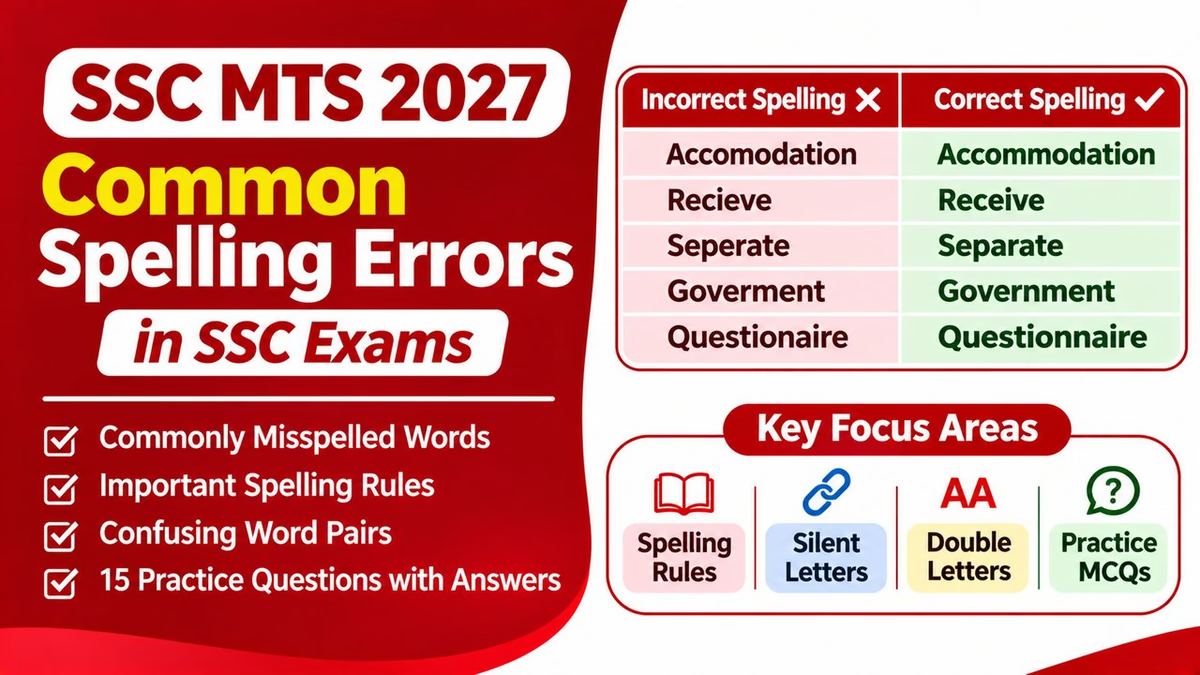
Correct spelling is an important part of English language preparation for competitive examinations. A small spelling mistake can change the appearance of a word and make a sentence incorrect. Students preparing for SSC MTS 2027 should regularly practise commonly confused words, spelling patterns and error-identification questions.
In previous SSC MTS papers, candidates have encountered questions such as identifying incorrectly spelt words, correcting spelling errors in sentences and selecting correctly spelt options. This makes spelling practice a useful part of English grammar and vocabulary revision.
In this guide, you will learn common spelling mistakes, correct word spellings, useful spelling rules, confusing word pairs and 15 practice MCQs with answers and explanations.
Spelling errors occur when a word is written with incorrect letters, missing letters, extra letters or letters in the wrong order.
For example:
In competitive examinations, spelling-based questions may ask you to identify the incorrectly spelt word, select the correct spelling or correct a misspelt word in a sentence.
Learn the following commonly confused spellings. Pay attention to the letters that are frequently omitted, repeated or placed in the wrong order.
| Incorrect Spelling | Correct Spelling |
|---|---|
| Accomodation | Accommodation |
| Acheive | Achieve |
| Beggining | Beginning |
| Calender | Calendar |
| Definately | Definitely |
| Enviroment | Environment |
| Existance | Existence |
| Goverment | Government |
| Independant | Independent |
| Knowlege | Knowledge |
| Maintanance | Maintenance |
| Neccessary | Necessary |
| Occured | Occurred |
| Recieve | Receive |
| Seperate | Separate |
| Succesful | Successful |
| Tommorow | Tomorrow |
| Untill | Until |
| Writting | Writing |
| Questionaire | Questionnaire |
Preparation tip: Do not just read these words. Cover the correct spelling column, write each word from memory and check your mistakes.
English spelling has exceptions, but understanding common spelling patterns can help reduce mistakes.
A commonly taught spelling pattern is that i usually comes before e, except after c in certain words.
Remember: This is a useful pattern, not a universal rule. English has several exceptions, so learn frequently used words individually.
When adding a suffix such as -ing or -ed, some words double their final consonant. This commonly happens when a short stressed vowel is followed by a single consonant.
Compare these examples:
When a consonant comes before the final y, the y often changes to i before adding certain suffixes.
However, when a vowel comes before y, the y is generally retained.
Some English words contain letters that are written but not pronounced. These letters are called silent letters.
| Word | Silent Letter |
|---|---|
| Know | K |
| Write | W |
| Doubt | B |
| Honest | H |
| Listen | T |
| Island | S |
| Climb | B |
Some words contain two identical letters together. Missing one letter or adding an extra letter can make the spelling incorrect.
Some English words sound similar or have similar spellings but different meanings. Understanding their meanings helps you select the correct word in a sentence.
| Word | Meaning | Example |
|---|---|---|
| Accept | To agree or receive | I accept your invitation. |
| Except | Excluding | Everyone came except Ravi. |
| Affect | To influence | Weather can affect travel. |
| Effect | A result or consequence | The medicine had a positive effect. |
| Principal | Head of a school; main | The principal addressed the students. |
| Principle | A basic rule or belief | Honesty is an important principle. |
| Stationary | Not moving | The vehicle remained stationary. |
| Stationery | Writing materials | She bought stationery for school. |
| Their | Belonging to them | Their books are new. |
| There | A place or position | Put the bag there. |
| Lose | To misplace or fail to win | Do not lose your keys. |
| Loose | Not tight | This shirt is loose. |
The following examples illustrate the types of spelling mistakes that students should practise. They are useful study examples, not a prediction of future examination questions.
These patterns help you understand why spelling questions can be challenging. Pay special attention to letter order, silent letters and repeated consonants.
Follow these steps when solving spelling-based multiple-choice questions:
Select the incorrectly spelt word.
Correct Answer: C. Definately
The correct spelling is Definitely.
Students should avoid these common mistakes while preparing for spelling-based questions.
Important: Some words have accepted British and American spelling variations. For example, colour (British English) and color (American English) are both correct. In Indian competitive-exam preparation, be consistent with the spelling convention used in the question and its official answer key.
Attempt the following 15 multiple-choice questions. Choose the correct option before checking the answer key.
Q1. Select the incorrectly spelt word.
A. Calendar
B. Separate
C. Goverment
D. Necessary
Q2. Choose the correct spelling.
A. Accomodation
B. Accommodation
C. Acommodation
D. Accommmodation
Q3. Select the correctly spelt word.
A. Definately
B. Definetely
C. Definitely
D. Definitly
Q4. Identify the incorrectly spelt word.
A. Receive
B. Believe
C. Achieve
D. Recieve
Q5. Choose the correct spelling.
A. Enviroment
B. Environment
C. Envirnoment
D. Environmant
Q6. Select the incorrectly spelt word.
A. Successful
B. Committee
C. Occurred
D. Succesful
Q7. Choose the correct spelling.
A. Questionaire
B. Questionnaire
C. Questionnair
D. Questionnare
Q8. Select the correctly spelt word.
A. Independent
B. Independant
C. Independet
D. Indepandent
Q9. Identify the incorrectly spelt word.
A. Knowledge
B. Honest
C. Listen
D. Knowlege
Q10. Choose the correct spelling.
A. Maintenance
B. Maintainance
C. Maintanance
D. Maintenence
Q11. Select the correctly spelt word.
A. Beginning
B. Beggining
C. Begining
D. Begginning
Q12. Identify the incorrectly spelt word.
A. Calendar
B. February
C. Tommorow
D. Wednesday
Q13. Choose the correct spelling.
A. Efficient
B. Eficient
C. Effecient
D. Efficent
Q14. Select the incorrectly spelt word.
A. Navigation
B. Strengthen
C. Beautiful
D. Naviggetion
Q15. Choose the correctly spelt sentence.
A. The librarian arranged the books in a seperate section.
B. The librarian arranged the books in a separate section.
C. The librerian arranged the books in a separate section.
D. The librarian arranged the books in a separete section.
| Q. | Answer | Explanation |
|---|---|---|
| 1 | C. Goverment | Correct spelling: Government. |
| 2 | B. Accommodation | The word contains double C and double M. |
| 3 | C. Definitely | Definitely is the correct spelling. |
| 4 | D. Recieve | Correct spelling: Receive. |
| 5 | B. Environment | Environment contains the correct letter sequence. |
| 6 | D. Succesful | Correct spelling: Successful, with double C and double S. |
| 7 | B. Questionnaire | Questionnaire is the correct spelling. |
| 8 | A. Independent | Independent ends with -ent, not -ant. |
| 9 | D. Knowlege | Correct spelling: Knowledge. |
| 10 | A. Maintenance | Maintenance is the correct spelling. |
| 11 | A. Beginning | Beginning has double N and one G. |
| 12 | C. Tommorow | Correct spelling: Tomorrow, with one M and double R. |
| 13 | A. Efficient | Efficient has double F and one C. |
| 14 | D. Naviggetion | Correct spelling: Navigation. |
| 15 | B | Librarian and separate are both correctly spelt. |
Follow this seven-day revision plan to improve spelling accuracy through regular practice.
| Day | Topic | Practice Task |
|---|---|---|
| Day 1 | Commonly Misspelled Words | Learn and write 20 words. |
| Day 2 | Double Letters | Practise 15 words with repeated letters. |
| Day 3 | Vowel Combinations | Revise words containing ie and ei. |
| Day 4 | Silent Letters | Learn 15 words with silent letters. |
| Day 5 | Confusing Words | Practise 15 confusing word pairs. |
| Day 6 | Spelling MCQs | Solve 25 spelling-based questions. |
| Day 7 | Full Revision | Take a mixed spelling test and revise mistakes. |
Improving spelling requires more than memorising a list of words. Use these practical methods to build long-term accuracy.
Building strong English vocabulary and spelling accuracy requires consistent practice. Along with spelling correction, students should revise synonyms, antonyms, one-word substitutions, idioms, grammar rules and sentence correction.
Explore the courses and learning resources available at Katara Academy to support your competitive examination preparation.
Strengthen your vocabulary, grammar and exam practice through structured learning resources.
Common spelling errors are an important area to practise while preparing for SSC MTS 2027 English. Learning frequently confused words, understanding spelling patterns and revising difficult spellings can help improve accuracy.
Practise a few words every day, solve spelling-based MCQs and maintain a notebook of your mistakes. Regular revision and careful reading will help you build stronger English vocabulary and spelling skills.
Common spelling errors include missing letters, extra letters, incorrect vowel order, wrong double letters and confusion between similar-sounding words. Examples include separate, receive and accommodation.
Learn commonly misspelled words, maintain a spelling notebook, read English regularly and solve spelling correction MCQs. Revise incorrect answers frequently.
Practise common vowel patterns, double consonants, words ending in y, silent letters and frequently confused spellings. Remember that many English spelling rules have exceptions.
The correct spelling is Separate. Seperate is incorrect.
Accept means to agree to or receive something, whereas except means excluding someone or something.
Some English words require repeated consonants. For example, accommodation has double C and double M, while successful has double C and double S.
Practise identifying incorrectly spelt words, correcting words in sentences, selecting correctly spelt options and reviewing previous-year examination questions.
Yes. Spelling practice helps develop vocabulary and accuracy. Previous SSC MTS papers have included spelling-identification and spelling-correction question formats.
