

Download the App & Start Learning
- Expert Faculty Guidance
- Updated Study Material
- Mock Tests & Practice Quiz
- Live Doubt Solving Sessions
- Exam-Oriented Preparation
- Motivation & Success Strategy
Katara Academy

16/11/2026
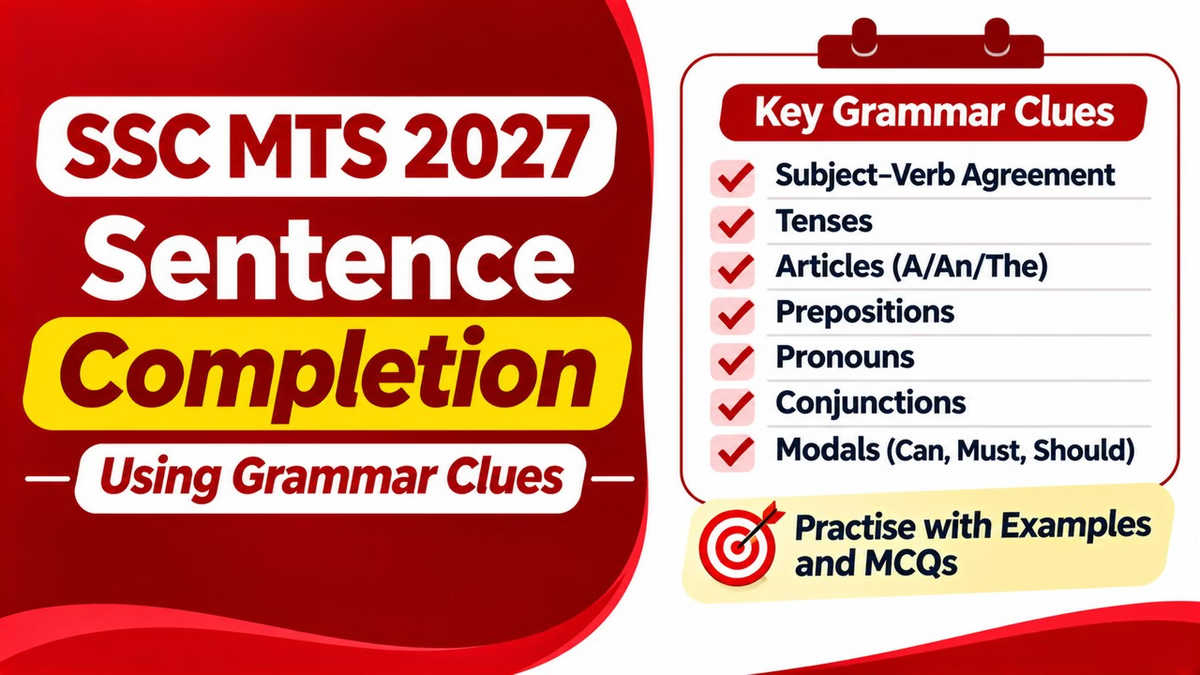
Sentence completion is an important English practice area for students preparing for competitive examinations such as SSC MTS 2027. These questions test a candidate's understanding of grammar, vocabulary, sentence structure and contextual meaning.
In a sentence-completion question, a word or phrase is missing from a sentence. Candidates must select the most suitable option to make the sentence grammatically correct and meaningful. Instead of guessing the answer, students can use grammar clues to eliminate incorrect options and identify the correct answer.
This guide explains how to solve sentence completion questions using grammar clues, with rules, examples, common mistakes and practice MCQs for SSC MTS 2027 preparation.
Sentence completion is a type of English question in which one or more words are missing from a sentence. The candidate has to choose the correct word or phrase from the given options.
The correct answer must satisfy two important conditions:
Example:
She _____ to school every day.
Correct Answer: B. goes
Grammar clue: The subject "She" is third-person singular, and the sentence describes a daily routine. Therefore, the simple present tense requires "goes".
Grammar clues help you identify which type of word is required in a blank. The following rules are useful for solving sentence-completion questions.
A verb must agree with its subject in number and person. A singular subject generally takes a singular verb, while a plural subject takes a plural verb.
Examples:
Answers: plays, are, lives.
Clue: First identify the subject. Then check whether it is singular or plural before selecting the verb.
Time expressions and the context of a sentence help identify the correct tense.
| Time Clue | Common Tense | Example |
|---|---|---|
| Every day | Simple Present | She walks every day. |
| Yesterday | Simple Past | He visited us yesterday. |
| Tomorrow | Future | They will travel tomorrow. |
| Since 2020 | Often Present Perfect or Present Perfect Continuous | She has lived here since 2020. |
Example: They _____ the match yesterday.
Correct Answer: C. won
Grammar clue: "Yesterday" indicates a completed action in the past.
Articles are used before nouns. Choosing the correct article depends on the sound of the following word and whether the noun is specific.
Examples:
Answers: an, an, The.
Clue: Pay attention to pronunciation, not just the first letter of the word.
Prepositions show relationships involving time, place, direction and position. Some words are commonly used with specific prepositions.
| Preposition | Common Usage | Example |
|---|---|---|
| At | Specific time | At 6 o'clock |
| On | Days and dates | On Monday |
| In | Months, years and longer periods | In January |
| Since | Starting point of time | Since Monday |
| For | Duration | For two hours |
Example: The train arrived _____ 8:30 a.m.
Correct Answer: C. at
A pronoun replaces a noun. It should agree with the noun it refers to in person and number.
Examples:
Answers: She, their, our.
Clue: Identify the noun or person being referred to before choosing the pronoun.
The blank may require a noun, verb, adjective or adverb. Check the words around the blank to identify the required part of speech.
| Required Word | Grammar Clue | Example |
|---|---|---|
| Noun | Often follows an article or adjective | She bought a _____. |
| Verb | Expresses an action or state | They _____ football. |
| Adjective | Describes a noun | It is a _____ day. |
| Adverb | Often describes a verb | She speaks _____. |
Example: The children played _____ in the park.
Correct Answer: B. happily
Grammar clue: The blank describes how the children played. An adverb is required.
Conjunctions connect words, phrases or clauses. The meaning of the sentence helps identify the correct conjunction.
Example: He was tired, _____ he continued working.
Correct Answer: B. but
Grammar clue: The sentence shows a contrast between being tired and continuing to work.
Modal verbs express ability, possibility, permission, advice or obligation. Common modals include can, could, may, might, must, should and would.
Examples:
Answers: must, May, could.
Clue: Understand the purpose of the sentence: ability, permission, advice or necessity.
Follow this method to solve sentence-completion questions accurately:
| Clue | What to Check |
|---|---|
| Subject | Singular or plural subject |
| Time expression | Present, past or future tense |
| Article | A, an or the |
| Preposition | Time, place or word combinations |
| Pronoun | Noun reference and agreement |
| Conjunction | Relationship between ideas |
| Modal | Ability, permission, advice or necessity |
| Parts of speech | Noun, verb, adjective or adverb |
Try the following 15 practice questions. Select the most appropriate option for each sentence.
Q1. My father _____ to the office every morning.
Q2. The children _____ playing in the garden when it started raining.
Q3. She has been studying _____ two hours.
Q4. He is _____ honest person.
Q5. The teacher asked the students to complete _____ assignments.
Q6. She speaks English very _____.
Q7. I will call you _____ I reach home.
Q8. You _____ wear a helmet while riding a two-wheeler.
Q9. Neither of the two boys _____ present yesterday.
Q10. The train arrived _____ the station on time.
Q11. If you work hard, you _____ succeed.
Q12. The book _____ is lying on the table belongs to me.
Q13. He was ill, _____ he attended the meeting.
Q14. She is interested _____ learning new languages.
Q15. By the time we reached the cinema, the movie _____.
| Question | Answer | Grammar Clue |
|---|---|---|
| 1 | B. goes | Singular subject "father" takes "goes" in the simple present. |
| 2 | C. were | Plural subject "children" takes "were" in the past continuous. |
| 3 | B. for | "For" indicates a duration of two hours. |
| 4 | B. an | "Honest" begins with a vowel sound. |
| 5 | C. their | "Their" refers to the plural noun "students". |
| 6 | B. well | The adverb "well" describes how she speaks. |
| 7 | A. when | "When" introduces the time of the call. |
| 8 | A. must | "Must" expresses a strong obligation. |
| 9 | C. was | "Neither" is singular in this construction and takes "was". |
| 10 | A. at | "Arrive at" is used with a specific place such as a station. |
| 11 | A. will | The first conditional uses present simple in the if-clause and will + base verb in the main clause. |
| 12 | B. which | "Which" refers to the thing, "the book". |
| 13 | B. but | "But" expresses contrast between illness and attending the meeting. |
| 14 | C. in | The correct expression is "interested in". |
| 15 | C. had started | Past perfect describes the earlier of two past actions. |
| Day | Topic | Practice Task |
|---|---|---|
| Day 1 | Subject–Verb Agreement | Solve 15 questions. |
| Day 2 | Tenses | Practise 15 questions using time clues. |
| Day 3 | Articles and Prepositions | Solve 20 fill-in-the-blank questions. |
| Day 4 | Pronouns and Parts of Speech | Practise 15 mixed questions. |
| Day 5 | Conjunctions and Modals | Solve 20 questions. |
| Day 6 | Mixed Sentence Completion | Attempt 25 questions with a timer. |
| Day 7 | Revision and Mock Practice | Review mistakes and attempt a short test. |
Consistent practice and a clear understanding of English grammar can help you improve your performance in competitive examinations. Focus on the rules, practise different question types and review your mistakes regularly.
Explore learning resources and courses at Katara Academy to support your competitive exam preparation.
Explore Courses at Katara Academy
Sentence completion using grammar clues is a useful skill for SSC MTS 2027 English preparation. By understanding subject–verb agreement, tenses, articles, prepositions, pronouns, conjunctions and parts of speech, candidates can approach fill-in-the-blank questions more systematically.
Practise regularly, understand why an option is correct and revise the grammar rules behind your mistakes. This approach can help improve both accuracy and confidence in English questions.
Sentence completion is a question type in which a missing word or phrase must be selected to make a sentence grammatically correct and meaningful.
Read the complete sentence, identify the subject and tense, check the words around the blank, eliminate grammatically incorrect options and select the word that fits the meaning.
Important topics include subject–verb agreement, tenses, articles, prepositions, pronouns, conjunctions, modals and parts of speech.
Time expressions such as yesterday, every day, since and tomorrow can indicate which tense is suitable for the sentence.
An adjective describes a noun or pronoun, while an adverb commonly describes a verb, adjective or another adverb. The surrounding words help identify which form is required.
Revise grammar rules, practise mixed questions, learn common preposition combinations and review every incorrect answer to understand the reason behind the mistake.
Yes. Sentence-completion practice helps candidates strengthen grammar, vocabulary and sentence structure skills that are useful for English-language preparation.
Start with 10–15 questions daily and gradually increase the number as your accuracy improves. Review the explanations instead of focusing only on the number of questions attempted.