

Download the App & Start Learning
- Expert Faculty Guidance
- Updated Study Material
- Mock Tests & Practice Quiz
- Live Doubt Solving Sessions
- Exam-Oriented Preparation
- Motivation & Success Strategy
Katara Academy

16/11/2026
Synonyms are an important part of English vocabulary preparation for competitive examinations such as SSC MTS 2027. A strong vocabulary helps candidates understand word meanings, identify similar words and solve questions more confidently.
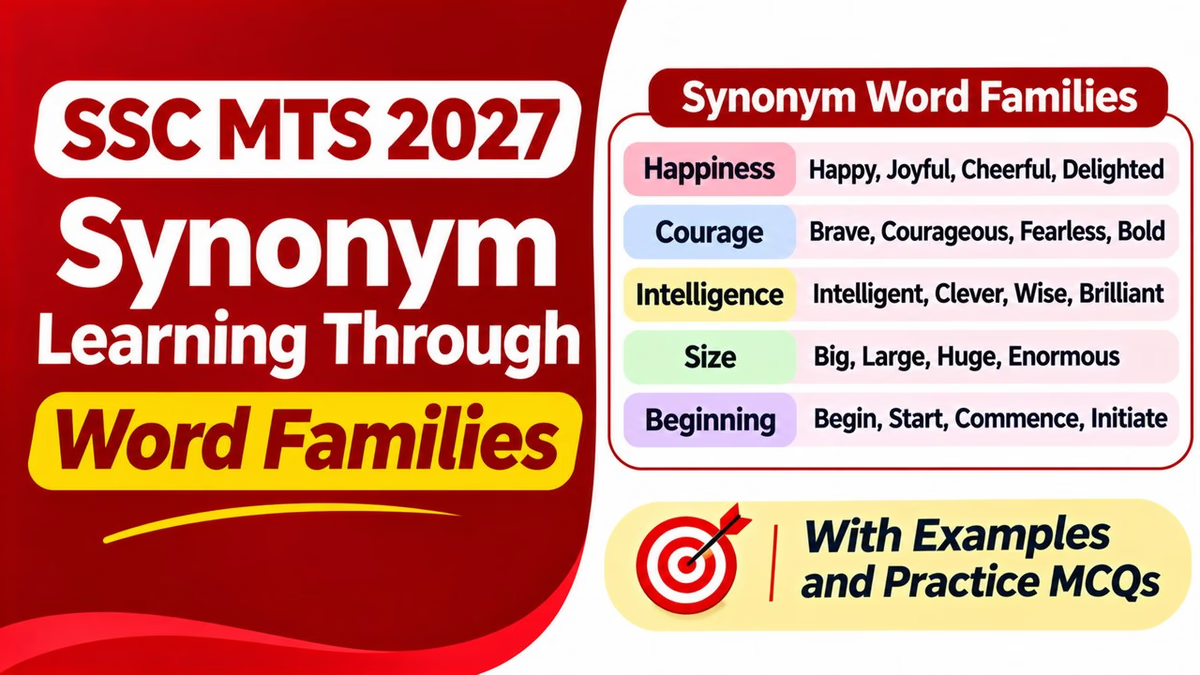
One effective way to learn synonyms is through word families. Instead of memorising individual words separately, students can group words with similar meanings and learn them together. For example, words such as happy, joyful, cheerful and delighted belong to a related meaning group.
This method makes vocabulary learning more organised and helps students remember related words through meaning, context and usage. In this guide, you will learn how to study synonyms through word families, understand important vocabulary groups and practise 15 MCQs for SSC MTS 2027.
Synonyms are words that have the same or nearly the same meaning as another word. They help avoid repetition and make communication more effective.
Examples:
| Word | Synonyms |
|---|---|
| Happy | Joyful, cheerful, delighted |
| Big | Large, huge, enormous |
| Begin | Start, commence, initiate |
| Brave | Courageous, fearless, bold |
| Quick | Fast, rapid, swift |
Important: Synonyms may have similar meanings but are not always interchangeable in every sentence. Context and usage matter.
A word family is a group of words connected through a common root, related form or meaning. When learning synonyms, students can organise words into meaning-based groups to remember several related words together.
Example: Happiness Word Family
These words belong to a similar meaning group. Learning them together helps students build connections between vocabulary words.
Note: A synonym group is a meaning-based vocabulary group. It is different from a morphological word family, which contains words formed from the same root, such as happy, happiness and happily.
The following vocabulary groups are useful for building English vocabulary. Learn the meanings and observe how each word is used.
| Word | Synonyms | Meaning |
|---|---|---|
| Happy | Glad, joyful | Feeling pleased |
| Cheerful | Merry, upbeat | Positive and happy |
| Delighted | Thrilled, pleased | Extremely pleased |
| Content | Satisfied, fulfilled | Feeling satisfied |
| Word | Synonyms | Meaning |
|---|---|---|
| Sad | Unhappy, sorrowful | Feeling unhappy |
| Miserable | Wretched, unhappy | Extremely unhappy |
| Grief | Sorrow, anguish | Deep sadness |
| Depressed | Dejected, downcast | Feeling very low |
| Word | Synonyms | Meaning |
|---|---|---|
| Brave | Courageous, bold | Showing courage |
| Fearless | Dauntless, intrepid | Without fear |
| Cowardly | Timid, fearful | Lacking courage |
| Afraid | Scared, frightened | Feeling fear |
| Word | Synonyms | Meaning |
|---|---|---|
| Intelligent | Clever, smart | Having good understanding |
| Wise | Sensible, prudent | Showing good judgement |
| Knowledgeable | Informed, learned | Having knowledge |
| Brilliant | Exceptional, outstanding | Exceptionally talented or intelligent |
| Word | Synonyms | Meaning |
|---|---|---|
| Quick | Fast, swift | Moving or happening rapidly |
| Rapid | Speedy, swift | Happening very quickly |
| Slow | Sluggish, unhurried | Moving without speed |
| Hasty | Rushed, hurried | Done too quickly |
| Word | Synonyms | Meaning |
|---|---|---|
| Big | Large, huge | Of great size |
| Enormous | Immense, gigantic | Extremely large |
| Small | Tiny, little | Of limited size |
| Minute | Tiny, microscopic | Extremely small |
| Word | Synonyms | Meaning |
|---|---|---|
| Begin | Start, commence | To start something |
| Initiate | Launch, commence | To cause something to begin |
| End | Finish, conclude | To bring something to a close |
| Terminate | Cease, discontinue | To bring something to an end |
| Word | Synonyms | Meaning |
|---|---|---|
| Honest | Truthful, sincere | Telling the truth |
| Genuine | Authentic, real | Actually what it claims to be |
| Deceitful | Dishonest, fraudulent | Intended to mislead |
| False | Untrue, incorrect | Not true |
Follow these simple steps to make vocabulary learning more effective:
Example:
Base Word: Brave
Learning these words together helps you understand their similarities and differences.
Choose the option that is closest in meaning to the given word.
Q1. Choose the synonym of HAPPY.
Q2. Choose the synonym of BRAVE.
Q3. Choose the synonym of RAPID.
Q4. Choose the synonym of ENORMOUS.
Q5. Choose the synonym of BEGIN.
Q6. Choose the synonym of INTELLIGENT.
Q7. Choose the synonym of SAD.
Q8. Choose the synonym of HONEST.
Q9. Choose the synonym of ANCIENT.
Q10. Choose the synonym of ASSIST.
Q11. Choose the synonym of DELIGHTED.
Q12. Choose the synonym of ABANDON.
Q13. Choose the synonym of GENEROUS.
Q14. Choose the synonym of CONCLUDE.
Q15. Choose the synonym of FRAGILE.
| Question | Answer | Explanation |
|---|---|---|
| 1 | B. Joyful | Joyful means feeling great happiness. |
| 2 | C. Courageous | Courageous means showing bravery. |
| 3 | B. Swift | Swift means moving or happening quickly. |
| 4 | C. Immense | Immense means extremely large. |
| 5 | B. Commence | Commence means to begin. |
| 6 | B. Clever | Clever means quick to understand or learn. |
| 7 | B. Sorrowful | Sorrowful means feeling sadness. |
| 8 | A. Truthful | Truthful means honest and sincere. |
| 9 | C. Old | Ancient refers to something from a very long time ago. |
| 10 | B. Help | Assist means to help someone. |
| 11 | A. Pleased | Delighted means extremely pleased. |
| 12 | B. Leave | Abandon means to leave something or someone behind. |
| 13 | C. Charitable | Charitable describes someone willing to give or help others. |
| 14 | C. Finish | Conclude means to bring something to an end. |
| 15 | B. Delicate | Fragile means easily broken or damaged. |
| Day | Topic | Practice Task |
|---|---|---|
| Day 1 | Happiness and Sadness | Learn 10 related words and their meanings. |
| Day 2 | Courage and Fear | Create two word groups and write examples. |
| Day 3 | Intelligence and Knowledge | Revise 10 synonyms. |
| Day 4 | Speed and Movement | Practise 15 vocabulary questions. |
| Day 5 | Size and Quantity | Learn 10 words with example sentences. |
| Day 6 | Beginning, Ending and Truth | Revise all previous word groups. |
| Day 7 | Mixed Synonym Practice | Attempt a timed vocabulary test. |
Building a strong English vocabulary requires regular learning and revision. Understanding synonyms through word families can make vocabulary practice more organised and help you remember related words effectively.
Explore learning resources and courses at Katara Academy to support your competitive examination preparation.
Explore Courses at Katara Academy
Learning synonyms through word families is a practical way to develop English vocabulary for SSC MTS 2027. By grouping related words, understanding their meanings and using them in sentences, students can improve vocabulary retention and word usage.
Practise regularly, revise previously learned words and solve vocabulary MCQs to strengthen your preparation. A consistent learning routine can help you become more confident in English vocabulary questions.
Synonyms are words that have the same or nearly the same meaning as another word. For example, happy and joyful have similar meanings.
Word families are groups of words connected through a common root, related form or meaning. Meaning-based groups help learners study related synonyms together.
Choose a base word, identify related synonyms, understand their meanings, organise them into groups and practise using them in sentences.
Synonym practice helps candidates develop vocabulary and understand similar word meanings, which are useful skills for English-language preparation.
No. Synonyms may have similar meanings but can differ in intensity, context, tone and usage. Always check whether a word fits the sentence.
Start with five to ten new words daily. Focus on understanding and revising them rather than memorising a large number without practice.
Synonyms are words with similar meanings, whereas antonyms are words with opposite meanings. For example, happy and joyful are synonyms, while happy and sad are antonyms.
Group related words, write simple meanings, create example sentences and revise vocabulary at regular intervals. Practising MCQs also helps strengthen recall.
