
Download the App & Start Learning
- Expert Faculty Guidance
- Updated Study Material
- Mock Tests & Practice Quiz
- Live Doubt Solving Sessions
- Exam-Oriented Preparation
- Motivation & Success Strategy
Katara Academy

16/11/2026
Antonyms are an important part of English vocabulary preparation for competitive examinations such as SSC MTS 2027. These questions test a candidate's ability to understand word meanings and identify words with opposite meanings.
Simply memorising opposite words may not always be enough. A word can have different meanings depending on the sentence in which it is used. Therefore, learning antonyms through contextual examples helps students understand how opposite words work in real situations.
In this guide, you will learn important antonym groups, understand how to identify opposites using sentence context, explore common vocabulary mistakes and practise 15 MCQs with answers and explanations for SSC MTS 2027.
Antonyms are words that have opposite or contrasting meanings. They are useful for understanding vocabulary, comparing ideas and expressing differences.
Examples:
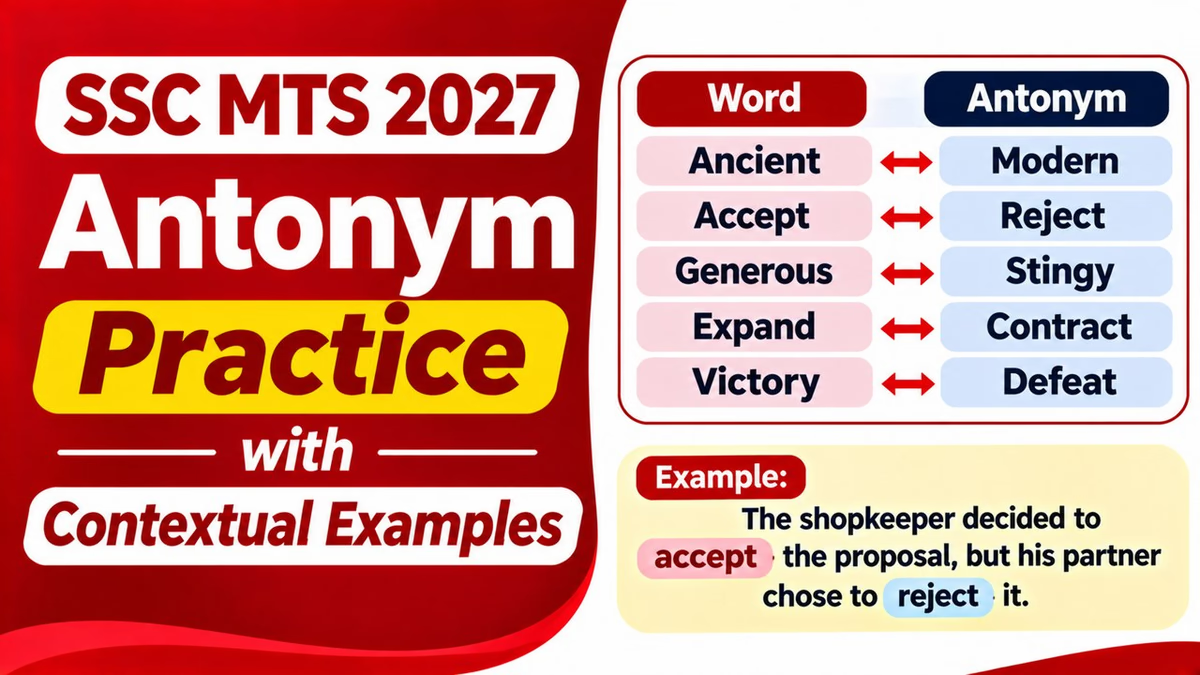
| Word | Antonym |
|---|---|
| Accept | Reject |
| Ancient | Modern |
| Brave | Cowardly |
| Expand | Contract |
| Generous | Stingy |
Example in a sentence:
The road was wide, but the street behind the building was narrow.
Explanation: Wide and narrow express opposite meanings related to width.
Contextual examples show how a word is used in a sentence and help identify its correct opposite according to the meaning.
Example:
The manager decided to accept the proposal.
Opposite: Reject
Contextual sentence: The manager decided to reject the proposal because it did not meet the requirements.
Study the following opposite-word groups with their meanings and contextual examples. These are useful vocabulary practice words, not a prediction of specific examination questions.
| Word | Antonym | Contextual Example |
|---|---|---|
| Honest | Dishonest | An honest person tells the truth, while a dishonest person may deceive others. |
| Generous | Stingy | A generous person shares resources, while a stingy person is unwilling to give. |
| Polite | Rude | The polite student spoke respectfully, but the rude student interrupted others. |
| Brave | Cowardly | The brave soldier faced danger, while the cowardly person avoided it. |
| Humble | Arrogant | Despite his success, he remained humble rather than arrogant. |
| Word | Antonym | Contextual Example |
|---|---|---|
| Huge | Tiny | The huge building stood beside a tiny house. |
| Wide | Narrow | The main road is wide, but the lane is narrow. |
| Abundant | Scarce | Water was abundant during the rainy season but scarce in summer. |
| Maximum | Minimum | The maximum limit is 100, while the minimum requirement is 40. |
| Deep | Shallow | The lake is deep near the centre but shallow near the shore. |
| Word | Antonym | Contextual Example |
|---|---|---|
| Ancient | Modern | The museum displays ancient coins alongside modern currency. |
| Temporary | Permanent | The temporary arrangement was later replaced by a permanent one. |
| Early | Late | She arrived early, while her friend arrived late. |
| Fresh | Stale | The bakery sells fresh bread, not stale bread. |
| Word | Antonym | Contextual Example |
|---|---|---|
| Accept | Reject | She accepted the invitation, but he rejected it. |
| Expand | Contract | Metal expands when heated and contracts when cooled. |
| Arrive | Depart | The train will arrive at noon and depart in the evening. |
| Include | Exclude | The list includes all students but excludes visitors. |
| Increase | Decrease | Prices increased last month but decreased this month. |
| Word | Antonym | Contextual Example |
|---|---|---|
| Optimistic | Pessimistic | An optimistic person expects good results, while a pessimistic person expects bad results. |
| Calm | Agitated | She remained calm during the discussion, while he became agitated. |
| Victory | Defeat | The team celebrated its victory after accepting the possibility of defeat. |
| Artificial | Natural | The garden contains natural flowers and artificial decorations. |
Sometimes a word may have more than one opposite depending on its meaning. Use the sentence to identify the correct sense before selecting an answer.
Do not select an antonym by looking at the target word alone. Read the surrounding words to understand the situation.
Determine how the word is being used in the sentence.
Think of a word that expresses the opposite idea in that particular context.
Remove options that are similar in meaning, unrelated or unsuitable for the sentence.
Check whether the selected antonym fits the sentence naturally and preserves the intended contrast.
Example:
The shopkeeper decided to reduce the price of the product.
Correct Answer: C. Increase
Explanation: Reduce means to make something smaller or lower. Increase means to make something greater, so it is the opposite.
Choose the option that is opposite in meaning to the given word. Read each question carefully and consider the word's meaning.
Q1. Choose the antonym of GENEROUS.
Q2. Choose the antonym of ANCIENT.
Q3. Choose the antonym of EXPAND.
Q4. Choose the antonym of HUMBLE.
Q5. Choose the antonym of SCARCE.
Q6. Choose the antonym of ACCEPT.
Q7. Choose the antonym of OPTIMISTIC.
Q8. Choose the antonym of TEMPORARY.
Q9. Choose the antonym of VICTORY.
Q10. Choose the antonym of POLITE.
Q11. Choose the antonym of INCLUDE.
Q12. Choose the antonym of DECREASE.
Q13. Choose the antonym of FRAGILE.
Q14. Choose the antonym of CALM.
Q15. Choose the antonym of ARTIFICIAL.
| Question | Answer | Explanation |
|---|---|---|
| 1 | C. Stingy | Generous means willing to give; stingy means unwilling to give or spend. |
| 2 | C. Modern | Ancient refers to the distant past, while modern refers to the present or recent times. |
| 3 | C. Contract | Expand means to become larger; contract means to become smaller. |
| 4 | B. Arrogant | Humble means modest, while arrogant means having an exaggerated sense of importance. |
| 5 | C. Abundant | Scarce means insufficient or limited; abundant means available in large quantities. |
| 6 | D. Reject | Accept means to agree to receive or take something; reject means to refuse it. |
| 7 | C. Pessimistic | Optimistic means expecting good results; pessimistic means expecting negative results. |
| 8 | C. Permanent | Temporary means lasting for a limited time; permanent means lasting indefinitely or for a very long time. |
| 9 | D. Defeat | Victory means winning; defeat means losing. |
| 10 | C. Rude | Polite means showing good manners; rude means behaving disrespectfully. |
| 11 | C. Exclude | Include means to make something part of a group; exclude means to leave it out. |
| 12 | D. Increase | Decrease means to become less; increase means to become more. |
| 13 | C. Sturdy | Fragile means easily damaged; sturdy means strong and well-built. |
| 14 | D. Agitated | Calm means peaceful and relaxed; agitated means disturbed or excited. |
| 15 | D. Natural | Artificial means made by humans; natural means existing in or produced by nature. |
| Day | Topic | Practice Task |
|---|---|---|
| Day 1 | Positive and Negative Qualities | Learn 10 opposite-word pairs with examples. |
| Day 2 | Size and Quantity | Practise 15 antonym questions. |
| Day 3 | Time and Age | Learn 10 word pairs and write sentences. |
| Day 4 | Actions and Movement | Solve 15 contextual vocabulary questions. |
| Day 5 | Emotions and Conditions | Revise opposite words with example sentences. |
| Day 6 | Mixed Antonym Practice | Attempt 20 mixed MCQs. |
| Day 7 | Revision and Self-Test | Take a timed test and review incorrect answers. |
Improving English vocabulary requires regular practice, revision and a clear understanding of word meanings. Learning antonyms through contextual examples can help you recognise opposite meanings and use vocabulary more effectively.
Explore learning resources and courses at Katara Academy to support your competitive examination preparation.
Explore Courses at Katara Academy
Antonym practice with contextual examples is a useful way to strengthen English vocabulary for SSC MTS 2027. By understanding words in sentences, learning opposite-word groups and practising MCQs, students can improve their ability to identify contrasting meanings.
Focus on understanding rather than memorising. Revise regularly, use new words in sentences and analyse your mistakes to build a stronger vocabulary.
Antonyms are words with opposite or contrasting meanings. For example, accept and reject, ancient and modern, and victory and defeat.
Contextual examples help you understand the exact meaning of a word and identify its appropriate opposite in a sentence.
Synonyms have similar meanings, whereas antonyms have opposite meanings. For example, happy and joyful are synonyms, while happy and sad are antonyms.
Read the complete question, understand the target word in context, identify its opposite meaning and eliminate options that do not fit.
Start by learning five to ten opposite-word pairs daily. Focus on their meanings, sentence usage and regular revision.
Yes. Antonym practice develops vocabulary and helps candidates understand contrasting word meanings, which are useful skills for English preparation.
Yes. A word can have different antonyms depending on its meaning and context. For example, light can mean not heavy or bright, and its opposite changes according to the intended meaning.
Learn opposite-word pairs by topic, use them in sentences, practise MCQs and revise difficult words regularly.