



Download the App & Start Learning
- Expert Faculty Guidance
- Updated Study Material
- Mock Tests & Practice Quiz
- Live Doubt Solving Sessions
- Exam-Oriented Preparation
- Motivation & Success Strategy
Katara Academy

18/11/2026
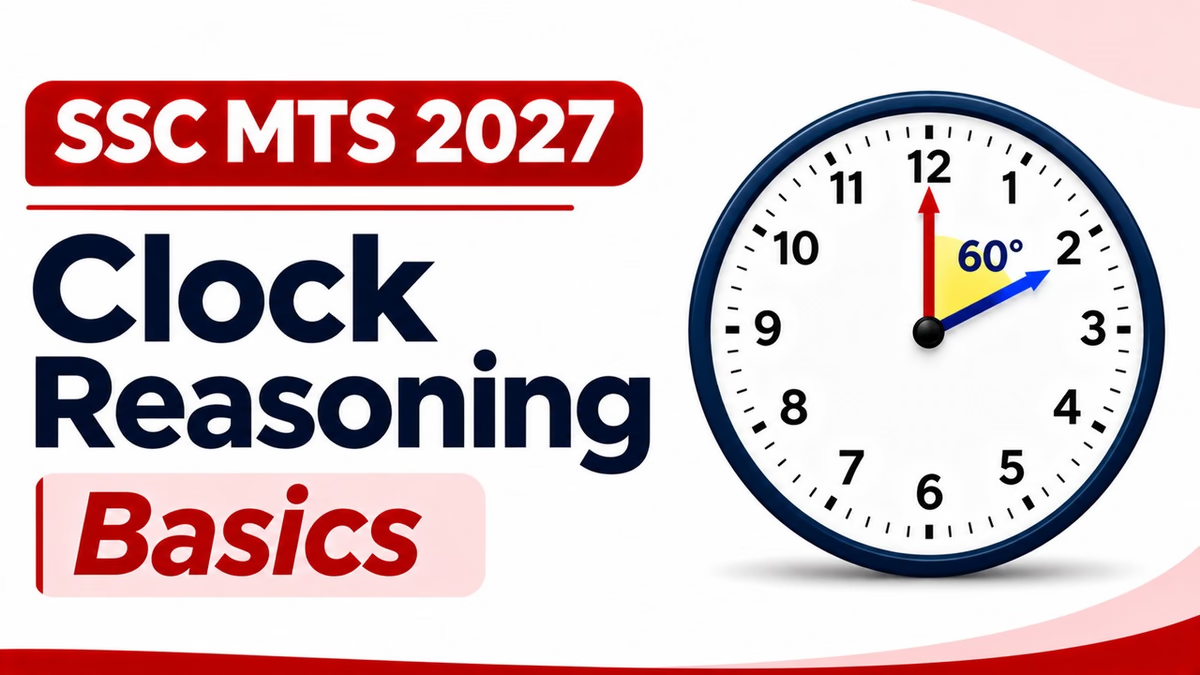
Clock reasoning is an important topic in logical reasoning and aptitude preparation. It involves understanding the movement of the hour hand and minute hand, calculating angles between them and identifying their positions at different times.
For beginners preparing for SSC MTS 2027, clock reasoning becomes easier when the basic concepts and formulas are understood properly. You do not need to memorise complicated tricks. Learning how clock hands move and practising simple angle calculations can help you solve different types of questions.
Clock reasoning is a topic in which questions are based on the movement and position of the hour hand and minute hand.
Common question types include:
A standard clock has 12 numbers, from 1 to 12, arranged in a circular pattern. It has two main hands:
A complete circle contains 360 degrees. Since the clock has 12 equal divisions, the angle between two consecutive numbers is:
360° ÷ 12 = 30°
Therefore, each movement from one number to the next represents 30 degrees for the hour hand.
Understanding the speed of both hands is essential for solving clock reasoning questions.
| Clock Hand | Movement | Speed |
|---|---|---|
| Minute Hand | 360° in 60 minutes | 6° per minute |
| Hour Hand | 360° in 12 hours | 30° per hour |
| Hour Hand | 30° in 60 minutes | 0.5° per minute |
Important: The minute hand moves faster than the hour hand. The relative speed between them is 5.5 degrees per minute.
Formula 1: Angle Covered by the Minute Hand
Angle = 6 × Minutes
Formula 2: Angle Covered by the Hour Hand
Angle = 30 × Hours + 0.5 × Minutes
Formula 3: Angle Between Both Hands
θ = |30H − 5.5M|
Here:
Formula 4: Smaller Angle Between the Hands
First calculate θ using the angle formula. If θ is greater than 180°, subtract it from 360° to obtain the smaller angle.
Smaller Angle = Minimum of (θ, 360° − θ)
Use the hour value from 1 to 11 and the minute value from 0 to 59. For 12 o'clock, use H = 0 when applying the formula.
Some angles appear frequently in clock reasoning questions. Remember these basic angle types:
| Angle | Measurement | Type |
|---|---|---|
| 0° | 0 degrees | Zero Angle |
| 90° | 90 degrees | Right Angle |
| 180° | 180 degrees | Straight Angle |
| 270° | 270 degrees | Reflex Angle |
| 360° | 360 degrees | Complete Angle |
Follow these steps to calculate the angle between the hour hand and minute hand:
Example 1: Find the Angle at 3:00
Question: What is the angle between the hour hand and minute hand at 3:00?
Solution:
H = 3 and M = 0
θ = |30 × 3 − 5.5 × 0|
θ = |90 − 0| = 90°
Answer: 90 degrees.
Example 2: Find the Angle at 6:00
Question: What is the angle between the two hands at 6:00?
Solution:
θ = |30 × 6 − 5.5 × 0|
θ = 180°
Answer: 180 degrees.
Example 3: Find the Angle at 2:30
Question: Calculate the angle between the clock hands at 2:30.
Solution:
H = 2 and M = 30
θ = |30 × 2 − 5.5 × 30|
θ = |60 − 165|
θ = 105°
Answer: 105 degrees.
Example 4: Find the Angle at 4:20
Question: What is the smaller angle between the clock hands at 4:20?
Solution:
θ = |30 × 4 − 5.5 × 20|
θ = |120 − 110|
θ = 10°
Answer: 10 degrees.
Example 5: Calculate Minute-Hand Movement
Question: How many degrees does the minute hand move in 25 minutes?
Solution:
Angle = 6 × 25 = 150°
Answer: 150 degrees.
Attempt these 15 beginner-friendly MCQs to test your understanding of clock angles and hand movements.
Q1. How many degrees does the minute hand move in 20 minutes?
A) 60°
B) 90°
C) 120°
D) 180°
Q2. How many degrees does the hour hand move in 2 hours?
A) 30°
B) 60°
C) 90°
D) 120°
Q3. What is the angle between the hands at 3:00?
A) 60°
B) 90°
C) 120°
D) 180°
Q4. What is the angle between the hands at 6:00?
A) 90°
B) 120°
C) 150°
D) 180°
Q5. Find the smaller angle between the hands at 2:30.
A) 75°
B) 90°
C) 105°
D) 120°
Q6. What is the smaller angle between the hands at 4:20?
A) 10°
B) 20°
C) 30°
D) 40°
Q7. Find the angle between the hands at 7:15.
A) 112.5°
B) 120°
C) 127.5°
D) 135°
Q8. What is the smaller angle between the hands at 9:30?
A) 90°
B) 105°
C) 120°
D) 150°
Q9. What is the angle between the hands at 5:00?
A) 120°
B) 135°
C) 150°
D) 180°
Q10. Find the smaller angle between the hands at 12:15.
A) 60°
B) 75°
C) 82.5°
D) 90°
Q11. How many degrees does the minute hand move in 45 minutes?
A) 180°
B) 225°
C) 270°
D) 300°
Q12. How many degrees does the hour hand move in 30 minutes?
A) 10°
B) 15°
C) 20°
D) 30°
Q13. Find the smaller angle between the hands at 10:10.
A) 105°
B) 110°
C) 115°
D) 120°
Q14. What is the smaller angle between the hands at 1:20?
A) 60°
B) 70°
C) 80°
D) 90°
Q15. Find the smaller angle between the hands at 8:40.
A) 10°
B) 20°
C) 30°
D) 40°
| Question | Answer | Correct Result |
|---|---|---|
| 1 | C | 120° |
| 2 | B | 60° |
| 3 | B | 90° |
| 4 | D | 180° |
| 5 | C | 105° |
| 6 | A | 10° |
| 7 | C | 127.5° |
| 8 | B | 105° |
| 9 | C | 150° |
| 10 | C | 82.5° |
| 11 | C | 270° |
| 12 | B | 15° |
| 13 | C | 115° |
| 14 | C | 80° |
| 15 | B | 20° |
Q1 Explanation: The minute hand moves 6 degrees per minute. In 20 minutes, it moves 6 × 20 = 120 degrees.
Q2 Explanation: The hour hand moves 30 degrees in one hour. In 2 hours, it moves 30 × 2 = 60 degrees.
Q3 Explanation: At 3:00, the minute hand is at 12 and the hour hand is at 3. The angle is 3 × 30 = 90 degrees.
Q4 Explanation: At 6:00, the hands point in opposite directions. The angle is 6 × 30 = 180 degrees.
Q5 Explanation: θ = |30 × 2 − 5.5 × 30| = |60 − 165| = 105 degrees.
Q6 Explanation: θ = |30 × 4 − 5.5 × 20| = |120 − 110| = 10 degrees.
Q7 Explanation: θ = |30 × 7 − 5.5 × 15| = |210 − 82.5| = 127.5 degrees.
Q8 Explanation: θ = |30 × 9 − 5.5 × 30| = |270 − 165| = 105 degrees.
Q9 Explanation: At 5:00, the minute hand is at 12 and the hour hand is at 5. The angle is 5 × 30 = 150 degrees.
Q10 Explanation: θ = |30 × 0 − 5.5 × 15| = 82.5 degrees. The smaller angle is 82.5 degrees.
Q11 Explanation: The minute hand moves 6 degrees per minute. In 45 minutes, it moves 6 × 45 = 270 degrees.
Q12 Explanation: The hour hand moves 0.5 degrees per minute. In 30 minutes, it moves 0.5 × 30 = 15 degrees.
Q13 Explanation: θ = |30 × 10 − 5.5 × 10| = |300 − 55| = 245 degrees. The smaller angle is 360 − 245 = 115 degrees.
Q14 Explanation: θ = |30 × 1 − 5.5 × 20| = |30 − 110| = 80 degrees.
Q15 Explanation: θ = |30 × 8 − 5.5 × 40| = |240 − 220| = 20 degrees.
| Day | Practice Topic |
|---|---|
| Day 1 | Understand clock numbers, hands and basic angles. |
| Day 2 | Learn minute-hand and hour-hand movement. |
| Day 3 | Practise the angle formula with whole-hour times. |
| Day 4 | Solve questions involving minutes such as 2:30 and 4:20. |
| Day 5 | Practise smaller-angle and reflex-angle calculations. |
| Day 6 | Attempt mixed clock reasoning MCQs. |
| Day 7 | Take a timed practice test and review incorrect answers. |
Building a strong foundation in reasoning requires clear concepts and consistent practice. Start with basic clock movement, understand the angle formula and gradually practise different question patterns.
Explore learning resources and courses at Katara Academy to support your competitive exam preparation.
Explore Courses at Katara Academy
Clock reasoning becomes easier when you understand how the hour hand and minute hand move. Learn the basic angle formulas, practise solved examples and attempt different MCQs to improve your calculation skills. Regular practice can help you develop confidence in clock reasoning as part of your SSC MTS 2027 preparation.
Clock reasoning is a logical reasoning topic based on the movement and position of the hour and minute hands of a clock.
The minute hand moves 6 degrees in one minute because it completes 360 degrees in 60 minutes.
The hour hand moves 0.5 degrees per minute because it completes 360 degrees in 12 hours.
The formula is θ = |30H − 5.5M|, where H represents the hour value and M represents the minute value. Apply the smaller-angle rule if required.
The angle between the hour hand and minute hand at 3:00 is 90 degrees.
The angle between the hands at 6:00 is 180 degrees because they point in opposite directions.
Calculate the angle difference first. If the result is greater than 180 degrees, subtract it from 360 degrees to obtain the smaller angle.
Start by learning the movement of both hands, memorise the angle formula, practise solved examples and attempt regular MCQ exercises.