



Download the App & Start Learning
- Expert Faculty Guidance
- Updated Study Material
- Mock Tests & Practice Quiz
- Live Doubt Solving Sessions
- Exam-Oriented Preparation
- Motivation & Success Strategy
Katara Academy

18/11/2026
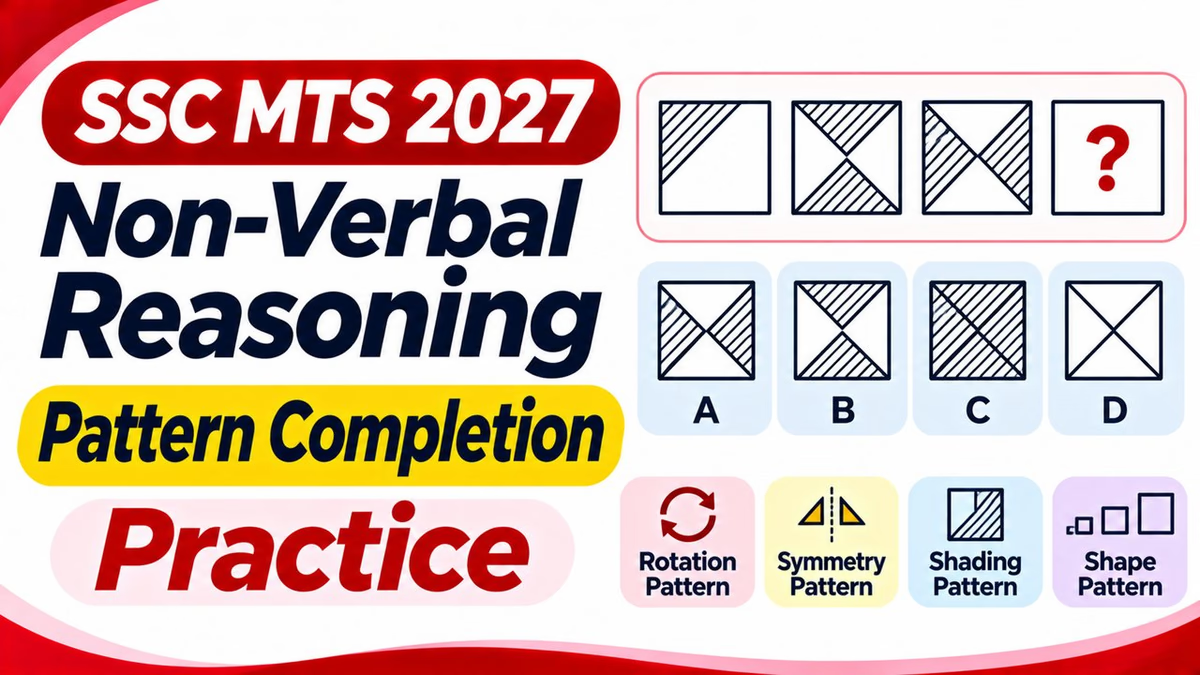
Non-verbal reasoning is an important part of logical reasoning preparation. It tests your ability to understand figures, identify visual relationships and recognise patterns without depending on lengthy written calculations.
Pattern completion questions require you to identify the missing part of a figure or sequence by observing the arrangement of shapes, lines, symbols and designs. These questions test visual observation, logical thinking and attention to detail.
For beginners preparing for SSC MTS 2027, learning basic figure patterns and practising different question types can help build confidence and improve accuracy.
Pattern completion is a type of non-verbal reasoning question in which a figure, design or sequence is incomplete. You must identify the missing portion by understanding the rule followed by the given pattern.
For example, consider this sequence:
○ □ △ ○ □ ?
The shapes repeat in the same order: circle, square and triangle. Therefore, the missing figure is a triangle.
In actual figure-based questions, the missing part may involve lines, shapes, shading, rotation or symmetry.
1. Shape-Based Patterns
These questions involve repeating or changing geometric shapes. Observe the order and identify which shape should appear next.
○ △ □ ○ △ ?
2. Rotation-Based Patterns
A figure may rotate clockwise or anticlockwise. Observe its orientation and determine the next position.
↑ → ↓ ← ?
3. Shading-Based Patterns
Some figures change from unshaded to shaded or alternate between two shading styles.
□ ■ □ ■ ?
4. Mirror Image and Symmetry Patterns
These questions test whether you can identify matching or reflected parts of a figure. Compare the left and right sides carefully.
5. Line and Dot Patterns
The number or position of lines and dots may increase, decrease or change according to a fixed rule.
6. Figure Completion
A figure may have a missing section. You must choose the option that completes its outline, arrangement or design correctly.
| Pattern Rule | What to Observe |
|---|---|
| Repetition | Whether shapes repeat in the same order. |
| Rotation | Whether the figure turns clockwise or anticlockwise. |
| Reflection | Whether the figure is reversed like a mirror image. |
| Shading | Whether filled and unfilled areas alternate. |
| Counting | Whether the number of elements increases or decreases. |
| Position | Whether an element moves to another part of the figure. |
Example 1: Shape Repetition
Question: Find the missing shape in the sequence.
○ □ △ ○ □ ?
Solution: The sequence repeats after every three shapes: circle, square and triangle.
Answer: Triangle (△).
Example 2: Rotation Pattern
Question: Identify the next direction in the sequence.
↑ → ↓ ?
Solution: The arrow rotates 90 degrees clockwise at every step.
Answer: Left arrow (←).
Example 3: Shading Pattern
Question: Complete the following sequence.
□ ■ □ ■ ?
Solution: The unshaded and shaded squares alternate.
Answer: Unshaded square (□).
Example 4: Counting Pattern
Question: Find the missing number of dots.
• •• ••• •••• ?
Solution: One dot is added at every step.
Answer: Five dots.
Example 5: Shape Rotation
Question: Identify the next direction of the diagonal arrow.
↗ ↘ ↙ ?
Solution: The arrow rotates 90 degrees clockwise at each step.
Answer: ↖.
Attempt the following 15 beginner-friendly questions. These are original concept-based practice exercises presented with text symbols to help you understand the pattern rules.
Q1. Identify the missing shape in the sequence:
○ □ △ ○ □ ?
A) ○
B) □
C) △
D) ◇
Q2. Find the next figure:
↑ → ↓ ?
A) ↑
B) ←
C) →
D) ↓
Q3. Complete the shading pattern:
□ ■ □ ■ ?
A) ■
B) □
C) △
D) ○
Q4. How many dots should come next?
• •• ••• •••• ?
A) 3 dots
B) 4 dots
C) 5 dots
D) 6 dots
Q5. Find the missing shape:
△ □ ⬠ ?
A) ○
B) Hexagon
C) △
D) □
Q6. Identify the next arrow:
↗ ↘ ↙ ?
A) ↗
B) ↘
C) ↖
D) →
Q7. Complete the alternating pattern:
▲ ▼ ▲ ▼ ?
A) ▼
B) ▲
C) ◀
D) ▶
Q8. Find the missing shape in the repeating sequence:
○△ △□ □○ ?
A) ○△
B) △○
C) □△
D) ○□
Q9. What comes next in the size pattern?
Small ○ Large ○ Small ○ Large ○ ?
A) Large ○
B) Small ○
C) Small □
D) Large △
Q10. Complete the direction sequence:
← ↑ → ↓ ?
A) ↑
B) →
C) ←
D) ↓
Q11. Identify the missing number of lines:
| || ||| |||| ?
A) ||
B) |||
C) |||||
D) ||||||
Q12. Complete the shape pattern:
○ △ □ ○ △ ?
A) △
B) ○
C) □
D) ◇
Q13. Which figure comes next in the sequence?
↖ ↗ ↘ ↙ ?
A) ↗
B) ↘
C) ↙
D) ↖
Q14. Complete the alternating shape pattern:
○ ● ○ ● ?
A) ●
B) ○
C) □
D) △
Q15. Find the next figure in the sequence:
△ △△ △△△ ?
A) △
B) △△
C) △△△△
D) △△△△△
| Question | Answer | Correct Figure |
|---|---|---|
| 1 | C | △ |
| 2 | B | ← |
| 3 | B | □ |
| 4 | C | 5 dots |
| 5 | B | Hexagon |
| 6 | C | ↖ |
| 7 | B | ▲ |
| 8 | A | ○△ |
| 9 | B | Small ○ |
| 10 | C | ← |
| 11 | C | 5 lines |
| 12 | C | □ |
| 13 | D | ↖ |
| 14 | B | ○ |
| 15 | C | 4 triangles |
Q1 Explanation: The pattern repeats after three shapes: circle, square and triangle. Therefore, the missing shape is a triangle.
Q2 Explanation: Each arrow rotates 90 degrees clockwise: up, right, down and left. The correct answer is option B.
Q3 Explanation: The squares alternate between unshaded and shaded. The next figure is an unshaded square.
Q4 Explanation: One dot is added at each stage. After four dots, the next figure must contain five dots.
Q5 Explanation: The number of sides increases by one: triangle has 3 sides, square has 4 sides and pentagon has 5 sides. The next shape is a hexagon with 6 sides.
Q6 Explanation: The arrow rotates 90 degrees clockwise at each step. After ↗, ↘ and ↙, the next direction is ↖.
Q7 Explanation: The triangles alternate between pointing upwards and downwards. The next triangle points upwards.
Q8 Explanation: The first shape of each pair becomes the second shape in the next pair. The pairs repeat as ○△, △□, □○ and then ○△.
Q9 Explanation: The size alternates between small and large. Since the previous figure is large, the next one is a small circle.
Q10 Explanation: The arrows rotate 90 degrees anticlockwise: left, up, right and down. The next arrow points left.
Q11 Explanation: One vertical line is added at every stage. After four lines, the next figure contains five lines.
Q12 Explanation: The pattern repeats in groups of three: circle, triangle and square. The missing shape is a square.
Q13 Explanation: The arrows rotate 90 degrees clockwise in the sequence: north-west, north-east, south-east and south-west. The next arrow is north-west.
Q14 Explanation: The unfilled and filled circles alternate. The next figure is an unfilled circle.
Q15 Explanation: One triangle is added at each stage. The next figure contains four triangles.
| Day | Practice Topic |
|---|---|
| Day 1 | Learn basic geometric shapes and figure recognition. |
| Day 2 | Practise repeating and alternating shape patterns. |
| Day 3 | Solve rotation and direction-based patterns. |
| Day 4 | Practise shading, size and position changes. |
| Day 5 | Understand symmetry and mirror-image patterns. |
| Day 6 | Attempt mixed figure-completion practice questions. |
| Day 7 | Take a timed reasoning test and review mistakes. |
Strong non-verbal reasoning skills develop through regular observation and practice. Start with basic shapes and repeating patterns, then gradually move towards rotation, symmetry and more complex figure-completion exercises.
Explore learning resources and courses at Katara Academy to support your competitive exam preparation.
Explore Courses at Katara Academy
Pattern completion is a useful non-verbal reasoning skill that tests visual observation and logical thinking. Understanding repetition, rotation, symmetry, shading and counting rules can make these questions easier to solve. Beginners should practise simple patterns first and gradually attempt more challenging figure-based questions as part of their SSC MTS 2027 preparation.
Pattern completion is a reasoning exercise in which you identify the missing part of a figure or sequence by observing its visual pattern.
Common types include shape patterns, rotation, shading, symmetry, line patterns, counting patterns and figure completion.
Observe the given figure, identify changes in shape, direction, shading or position, and select the option that follows the same rule.
A rotation pattern occurs when a figure turns clockwise or anticlockwise by a fixed angle at each stage.
Rotation turns a figure around a point, whereas reflection produces a reversed image across a line, similar to a mirror image.
They help candidates practise visual observation, logical thinking and figure recognition as part of non-verbal reasoning preparation.
Start with simple shape sequences, practise rotation and shading patterns, and gradually attempt more complex figure-completion exercises.
Regular short practice sessions are helpful. Try solving a small set of questions daily and review the patterns you find difficult.
