







Download the App & Start Learning
- Expert Faculty Guidance
- Updated Study Material
- Mock Tests & Practice Quiz
- Live Doubt Solving Sessions
- Exam-Oriented Preparation
- Motivation & Success Strategy
Katara Academy

19/11/2026
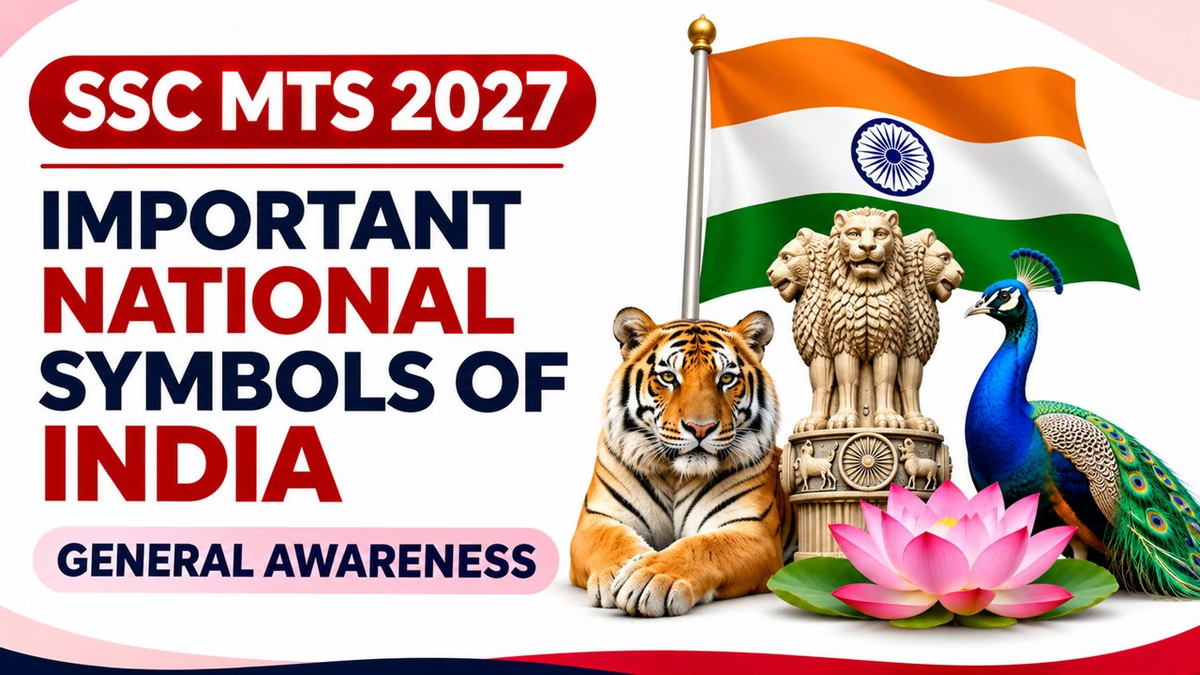
National symbols represent the identity, heritage, culture and values of a country. India has several important national symbols that reflect its history, traditions, biodiversity and national pride. These include the National Flag, National Anthem, National Song, National Emblem, National Animal, National Bird and other widely recognised symbols.
For candidates preparing for the SSC MTS 2027 examination, national symbols are an important part of General Awareness and Static General Knowledge. Questions may ask you to identify a symbol, its name, its designer, its composer or the date on which it was adopted.
In this article, you will learn the important national symbols of India, their key facts, easy memory tips and 15 practice MCQs with answers and explanations.
Use this table for a quick overview of important national symbols frequently covered in competitive-exam General Awareness preparation.
| National Symbol | Name |
|---|---|
| National Flag | Tiranga (Tricolour) |
| National Anthem | Jana Gana Mana |
| National Song | Vande Mataram |
| National Emblem | Lion Capital of Ashoka at Sarnath |
| National Animal | Royal Bengal Tiger |
| National Bird | Indian Peacock |
| National Flower | Lotus (commonly recognised) |
| National Tree | Banyan Tree |
| National Fruit | Mango (commonly recognised) |
| National Aquatic Animal | Ganges River Dolphin |
| National River | Ganga |
| National Calendar | Saka Calendar |
| National Currency | Indian Rupee (₹) |
| National Heritage Animal | Indian Elephant |
Exam note: Some frequently listed symbols, such as the national flower and national fruit, are widely taught in general knowledge material. However, not every commonly listed symbol has the same formal notification status. The Ministry of Home Affairs stated in a 2019 parliamentary reply that the national animal and national bird had been notified, while no such notification had been issued for the national flower.
The National Flag of India is popularly known as the Tiranga or Tricolour. It represents India's unity, freedom and national identity.
Meaning of the three colours:
The Ashoka Chakra is placed in the centre of the white band. It represents the wheel of law and continuous progress.
Remember: The National Flag was adopted by the Constituent Assembly on 22 July 1947, before India became independent.
Jana Gana Mana is the National Anthem of India. It was written by the famous poet and Nobel Prize winner Rabindranath Tagore.
The first stanza of the song was adopted as India's National Anthem by the Constituent Assembly on 24 January 1950.
Exam fact: Rabindranath Tagore wrote the National Anthem, and its full version takes approximately 52 seconds to sing.
Vande Mataram is the National Song of India. It was written by Bankim Chandra Chattopadhyay and published in his famous novel Anandamath.
Do not confuse: Jana Gana Mana is the National Anthem, whereas Vande Mataram is the National Song.
The National Emblem of India is adapted from the Lion Capital of Ashoka at Sarnath, Uttar Pradesh. It was adopted on 26 January 1950, the day the Constitution of India came into effect.
The abacus below the lions contains representations of a horse, a bull, an elephant and a lion. The Dharma Chakra is also shown on the abacus.
Exam fact: The National Emblem was adopted on 26 January 1950, while the National Flag was adopted on 22 July 1947.
The Royal Bengal Tiger is the National Animal of India. It represents strength, power, courage and grace.
Project Tiger was launched to protect India's tiger population and conserve its natural habitats.
Exam fact: Remember the scientific name Panthera tigris and the year 1973 for Project Tiger.
The Indian Peacock is the National Bird of India. It is known for its colourful feathers and beautiful display during courtship.
The peacock is an important part of Indian culture, art and traditions. It is also protected under the Wildlife (Protection) Act, 1972.
The Lotus is commonly recognised and taught as India's National Flower. It is associated with purity, beauty and cultural heritage.
Important clarification: In a Rajya Sabha reply dated 10 July 2019, the Ministry of Home Affairs stated that the relevant ministry had notified the tiger and peacock as national animal and national bird, but no such notification had been issued for the national flower. Lotus remains the commonly accepted answer in standard Static GK lists.
The Banyan Tree is commonly recognised as the National Tree of India. It is known for its wide branches and aerial roots that grow downwards and develop into additional supporting trunks.
The banyan tree is known for its long life and large canopy, making it an important symbol in Indian culture.
Mango is commonly recognised as the National Fruit of India. It is one of the most popular fruits in the country and is widely cultivated in different regions.
Mango is often called the King of Fruits because of its popularity, taste and cultural importance.
The Ganges River Dolphin is the National Aquatic Animal of India. It is a freshwater dolphin found in the Ganga and other river systems of the Indian subcontinent.
Exam fact: Do not confuse the National Animal (Tiger) with the National Aquatic Animal (Ganges River Dolphin).
The Ganga is recognised as the National River of India. It holds great cultural, historical and ecological importance.
The Ganga supports agriculture, livelihoods, biodiversity and settlements across several Indian states.
India's National Calendar is based on the Saka Era. It is used alongside the Gregorian calendar for official purposes.
The Saka Calendar is used in government communications and official publications along with the Gregorian calendar.
The official currency of India is the Indian Rupee, represented by the symbol ₹.
The rupee symbol combines the Devanagari letter 'र' and the Roman capital letter 'R', with parallel lines representing the national flag and an equal sign.
The Indian Elephant is recognised as India's National Heritage Animal. It is an important part of the country's natural and cultural heritage.
Exam fact: The Indian Elephant is the National Heritage Animal, not the National Animal. India's National Animal is the tiger.
Some facts are repeatedly confused in competitive examinations. Revise these differences carefully.
| Common Confusion | Correct Fact |
|---|---|
| National Anthem | Jana Gana Mana |
| National Song | Vande Mataram |
| National Animal | Tiger |
| National Aquatic Animal | Ganges River Dolphin |
| National Heritage Animal | Indian Elephant |
| National Emblem | Lion Capital of Ashoka at Sarnath |
| National Motto | Satyameva Jayate |
Important trick questions:
Use these short associations to revise the most important national symbols quickly:
Revision trick: Practise recalling the symbol when you read its category, and then reverse the exercise by recalling the category when you see the symbol's name.
Test your preparation with these 15 original multiple-choice questions. Try solving them without looking at the answer key.
Q1. Who designed the National Flag of India?
Q2. When was the National Flag of India adopted?
Q3. How many spokes are there in the Ashoka Chakra?
Q4. Who wrote the National Anthem of India, Jana Gana Mana?
Q5. Vande Mataram was written by whom?
Q6. The National Emblem of India is adapted from which historical structure?
Q7. What is the motto written below India's National Emblem?
Q8. What is the scientific name of the Royal Bengal Tiger?
Q9. Which bird is the National Bird of India?
Q10. Which is commonly recognised as the National Flower of India?
Q11. What is the National Aquatic Animal of India?
Q12. Which calendar is India's National Calendar?
Q13. Who designed the Indian Rupee symbol?
Q14. Which animal is recognised as India's National Heritage Animal?
Q15. Which statement about India's National Game is correct?
| Question | Answer | Correct Option |
|---|---|---|
| 1 | Pingali Venkayya | B |
| 2 | 22 July 1947 | C |
| 3 | 24 | D |
| 4 | Rabindranath Tagore | B |
| 5 | Bankim Chandra Chattopadhyay | B |
| 6 | Lion Capital of Ashoka at Sarnath | C |
| 7 | Satyameva Jayate | B |
| 8 | Panthera tigris | A |
| 9 | Indian Peacock | C |
| 10 | Lotus | D |
| 11 | Ganges River Dolphin | B |
| 12 | Saka Calendar | C |
| 13 | D. Udaya Kumar | B |
| 14 | Indian Elephant | C |
| 15 | No sport has been officially declared the National Game | D |
Explanations:
| Day | Revision Task |
|---|---|
| Day 1 | Revise the National Flag, National Anthem and National Song. |
| Day 2 | Study the National Emblem, its motto and adoption date. |
| Day 3 | Learn the National Animal, Bird and their scientific names. |
| Day 4 | Revise the National Flower, Tree and Fruit. |
| Day 5 | Study the National River, Aquatic Animal and Heritage Animal. |
| Day 6 | Revise the Saka Calendar, Rupee symbol and important dates. |
| Day 7 | Attempt all 15 MCQs and revise incorrect answers. |
Consistent revision and regular practice are essential for improving your General Awareness preparation. Learn important Static GK topics, practise exam-oriented questions and strengthen your preparation with a structured study routine.
Explore courses and learning resources at Katara Academy to support your competitive examination preparation.
National Symbols of India is an important Static GK topic for candidates preparing for SSC MTS 2027. Understanding the National Flag, Anthem, Song, Emblem, Animal, Bird, Flower, Tree, Fruit, River and other important symbols can help you answer basic General Awareness questions with confidence.
Revise the quick-reference table, remember important dates and practise the MCQs regularly. Also, be careful about common misconceptions such as Hockey being India's National Game or Hindi being India's National Language.
The Royal Bengal Tiger is the National Animal of India. Its scientific name is Panthera tigris.
Pingali Venkayya is credited with designing the Indian National Flag, which was adopted on 22 July 1947.
Jana Gana Mana, written by Rabindranath Tagore, is the National Anthem of India.
Vande Mataram, written by Bankim Chandra Chattopadhyay, is the National Song of India.
The Indian Peacock, scientifically known as Pavo cristatus, is the National Bird of India.
The Ganges River Dolphin, scientifically known as Platanista gangetica, is the National Aquatic Animal of India.
The Saka Calendar is India's National Calendar. It was adopted for official use in 1957, with Chaitra as its first month.
No. The Government of India has clarified that no sport has been officially declared the National Game of India.
