

Download the App & Start Learning
- Expert Faculty Guidance
- Updated Study Material
- Mock Tests & Practice Quiz
- Live Doubt Solving Sessions
- Exam-Oriented Preparation
- Motivation & Success Strategy
Katara Academy

17/11/2026
Coding-decoding is an important topic in the reasoning section of SSC MTS preparation. These questions test your ability to understand a hidden pattern and use it to identify the correct code for a letter, word or number.
In simple coding-decoding questions, letters may be shifted forward or backward, words may be written using reverse alphabet positions, or numbers may represent the positions of letters. Learning these basic patterns can help you solve questions more accurately and confidently.
In this guide, you will learn the basic types of coding-decoding, simple solving methods, examples and 15 practice questions for SSC MTS 2027.
Coding-decoding is a reasoning method in which a word, letter or number is changed according to a specific rule. You need to identify that rule and apply it to find the correct answer.
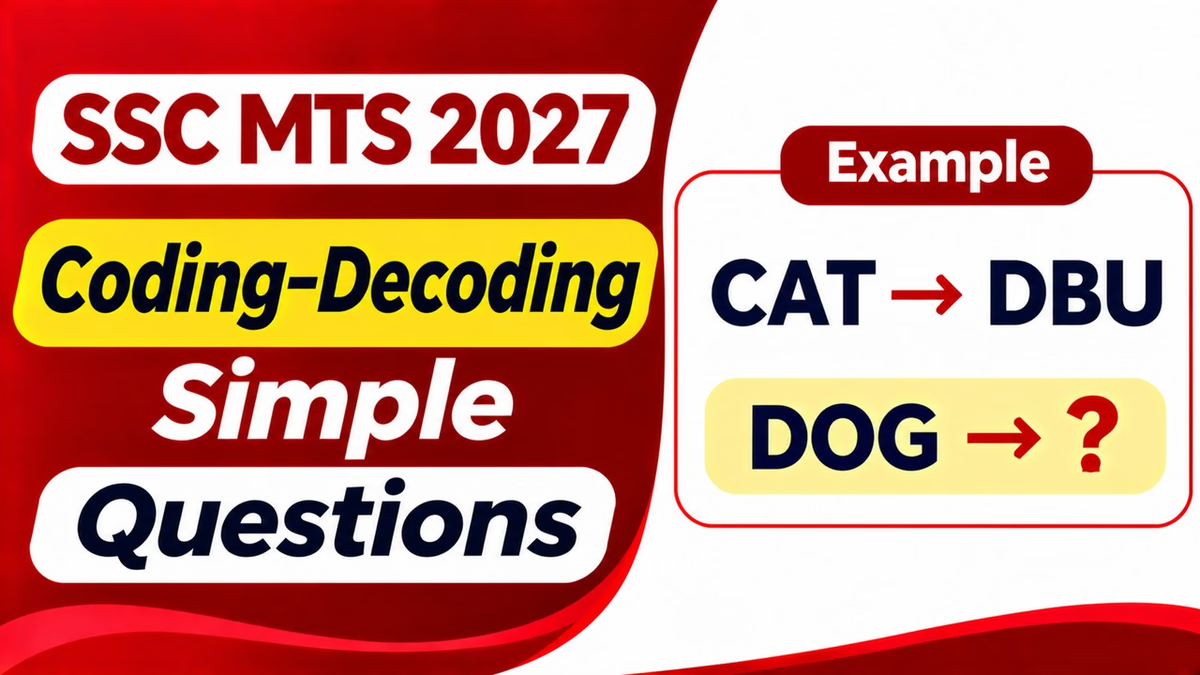
Example: If CAT is coded as DBU, how will DOG be coded?
Using the same rule:
Therefore, DOG is coded as EPH.
Knowing alphabet positions makes letter-based coding questions easier. Remember the position of each letter from A = 1 to Z = 26.
| Letter | Position | Letter | Position |
|---|---|---|---|
| A | 1 | N | 14 |
| B | 2 | O | 15 |
| C | 3 | P | 16 |
| D | 4 | Q | 17 |
| E | 5 | R | 18 |
| F | 6 | S | 19 |
| G | 7 | T | 20 |
| H | 8 | U | 21 |
| I | 9 | V | 22 |
| J | 10 | W | 23 |
| K | 11 | X | 24 |
| L | 12 | Y | 25 |
| M | 13 | Z | 26 |
In forward letter coding, each letter is replaced by another letter a fixed number of positions ahead in the alphabet.
Example: If CAT is coded as DBU, how will BAT be coded?
Therefore, BAT = CBU.
In backward coding, each letter moves a fixed number of positions backward in the alphabet.
Example: If DOG is coded as CNF, how will BAT be coded?
Therefore, BAT = AZS.
In reverse alphabet coding, each letter is replaced by its opposite letter in the alphabet.
The opposite letter pairs are A–Z, B–Y, C–X, D–W and so on.
Example: If CAT is coded using reverse alphabet positions:
Therefore, CAT = XZG.
In number coding, letters are represented by their numerical positions in the alphabet.
Example: If A = 1, B = 2, C = 3, then how is BAD written?
Therefore, BAD = 2-1-4.
Sometimes a complete word is converted into another word by applying the same letter rule to every character.
Example: If BOOK is coded as CPPL, how is PEN coded?
Each letter moves forward by one position. Therefore:
Answer: QFO.
| Coding Rule | Example | Result |
|---|---|---|
| Forward +1 | CAT | DBU |
| Forward +2 | CAT | ECV |
| Backward -1 | CAT | BZS |
| Backward -2 | CAT | AYR |
| Reverse alphabet | CAT | XZG |
| Alphabet positions | BAD | 2-1-4 |
Try these original practice questions to test your understanding of simple coding-decoding patterns. Choose the correct option for each question.
If CAT is coded as DBU, how will DOG be coded using the same rule?
(A) EPH (B) EOG (C) FPH (D) DPH
If BAT is coded as AZS, how will CAT be coded?
(A) BZS (B) DBU (C) BZR (D) CZS
If PEN is coded as QFO, how will BOOK be coded?
(A) CPPL (B) CQQM (C) APPL (D) DQQL
If A = 1, B = 2, C = 3 and so on, what is the code for DOG?
(A) 4-15-7 (B) 5-14-8 (C) 4-14-7 (D) 3-15-6
If CAT is coded as XZG using reverse alphabet positions, how will DOG be coded?
(A) WLT (B) DLT (C) VKS (D) WLS
If each letter is moved two positions forward, how will MAN be coded?
(A) OCP (B) NBO (C) OCN (D) MCP
If each letter is moved one position backward, how will FISH be coded?
(A) EHRG (B) GJTI (C) EIRG (D) DHRG
If SUN is coded as TVO, how will MOON be coded using the same rule?
(A) NPPO (B) NQPO (C) MPPO (D) NPPN
If BAD is written as 2-1-4, how will FACE be written using alphabet positions?
(A) 6-1-3-5 (B) 5-1-3-6 (C) 6-2-3-5 (D) 6-1-4-5
If each letter is replaced by its opposite alphabet letter, how will MAN be coded?
(A) NZM (B) MZN (C) OAN (D) NXM
If BOOK is coded as CPPL, how will TREE be coded?
(A) USFF (B) UQFF (C) USFE (D) VSGG
If each letter is moved two positions backward, how will LION be coded?
(A) JGML (B) KHMN (C) JHML (D) KGML
If the code of APPLE is 1-16-16-12-5, what is the code of MANGO?
(A) 13-1-14-7-15 (B) 12-1-13-7-15 (C) 13-2-14-8-15 (D) 13-1-15-7-14
If each letter is moved one position forward, how will ZERO be coded?
(A) AFSP (B) AFRO (C) YDQN (D) BGSP
If the word KING is coded as LJ OH (without spaces: LJOH), how will QUEEN be coded using the same rule?
(A) RVFFO (B) RVFFN (C) PTFDM (D) RVGFO
| Question | Correct Answer | Coding Rule |
|---|---|---|
| 1 | A – EPH | Forward +1 |
| 2 | A – BZS | Backward -1 |
| 3 | A – CPPL | Forward +1 |
| 4 | A – 4-15-7 | Alphabet positions |
| 5 | A – WLT | Reverse alphabet |
| 6 | A – OCP | Forward +2 |
| 7 | A – EHRG | Backward -1 |
| 8 | A – NPPO | Forward +1 |
| 9 | A – 6-1-3-5 | Alphabet positions |
| 10 | A – NZM | Reverse alphabet |
| 11 | A – USFF | Forward +1 |
| 12 | A – JGML | Backward -2 |
| 13 | A – 13-1-14-7-15 | Alphabet positions |
| 14 | A – AFSP | Forward +1 |
| 15 | A – RVFFO | Forward +1 |
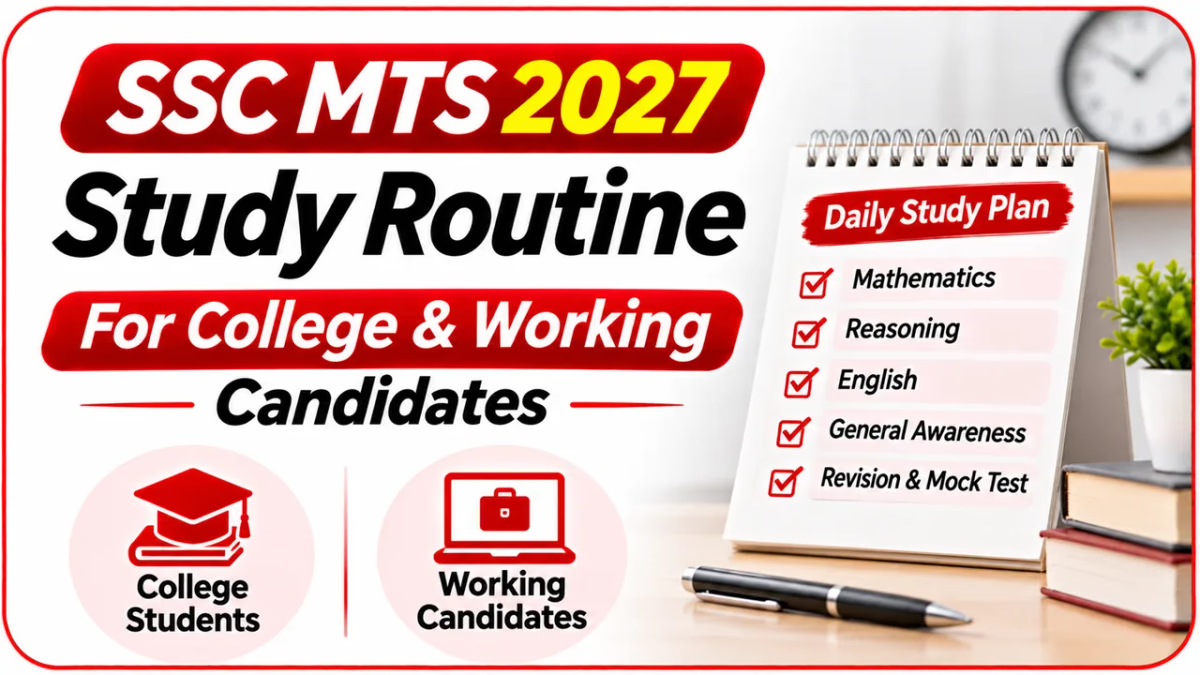
| Day | Practice Topic | Daily Target |
|---|---|---|
| Day 1 | Revise alphabet positions | Memorise A–Z |
| Day 2 | Forward letter coding | 15 questions |
| Day 3 | Backward letter coding | 15 questions |
| Day 4 | Reverse alphabet coding | 15 questions |
| Day 5 | Number coding | 15 questions |
| Day 6 | Mixed coding-decoding practice | 20 questions |
| Day 7 | Revision and timed practice | 25 questions |
Regular practice is important for improving your reasoning skills. Strengthen your understanding of letter coding, number coding and reverse alphabet patterns with consistent revision and question-solving practice.
Explore learning resources and courses at Katara Academy to support your SSC MTS 2027 preparation.
Simple coding-decoding questions can be solved by identifying the relationship between the original letters and their coded forms. Understanding forward shifts, backward shifts, reverse alphabet coding and number coding will help you approach basic reasoning problems systematically.
For SSC MTS 2027 preparation, revise alphabet positions regularly, practise different coding patterns and check your answers carefully to improve accuracy and confidence.
Coding-decoding is a reasoning topic in which letters, words or numbers are changed according to a particular rule. You need to identify the rule and apply it to find the answer.
Compare the original and coded words, identify the letter movements or number relationships, and apply the same rule to the new word.
Forward letter coding replaces each letter with another letter a fixed number of positions ahead. For example, CAT becomes DBU when every letter moves one position forward.
Reverse alphabet coding replaces each letter with its opposite letter. The pairs include A–Z, B–Y, C–X and D–W.
Letters may be represented by their alphabet positions. For example, BAD can be written as 2-1-4 because B = 2, A = 1 and D = 4.
Practise the alphabet positions from A = 1 to Z = 26 daily. Divide the alphabet into smaller groups and revise them regularly.
Start with 10–15 questions per day. Gradually increase the number as your understanding, speed and accuracy improve.
Yes. Coding-decoding practice helps develop pattern recognition and logical reasoning skills that are useful for preparing for the SSC MTS reasoning section.
