


Download the App & Start Learning
- Expert Faculty Guidance
- Updated Study Material
- Mock Tests & Practice Quiz
- Live Doubt Solving Sessions
- Exam-Oriented Preparation
- Motivation & Success Strategy
Katara Academy

17/11/2026
Number Analogy is an important topic for candidates preparing for the SSC MTS 2027 Reasoning section. These questions test the ability to identify mathematical relationships between pairs of numbers and apply the same relationship to another pair.
In number analogy questions, candidates are given a pair of numbers that follows a particular mathematical rule. Another number is provided, and candidates must identify the correct related number by applying the same rule.
Understanding basic operations such as addition, subtraction, multiplication, division, squares and cubes can help candidates solve these questions efficiently. This article explains different types of number analogy patterns, solving techniques, shortcuts and 15 practice MCQs with detailed solutions.
Number analogy is a reasoning concept in which two numbers are connected through a specific mathematical relationship. Candidates must identify that relationship and apply it to another number.
Example:
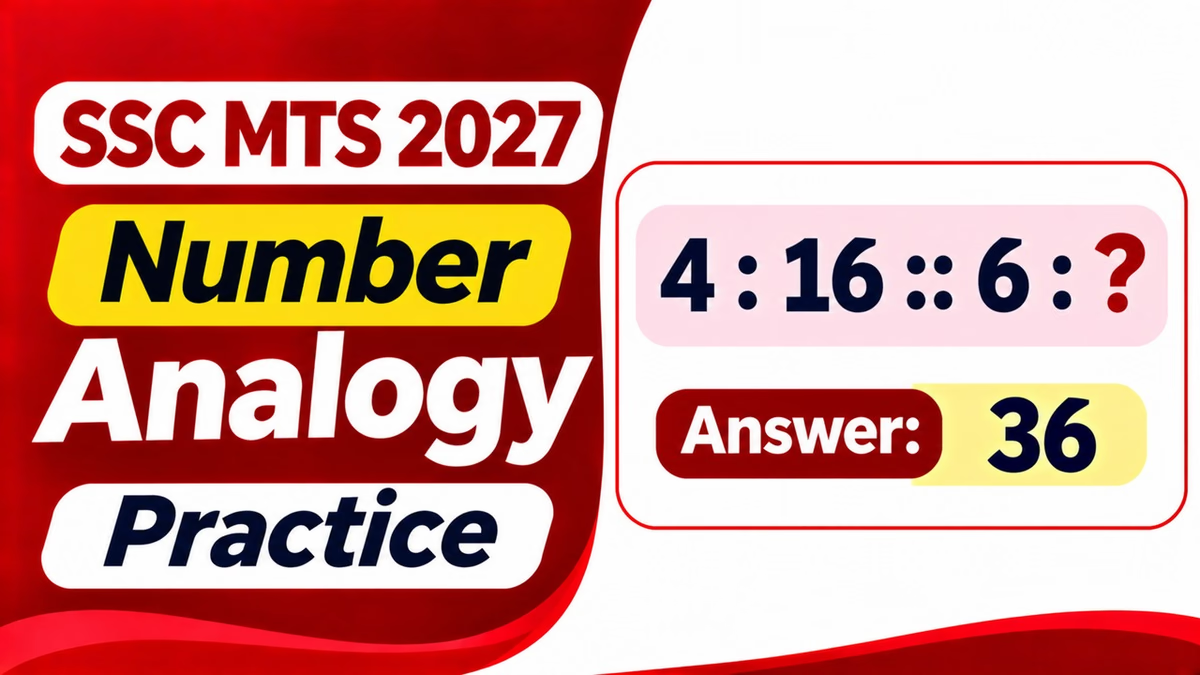
4 : 16 :: 6 : ?
Answer: 36
Logic: The first number is multiplied by itself.
Therefore, the correct answer is 36.
In these questions, a fixed number is added to the given number.
Example: 5 : 12 :: 8 : ?
Logic:
Answer: 15
These questions use subtraction to establish a relationship between two numbers.
Example: 18 : 13 :: 25 : ?
Logic:
Answer: 20
In multiplication-based questions, one number is multiplied by a fixed number to obtain the related number.
Example: 6 : 24 :: 9 : ?
Logic:
Answer: 36
These questions involve dividing the first number by a fixed value.
Example: 40 : 8 :: 60 : ?
Logic:
Answer: 12
Square-based questions involve multiplying a number by itself.
Example: 5 : 25 :: 8 : ?
Logic:
Answer: 64
These questions use the cube of a number, which means multiplying the number by itself three times.
Example: 3 : 27 :: 4 : ?
Logic:
Answer: 64
Some questions involve more than one mathematical operation, such as multiplication followed by addition.
Example: 4 : 17 :: 6 : ?
Logic:
Answer: 37
| Pattern | Example | Relationship |
|---|---|---|
| Addition | 5 : 12 | 5 + 7 = 12 |
| Subtraction | 15 : 10 | 15 - 5 = 10 |
| Multiplication | 7 : 35 | 7 × 5 = 35 |
| Division | 48 : 8 | 48 ÷ 6 = 8 |
| Square | 9 : 81 | 9² = 81 |
| Cube | 4 : 64 | 4³ = 64 |
| Square + 1 | 5 : 26 | 5² + 1 = 26 |
| Number × Next Number | 6 : 42 | 6 × 7 = 42 |
Attempt these 15 multiple-choice questions to test your understanding of different number analogy patterns. These are original practice questions prepared for revision, not confirmed future examination questions.
1. Find the missing number: 3 : 9 :: 5 : ?
A. 15
B. 20
C. 25
D. 30
2. Find the missing number: 4 : 64 :: 3 : ?
A. 9
B. 18
C. 27
D. 36
3. Find the missing number: 7 : 56 :: 9 : ?
A. 72
B. 81
C. 90
D. 99
4. Find the missing number: 18 : 9 :: 26 : ?
A. 11
B. 12
C. 13
D. 14
5. Find the missing number: 6 : 42 :: 8 : ?
A. 56
B. 64
C. 72
D. 80
6. Find the missing number: 5 : 26 :: 7 : ?
A. 48
B. 49
C. 50
D. 56
7. Find the missing number: 2 : 6 :: 4 : ?
A. 12
B. 16
C. 20
D. 24
8. Find the missing number: 11 : 121 :: 13 : ?
A. 156
B. 169
C. 179
D. 196
9. Find the missing number: 15 : 12 :: 20 : ?
A. 15
B. 16
C. 17
D. 18
10. Find the missing number: 3 : 12 :: 5 : ?
A. 20
B. 25
C. 30
D. 35
11. Find the missing number: 8 : 17 :: 11 : ?
A. 21
B. 22
C. 23
D. 24
12. Find the missing number: 9 : 28 :: 7 : ?
A. 20
B. 21
C. 22
D. 24
13. Find the missing number: 12 : 144 :: 15 : ?
A. 200
B. 215
C. 225
D. 250
14. Find the missing number: 40 : 8 :: 75 : ?
A. 10
B. 12
C. 15
D. 20
15. Find the missing number: 6 : 37 :: 8 : ?
A. 63
B. 64
C. 65
D. 66
| Q. | Answer | Logic and Solution |
|---|---|---|
| 1 | C. 25 | The number is squared: 3² = 9 and 5² = 25. |
| 2 | C. 27 | The number is cubed: 4³ = 64 and 3³ = 27. |
| 3 | C. 90 | Multiply the number by its successor: 7 × 8 = 56 and 9 × 10 = 90. |
| 4 | C. 13 | Divide the first number by 2: 18 ÷ 2 = 9 and 26 ÷ 2 = 13. |
| 5 | C. 72 | Multiply the number by its successor: 6 × 7 = 42 and 8 × 9 = 72. |
| 6 | C. 50 | Square the number and add 1: 5² + 1 = 26 and 7² + 1 = 50. |
| 7 | C. 20 | Multiply the number by its successor: 2 × 3 = 6 and 4 × 5 = 20. |
| 8 | B. 169 | Square the number: 11² = 121 and 13² = 169. |
| 9 | C. 17 | Subtract 3: 15 - 3 = 12 and 20 - 3 = 17. |
| 10 | C. 30 | Multiply the number by its successor: 3 × 4 = 12 and 5 × 6 = 30. |
| 11 | C. 23 | Multiply by 2 and add 1: 8 × 2 + 1 = 17 and 11 × 2 + 1 = 23. |
| 12 | C. 22 | Multiply by 3 and add 1: 9 × 3 + 1 = 28 and 7 × 3 + 1 = 22. |
| 13 | C. 225 | Square the number: 12² = 144 and 15² = 225. |
| 14 | C. 15 | Divide by 5: 40 ÷ 5 = 8 and 75 ÷ 5 = 15. |
| 15 | C. 65 | Square the number and add 1: 6² + 1 = 37 and 8² + 1 = 65. |
| Day | Practice Target |
|---|---|
| Day 1 | Practise addition and subtraction-based analogy questions. |
| Day 2 | Practise multiplication and division patterns. |
| Day 3 | Revise square-based analogy questions. |
| Day 4 | Practise cube-based analogy questions. |
| Day 5 | Solve questions involving combined mathematical operations. |
| Day 6 | Attempt 20 mixed number analogy questions with a time limit. |
| Day 7 | Take a revision test and analyse incorrect answers. |
Regular reasoning practice can help candidates develop calculation speed and logical thinking. Practise number analogy questions along with other reasoning topics, revise important mathematical patterns and take mock tests to monitor your preparation.
Explore Courses at Katara Academy
Number analogy questions test the ability to identify mathematical relationships between numbers and apply the same logic to new pairs. For SSC MTS 2027 Reasoning preparation, focus on basic operations, squares, cubes and combined number patterns. Regular practice and careful analysis of solutions can improve calculation speed, accuracy and confidence.
Number analogy is a reasoning topic in which candidates identify the mathematical relationship between one pair of numbers and apply the same relationship to another pair.
Yes. Practising number analogy helps develop numerical pattern recognition, logical thinking and calculation skills.
Common practice patterns include addition, subtraction, multiplication, division, squares, cubes and combined mathematical operations.
Check basic mathematical operations first, then examine square, cube and combined-operation patterns. Apply the same rule consistently to the new number.
Yes. Learning common squares and cubes can make it easier to recognise mathematical relationships and perform calculations quickly.
Beginners can start with 10–15 questions daily and gradually increase the number as their accuracy and speed improve.
Try basic operations first, compare the numbers carefully and then test squares, cubes or combined operations. Avoid selecting a pattern without verifying it.
No. The 15 questions are original practice questions designed to help candidates understand number analogy patterns and improve reasoning skills.