

Download the App & Start Learning
- Expert Faculty Guidance
- Updated Study Material
- Mock Tests & Practice Quiz
- Live Doubt Solving Sessions
- Exam-Oriented Preparation
- Motivation & Success Strategy
Katara Academy

17/11/2026
Odd-One-Out is an important topic for candidates preparing for the SSC MTS 2027 Reasoning section. These questions test the ability to identify similarities, differences and logical patterns among a group of words, numbers, letters or figures.
In an odd-one-out question, four or more options are given. Most options follow a common rule, while one option does not belong to that group. The candidate must identify the different option by understanding the relationship between the given items.
Instead of selecting an answer through guesswork, candidates should examine the possible patterns and apply a logical approach. This article explains different types of odd-one-out questions, logic identification techniques, common mistakes and 15 practice MCQs for SSC MTS 2027.
Odd-One-Out questions are reasoning problems in which candidates identify the item that does not follow the common characteristic shared by the remaining options.
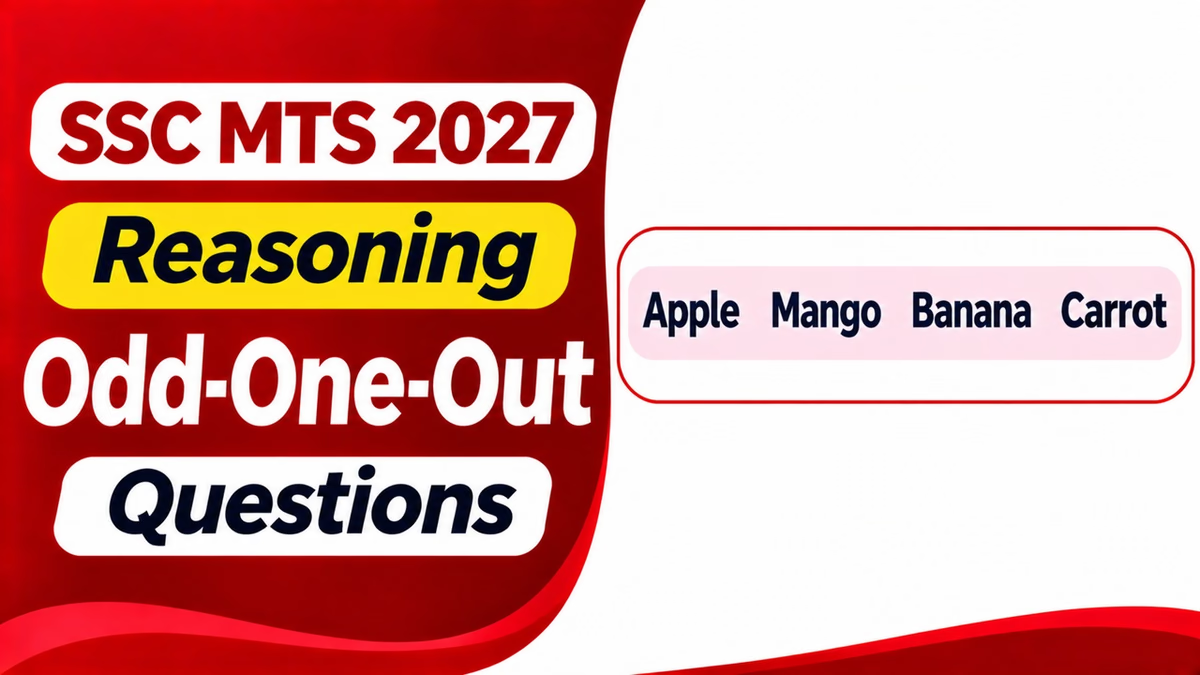
Example: Apple, Mango, Banana, Carrot
Answer: Carrot
Logic: Apple, Mango and Banana are commonly classified as fruits, whereas Carrot is a vegetable.
The main objective is to recognise the common relationship and identify the item that does not match it.
These questions involve identifying a word that belongs to a different category or has a different characteristic.
Example: Rose, Lotus, Jasmine, Potato
Answer: Potato
Logic: Rose, Lotus and Jasmine are flowers. Potato is a vegetable.
These questions require candidates to identify a number that does not follow the mathematical property shared by the other numbers.
Example: 9, 16, 25, 27
Answer: 27
Logic: 9, 16 and 25 are perfect squares (3², 4² and 5²). The number 27 is not a perfect square.
Alphabet-based questions test letter positions, sequences and relationships between letters.
Example: ACE, BDF, CEG, DFH
Answer: ACE is not the odd one out; all four groups follow the same consecutive-letter pattern with one letter skipped.
Logic: Each group contains letters whose alphabetical positions increase by two. This type of question requires careful comparison because not every set contains a different option.
These questions involve identifying an item that belongs to a different group based on general knowledge or classification.
Example: Cricket, Football, Hockey, Chess
Answer: Chess
Logic: Cricket, Football and Hockey are outdoor field or team sports. Chess is primarily an indoor board game.
In figure-based questions, candidates compare shapes and identify the figure that differs in rotation, size, number of sides, direction or arrangement.
Example: If three figures contain triangles and one contains a circle, the circle may be the odd one out based on shape.
Logic: Compare the number of sides, shape, orientation and arrangement of each figure before selecting an option.
Use the following steps to solve odd-one-out questions accurately:
| Pattern | What to Check |
|---|---|
| Number properties | Even, odd, prime, composite and perfect squares. |
| Mathematical operations | Addition, subtraction, multiplication and division patterns. |
| Alphabet positions | Letter order, position gaps and alphabetical sequences. |
| Word categories | Animals, fruits, flowers, professions and objects. |
| Spelling patterns | Word length, repeated letters and vowel-consonant patterns. |
| Figure properties | Shape, sides, rotation, direction and arrangement. |
Attempt these 15 practice questions to test your logical reasoning and pattern identification skills. These are original practice questions prepared for revision, not confirmed future examination questions.
1. Choose the odd one out.
A. Apple
B. Mango
C. Banana
D. Carrot
2. Identify the number that does not belong to the group.
A. 16
B. 25
C. 36
D. 48
3. Find the odd one out.
A. 2
B. 3
C. 5
D. 9
4. Choose the odd one out based on the category.
A. Tiger
B. Lion
C. Leopard
D. Cow
5. Identify the different letter group.
A. ACE
B. BDF
C. CEG
D. DFJ
6. Find the odd number.
A. 8
B. 27
C. 64
D. 100
7. Choose the odd one out.
A. January
B. March
C. May
D. June
8. Identify the different item.
A. Square
B. Rectangle
C. Triangle
D. Cube
9. Find the odd one out based on the number pattern.
A. 4
B. 9
C. 16
D. 20
10. Choose the odd one out.
A. Keyboard
B. Mouse
C. Monitor
D. Chair
11. Identify the different letter group.
A. AB
B. CD
C. EF
D. GI
12. Find the odd one out.
A. 11
B. 13
C. 17
D. 21
13. Choose the item that does not belong to the group.
A. Doctor
B. Teacher
C. Engineer
D. Hospital
14. Identify the odd one out.
A. 121
B. 144
C. 169
D. 180
15. Choose the odd one out based on the category.
A. Cricket
B. Football
C. Hockey
D. Chess
| Q. | Answer | Logic |
|---|---|---|
| 1 | D. Carrot | Apple, Mango and Banana are commonly classified as fruits; Carrot is a vegetable. |
| 2 | D. 48 | 16, 25 and 36 are perfect squares: 4², 5² and 6². 48 is not a perfect square. |
| 3 | D. 9 | 2, 3 and 5 are prime numbers. 9 is composite. |
| 4 | D. Cow | Tiger, Lion and Leopard are wild members of the cat family. Cow is a domesticated bovine animal. |
| 5 | D. DFJ | ACE, BDF and CEG have alphabetical position gaps of +2 and +2. DFJ has gaps of +2 and +4. |
| 6 | D. 100 | 8, 27 and 64 are perfect cubes: 2³, 3³ and 4³. 100 is not a perfect cube. |
| 7 | D. June | January, March and May have 31 days. June has 30 days. |
| 8 | D. Cube | Square, Rectangle and Triangle are two-dimensional shapes. Cube is three-dimensional. |
| 9 | D. 20 | 4, 9 and 16 are perfect squares: 2², 3² and 4². 20 is not a perfect square. |
| 10 | D. Chair | Keyboard, Mouse and Monitor are computer hardware devices. Chair is furniture. |
| 11 | D. GI | AB, CD and EF contain consecutive letters. G and I have one letter between them. |
| 12 | D. 21 | 11, 13 and 17 are prime numbers. 21 is composite because it is divisible by 3 and 7. |
| 13 | D. Hospital | Doctor, Teacher and Engineer are professions. Hospital is an institution. |
| 14 | D. 180 | 121, 144 and 169 are perfect squares: 11², 12² and 13². 180 is not a perfect square. |
| 15 | D. Chess | Cricket, Football and Hockey are outdoor team sports. Chess is an indoor board game. |
| Day | Practice Topic |
|---|---|
| Day 1 | Practise word and category-based odd-one-out questions. |
| Day 2 | Practise even, odd, prime and composite number patterns. |
| Day 3 | Revise perfect squares, cubes and mathematical properties. |
| Day 4 | Practise alphabet positions and letter-group questions. |
| Day 5 | Practise figure-based and classification questions. |
| Day 6 | Solve 20 mixed odd-one-out questions with a time limit. |
| Day 7 | Take a revision test and analyse incorrect answers. |
Regular reasoning practice helps candidates develop logical thinking and improve their ability to identify patterns. Practise odd-one-out questions along with other reasoning topics, analyse your mistakes and take regular mock tests as part of your SSC MTS 2027 preparation.
Explore Courses at Katara Academy
Odd-One-Out questions test the ability to recognise common patterns and identify differences among given options. For SSC MTS 2027 Reasoning preparation, candidates should practise word-based, number-based, alphabet-based and figure-based questions. Focus on understanding the logic behind every answer rather than memorising solutions. Regular practice can help improve logical thinking, speed and accuracy.
Odd-one-out questions require candidates to identify the item that does not share the common characteristic or pattern followed by the other options.
Yes. They are useful practice for developing classification, comparison and logical pattern-identification skills.
Common practice types include word-based, number-based, alphabet-based, category-based and figure-based questions.
Check properties such as even and odd numbers, prime numbers, perfect squares, cubes and mathematical relationships.
Convert letters into their alphabetical positions and compare the gaps, order and sequence of letters in each option.
Beginners can start with 10–15 questions daily and gradually increase the number as their accuracy and speed improve.
Compare all options, identify the common characteristic among three options and verify that the remaining option does not follow the same rule.
No. The 15 questions are original practice questions designed to help candidates understand odd-one-out logic and improve reasoning skills.
