


Download the App & Start Learning
- Expert Faculty Guidance
- Updated Study Material
- Mock Tests & Practice Quiz
- Live Doubt Solving Sessions
- Exam-Oriented Preparation
- Motivation & Success Strategy
Katara Academy

22/11/2026
Solving questions every day is an important part of SSC MTS 2027 preparation, but simply completing practice sets is not enough. Many candidates solve hundreds of questions without checking why they get certain answers wrong, which topics consume too much time or whether their accuracy is actually improving.
A daily question-solving log helps you record your practice, identify repeated mistakes, monitor weak topics and make better decisions about what to study next. Instead of practising randomly, you can use your daily performance to build a more organised SSC MTS preparation system.
Whether you are a beginner or already preparing for the examination, maintaining a simple question-solving log can help you make every practice session more productive.
A daily question-solving log is a record of the questions you practise during your preparation. It tracks more than just the number of questions completed. It also records your accuracy, mistakes, time taken, topics that need improvement and lessons learned from practice.
For SSC MTS preparation, you can maintain one log covering all four subjects:
You can maintain this log in a notebook, spreadsheet, diary or digital document. The format does not matter as much as regularly updating it and reviewing the information.
Daily question practice becomes more useful when you understand what your performance is telling you. A question log can help you:
The purpose of the log is not to make your preparation more complicated. It is to help you understand your progress with clear evidence.
Your daily question log should contain a few essential fields. Avoid adding so many columns that updating the log becomes a task of its own.
| Log Field | What to Record |
|---|---|
| Date | Day on which you completed the practice |
| Subject | Mathematics, Reasoning, English or General Awareness |
| Topic | Specific chapter or question type |
| Questions Attempted | Total number of questions attempted |
| Correct Answers | Number of questions answered correctly |
| Incorrect Answers | Number of wrong answers |
| Skipped Questions | Questions left unanswered during the practice |
| Time Taken | Approximate time spent on the practice set |
| Mistake Type | Concept, calculation, reading, guessing or time-related error |
| Next Action | What you need to revise or practise again |
For beginners, recording these details is enough to build a meaningful preparation record. You can add more information later if it helps your analysis.
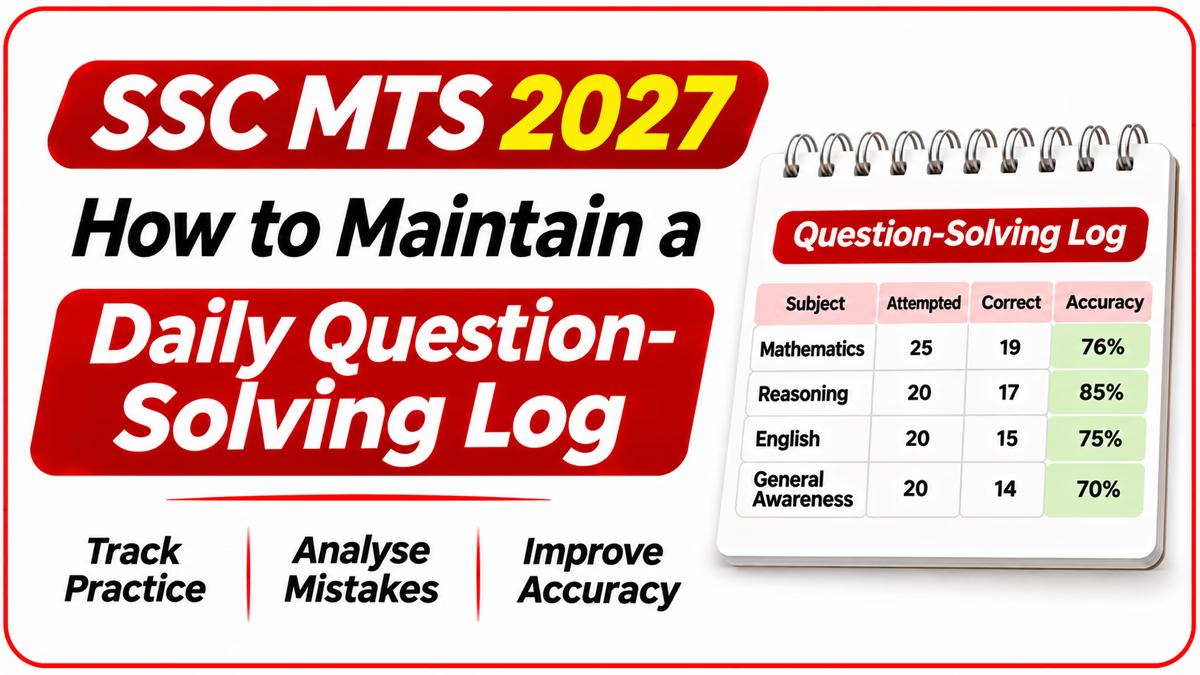
Use the following sample to understand how your daily practice log can look. These figures are only examples, not recommended mandatory daily targets.
| Date | Subject & Topic | Attempted | Correct | Wrong | Time |
|---|---|---|---|---|---|
| Day 1 | Maths – Percentage | 25 | 19 | 6 | 35 min |
| Day 1 | Reasoning – Number Series | 20 | 17 | 3 | 20 min |
| Day 1 | English – Error Spotting | 20 | 15 | 5 | 25 min |
| Day 1 | GA – Indian Polity | 20 | 14 | 6 | 20 min |
After recording the numbers, add a short analysis. For example:
This analysis is the most important part of your log. It tells you what your next study session should focus on.
Do not write only “wrong answer” beside a question. Identify the reason behind the mistake. Different errors require different solutions.
You did not understand the concept or applied the wrong method. Revisit the topic, understand the explanation and solve a few similar questions.
You knew how to solve the question but made an arithmetic error. Practise calculations carefully and check the step where the mistake occurred.
You missed a keyword, misunderstood what the question was asking or read a condition incorrectly. Practise reading the complete question before selecting an answer.
You forgot a formula, grammar rule, fact or vocabulary word. Add it to your revision notes and revisit it regularly.
You spent too much time on one question or could not finish the set. Record which question type slowed you down and practise similar questions with a reasonable time limit.
You selected an answer without sufficient reasoning. Note why you guessed and whether you could have eliminated options or skipped the question instead.
Once you identify the mistake category, your correction strategy becomes much clearer.
Record the topic, calculation errors, formulas you forgot and questions that took longer than expected.
Example log note: “Practised ratio questions. I understand the method but make mistakes when simplifying values. Revise simplification and solve 10 similar questions tomorrow.”
Record question patterns that you found confusing and the logic you initially missed.
Example log note: “Number series – solved most questions correctly, but missed alternating-pattern series. Review pattern identification and practise another set.”
Record grammar rules, vocabulary and the type of question where your understanding was weak.
Example log note: “Error spotting – repeated mistakes in subject-verb agreement. Revise singular/plural subject rules and practise sentences.”
Record facts, topics and questions you could not recall. Categorise them into History, Geography, Polity, Science, Static GK or Current Affairs.
Example log note: “Indian Polity – confused constitutional bodies with statutory bodies. Revise differences and make a comparison table.”
Tracking the number of questions attempted alone does not show the quality of your practice. Accuracy helps you understand how reliable your answers are.
Accuracy Formula:
Accuracy (%) = (Correct Answers ÷ Total Questions Attempted) × 100
For example, if you attempt 50 questions and answer 40 correctly:
Accuracy = (40 ÷ 50) × 100 = 80%
You can record your accuracy after each practice session and compare results over time. Do not judge improvement from a single day. Look at several practice sessions together because topic difficulty can vary.
Accuracy is a personal progress indicator for practice. It is not an official SSC score or selection predictor.
Daily recording is useful, but weekly review turns your log into a preparation strategy. Set aside time once a week to review your entries and decide what needs attention.
Look for topics where incorrect answers occur repeatedly. Do not select weak topics based on one difficult practice set alone.
Compare your recent practice sessions. Is your accuracy improving, staying the same or decreasing? Consider the difficulty of the questions when comparing results.
Check your mistake categories. If calculation mistakes appear repeatedly, dedicate time to calculation practice. If reading mistakes are common, work on question-reading habits.
Use your log to select topics for revision and practice. Give more time to weak areas while maintaining practice in subjects where you are already performing well.
Reattempt questions you previously answered incorrectly without looking at the solution. Check whether you now understand and can solve them independently.
Copy this structure into a notebook or spreadsheet and fill it in after your daily practice.
DAILY SSC MTS QUESTION LOG
Keep your notes short and clear. You do not need to write a full explanation for every question. Record detailed explanations only for mistakes that are important, repeated or difficult to understand.
Your log should be a working preparation tool. The aim is to identify a problem, correct it and check whether the same mistake happens again.
It is not compulsory, but it can be a useful preparation tool. A log helps you track practice, identify weak topics, review mistakes and plan revision more effectively.
You do not need to copy every question into your log. Record practice totals and details, and write down selected incorrect or difficult questions when their solutions or concepts need revision.
Try to spend around 5–10 minutes after a practice session recording your performance and noting the most important mistakes. Keep it simple enough to maintain consistently.
You can use one notebook or spreadsheet with separate sections for Mathematics, Reasoning, English and General Awareness. This makes it easier to compare progress across subjects.
Update it daily and review it weekly. Daily entries help you remember mistakes, while weekly reviews help identify recurring problems and plan your next revision targets.
Identify the reason for the mistake, understand the correct solution, revise the related concept and reattempt the question later without checking the answer.
Yes. A digital spreadsheet can help you organise topics, record daily practice, calculate accuracy and review your progress. A notebook works equally well if you prefer writing by hand.
Maintaining a daily question-solving log can make SSC MTS 2027 preparation more organised and result-focused. Instead of solving questions without direction, record your practice, understand your mistakes, track accuracy and identify the topics that need more attention.
Start with a simple format and update it consistently. Over time, your log will help you recognise patterns in your mistakes, improve your revision decisions and make better use of your study time.
Practise consistently, analyse your performance and strengthen your preparation with structured guidance from Katara Academy.